
Is Untangle Worth the Cost for a Connecticut Divorce?
Comprehensive Untangle pricing review for Connecticut divorce. Compare costs to attorneys and DIY options to see if this budget-friendly tool fits.
Quick answer: Short answer first
Untangle can be worth the cost for a Connecticut divorce if you want more structure than court forms without full attorney representation. It currently advertises $299/year plus a "Create free account" option with no credit card required. The value depends on whether the platform helps you avoid mistakes, delays, and extra attorney time.
- Understanding the True Cost of Connecticut Divorce
- What Untangle Includes: Feature Breakdown
- Cost Comparison: Untangle vs. Other Options
Get Help
Get help with your divorce
Get guided answers, organize your paperwork, and move through Connecticut divorce with a clearer plan.
In this answer
- Understanding the True Cost of Connecticut Divorce
- What Untangle Includes: Feature Breakdown
- Cost Comparison: Untangle vs. Other Options
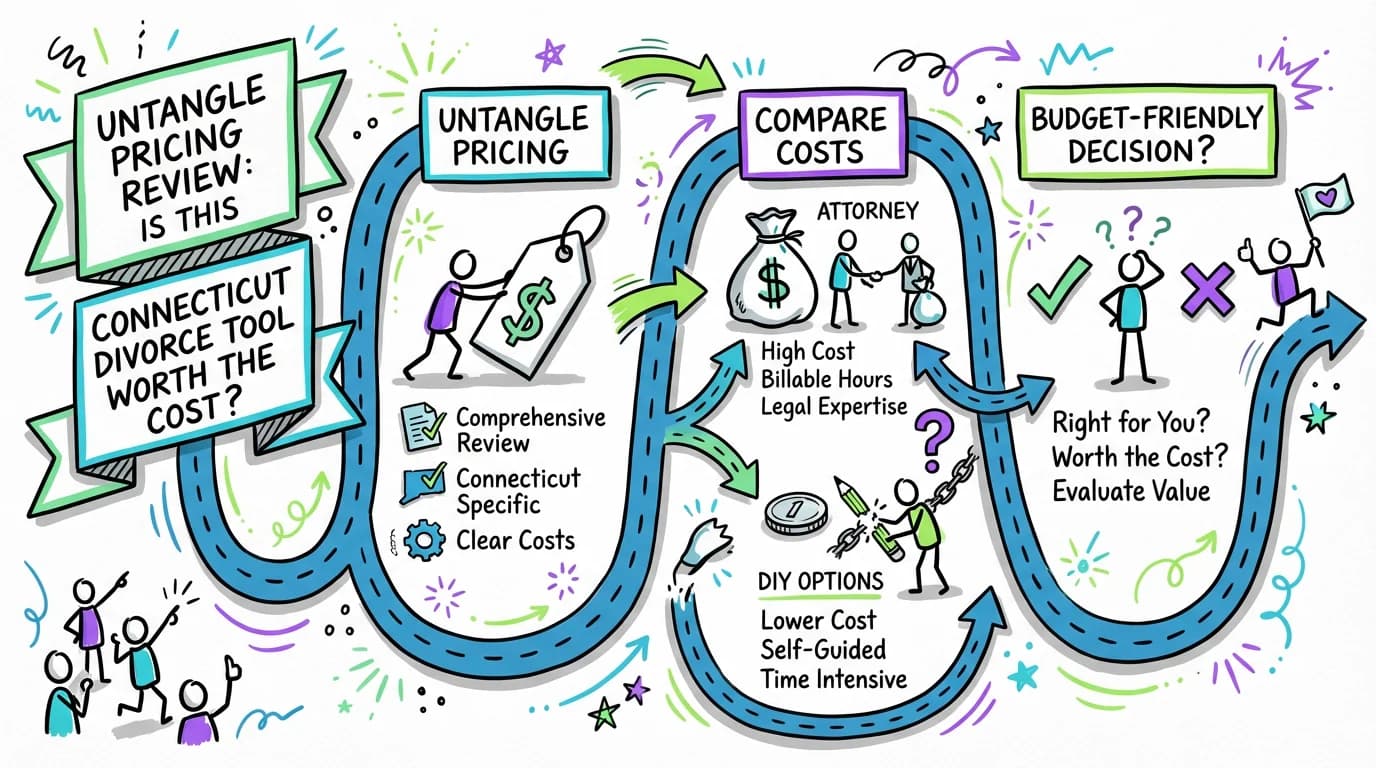
Is Untangle Worth the Cost for a Connecticut Divorce?
Untangle can be worth the cost for a Connecticut divorce if you want more structure than court forms without full attorney representation. It currently advertises $299/year plus a "Create free account" option with no credit card required. The value depends on whether the platform helps you avoid mistakes, delays, and extra attorney time.
Understanding the True Cost of Connecticut Divorce
Before evaluating any divorce tool's pricing, it's essential to understand what you're actually paying for in a Connecticut divorce. The state requires specific forms, financial disclosures, and procedural steps that can be overwhelming for self-represented parties. Connecticut's mandatory disclosure requirements under Practice Book Rule § 25-32 alone require gathering and exchanging tax returns, pay stubs, bank statements, and investment account records going back 24 months—a process that traditionally requires attorney guidance. Untangle's smart bank statement analysis can help simplify this complex gathering process, ensuring you don't miss critical details.
The current Connecticut Superior Court entry fee for a divorce filing is $360, regardless of whether you use an attorney or handle the case yourself, according to the Connecticut Judicial Branch court fee schedule. This fee is unavoidable and must be paid to the Superior Court when you file your complaint or joint petition. What varies dramatically is how much you spend on everything else: document preparation, negotiating your settlement agreement, and navigating the court process.
For many Connecticut couples, the real question isn't whether they can afford divorce—it's whether they can afford the traditional approach. Under C.G.S. § 46b-62, courts can order one spouse to pay the other's attorney fees based on their respective financial abilities, but this provision doesn't help couples who are both struggling financially. This is exactly where tools like Untangle become valuable, filling the gap between expensive full-service representation and confusing DIY courthouse forms.
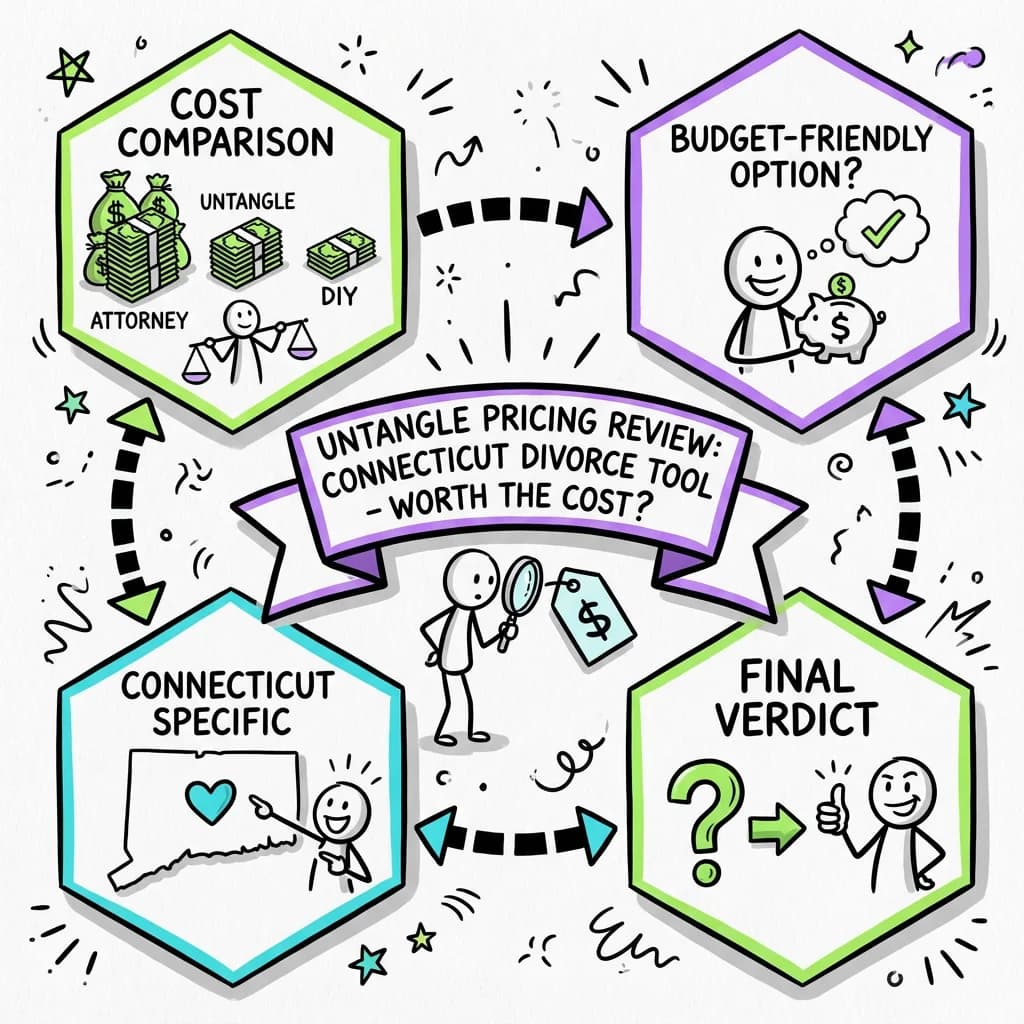
What Untangle Includes: Feature Breakdown
Untangle is most efficient when you are pursuing a fully agreed Connecticut divorce. If you fit the narrow nonadversarial-dissolution rules in C.G.S. § 46b-44a, the platform can help assemble the joint-petition packet and settlement paperwork. If you do not fit that track, it can still help organize a standard uncontested filing, but the court process is broader.
The platform's document assembly tools walk you through each required form with plain-language explanations. Instead of staring at blank court forms wondering what legal terminology means, you answer questions in your own words, and Untangle generates properly formatted documents. This includes the Financial Affidavit (JD-FM-006), which every divorcing party must file under Practice Book Rule § 25-30, and the separation agreement that will become a court order once your divorce is finalized.
What sets Untangle apart from generic document services is its Connecticut-specific focus. The platform understands the joint-petition eligibility rules in C.G.S. § 46b-44a, the automatic orders that take effect upon filing under Practice Book Rule § 25-5B, and the different timelines that apply in the nonadversarial track versus the standard complaint-and-service track. Rather than providing a one-size-fits-all template, you get documents tailored to Connecticut family court expectations.
Cost Comparison: Untangle vs. Other Options
Understanding how Untangle's pricing compares to alternatives helps you make an informed decision about the best path for your situation.
| Option | Typical Cost Range | What's Included | Best For |
|---|---|---|---|
| Full Attorney Representation | $15,000 - $50,000+ | Complete legal advocacy, court appearances, negotiations | Contested divorces, complex assets, high conflict |
| Limited Scope Attorney | $2,000 - $7,500 | Review of documents, specific task assistance | Those needing legal advice on key issues |
| Untangle | Platform pricing | Guided document preparation, agreement drafting, filing instructions | Amicable couples, straightforward situations |
| Pure DIY (Court Forms Only) | $360 (filing fee only) | Blank forms, basic court instructions | Legally savvy individuals, simple situations |
| Online Document Services | $300 - $800 | Generic templates, minimal guidance | Those comfortable with legal terminology |
The hidden cost of the pure DIY approach is often overlooked. While downloading forms from the Connecticut Judicial Branch website is free, mistakes can lead to rejected filings, delayed proceedings, or—worse—an agreement that doesn't adequately protect your interests. Under the Pathways case management system outlined in Practice Book Rule § 25-50A, improperly prepared cases may be assigned to more intensive court tracks, adding time and frustration to your divorce.
Untangle's value proposition centers on reducing these hidden costs. By providing step-by-step guidance through Connecticut's specific requirements, the platform helps you avoid common mistakes that could require attorney intervention to fix. The interactive guides translate legal requirements into actionable steps, reducing the learning curve that makes DIY divorce so daunting.
Key Features That Justify the Investment
The value here is not abstract convenience. It is the time you save organizing mandatory disclosures, the reduction in filing mistakes, and the added clarity around what Connecticut requires before a judge can approve an agreement. For budget-conscious couples, the product is only worth buying if it reduces real friction in the process rather than just rephrasing instructions you could already follow from blank forms.
For budget-conscious individuals, every dollar matters. Here's what you get with Untangle that you won't find with basic form downloads:
Financial Affidavit Assistance
Connecticut requires detailed sworn financial statements from both parties before any hearing on property division, alimony, or support. The Short Form Financial Affidavit (JD-FM-006) is used only when an individual affiant's gross annual income and total net assets are both under $75,000. Because spouses file separate affidavits, one spouse may need the long form even when the other still qualifies for the short form. Untangle's financial tools help you organize income, expenses, assets, and debts in the exact format the court requires, reducing errors that could delay your case.
The platform prompts you to gather the specific documents needed for mandatory disclosure under Practice Book Rule § 25-32, including three years of tax returns, 24 months of bank statements, and current pay stubs. Rather than scrambling to understand these requirements at the last minute, you build your financial picture systematically from the start.
Separation Agreement Drafting
Your separation agreement is the heart of your uncontested divorce—it becomes a binding court order once the judge approves it. A poorly drafted agreement can create years of confusion and conflict. Untangle's agreement builder ensures you address all required topics: property division, debt allocation, alimony considerations, and (if you have children) custody, visitation, and child support.
For child support specifically, Connecticut uses mandatory guidelines calculated using the Child Support and Arrearage Guidelines Worksheet (CCSG-001). Untangle helps you understand how these calculations work and ensures your agreement aligns with state requirements, reducing the chance of a judge rejecting your proposed terms.
Procedural Guidance
Connecticut's nonadversarial dissolution process under C.G.S. § 46b-44c offers a streamlined path, but strict adherence to the timeline is mandatory. The statute requires that your case be assigned a disposition date at least 30 days after filing, effectively creating a waiting period where specific procedural steps must be completed. During this window, the court reviews the file to ensure all statutory criteria are met, including the joint-petition attestations, the automatic-orders notice used for nonadversarial filings, and the satisfaction of residency requirements.
Understanding this timeline—and precisely what needs to happen before that date—is crucial for a smooth process. Missing a deadline or filing the wrong opening packet can result in the court removing your case from the nonadversarial docket, forcing you into the standard track which takes significantly longer. Untangle provides a clear roadmap of deadlines, alerting you to upcoming filing dates and explaining court expectations in plain English so you stay compliant.
Furthermore, the platform helps manage the distinction between the standard return-date and Pathways schedule in ordinary divorces and the accelerated 30-day disposition window available in qualifying nonadversarial cases. By clarifying which rules apply to your specific situation, Untangle prevents the confusion that often leads self-represented parties to miss their disposition date or appear in court unprepared. The case management features keep your timeline organized.
When Untangle Makes the Most Financial Sense
Untangle makes the most financial sense when the case is cooperative enough that better organization actually changes the outcome. If both spouses are willing to exchange information, finish affidavits, and sign a detailed agreement, software can replace a large amount of hourly legal admin work. If the case is drifting toward conflict, the calculation changes because you may end up paying for both the platform and significant attorney help anyway.
That is why the value question should be tied to case fit, not just the sticker price shown on a pricing page.
When Untangle Usually Fits
- Couples who agree on the divorce itself (no one is contesting)
- Spouses who can communicate respectfully about dividing assets and debts
- Situations without extremely complex assets (business valuations, stock options, pensions)
- Parents who can agree on custody and parenting time arrangements
- Individuals comfortable using technology and following detailed instructions
If you and your spouse truly satisfy the statutory limits for nonadversarial dissolution, including the restrictions on children, real-property ownership, pension type, and net property value, you're well-positioned to pursue the joint-petition route under Connecticut law. Untangle is specifically designed to support that streamlined process and can still help organize a standard uncontested filing when the joint-petition track is unavailable.
When You Should Add Professional Help
Even if you use Untangle for document preparation, some specific situations benefit significantly from at least limited attorney consultation. Complex assets often require specialized legal language that goes beyond standard forms. For example, dividing a 401(k) or pension usually requires a Qualified Domestic Relations Order (QDRO), a highly technical document that must be approved by the plan administrator. Similarly, owning real estate in multiple states can introduce jurisdictional issues that standard Connecticut forms may not fully address.
Concerns about hidden assets or financial transparency also warrant professional legal intervention. Connecticut courts take financial disclosure seriously, and cases like LaBorne v. LaBorne demonstrate that financial fraud can justify reopening divorce judgments years later. If you suspect your spouse is not being fully transparent, relying solely on a self-guided tool may leave you unprotected. In these instances, using Untangle for the basics while hiring a forensic accountant or attorney for the financial investigation can be a strategic hybrid approach.
Maximizing Value: Getting the Most from Untangle
To get maximum value from Untangle, approach your divorce preparation systematically. The platform works best when both parties are actively engaged and honest about their financial situations.
Step 1: Gather Financial Documents First
Before diving into document preparation, collect the records required under Practice Book Rule § 25-32: tax returns (last three years), bank and investment statements (last 24 months), pay stubs, and documentation of all debts. Having these ready makes the Untangle process faster and more accurate.
Step 2: Have Initial Conversations with Your Spouse
Untangle can help you draft an agreement, but it can't negotiate for you. Before using the platform, have honest discussions with your spouse about how you'll divide property, handle debts, and (if applicable) share parenting responsibilities. The more you've agreed upon before starting, the smoother the process.
Step 3: Use the Platform's Full Capabilities
Don't skip features to save time. Untangle's comprehensive checklists and document organization tools exist because Connecticut's requirements are detailed and specific. Taking shortcuts often creates problems that cost more to fix later.
Step 4: Review Everything Before Filing
Even with Untangle's guidance, review all documents carefully before submission. Under Practice Book Rule § 25-30, your financial affidavit is sworn under oath—errors aren't just inconvenient; they can have legal consequences.
The Bottom Line on Value
For Connecticut couples who can work together amicably, Untangle represents a middle path between expensive attorney representation and confusing pure-DIY approaches. The platform's Connecticut-specific focus means you're not adapting generic templates to local requirements—you're working with a tool designed for your state's unique legal landscape.
The investment makes particular sense when you consider not just the direct cost savings compared to attorney fees, but also the indirect savings from avoiding common DIY mistakes. Rejected filings, delayed proceedings, and agreements that require modification all add hidden costs that erode the savings of the cheapest approach.
Connecticut's mediation services, available under C.G.S. § 46b-53a in designated judicial districts, can complement Untangle for couples who agree on most issues but need help with specific sticking points. Using Untangle for document preparation while accessing court mediation for contentious issues can be an especially cost-effective combination.
When to Consider Alternative Approaches
While Untangle serves many Connecticut couples well, recognize when your situation calls for different resources. If your spouse is uncooperative, if you have significant concerns about hidden assets, or if there's any history of domestic violence, professional legal representation becomes essential—not just helpful.
Similarly, if your divorce involves complex financial instruments, business interests, or significant retirement assets, the cost of attorney representation is often justified by the value protected. The Connecticut courts have consistently held, as seen in cases like Netter v. Netter, that equitable distribution requires thorough understanding of marital assets—something that becomes increasingly difficult without professional guidance in complex cases.
For budget-conscious individuals in straightforward situations, however, Untangle offers a practical, affordable path to a Connecticut divorce. The platform's focus on your specific state requirements, combined with step-by-step guidance through each phase of the process, provides genuine value that justifies the investment for couples ready to do the work themselves.
Frequently Asked Questions
These are the questions readers ask most often when they are deciding whether Untangle fits this part of a Connecticut divorce. The answers below focus on what the platform actually does, where Connecticut procedure still controls the outcome, and when it makes sense to add a lawyer, mediator, or financial professional before you file or sign anything. Use them as a practical final check before you rely on a price, a timeline, or a product comparison claim that affects your next step.
How much does Untangle divorce service cost per month in Connecticut?
Untangle currently advertises a $299 yearly subscription and a "Create free account" option that says no credit card is required, so the product is not presented here as a monthly Connecticut-specific plan. That distinction matters because people often compare it to hourly legal bills rather than to another subscription. The better question is whether the annual price saves enough time and prevents enough mistakes to justify itself in your case. If the matter becomes contested, software cost is no longer the only pricing factor.
Is Untangle cheaper than hiring a divorce lawyer in CT?
Yes, in a straightforward uncontested case Untangle is generally much cheaper than retaining a Connecticut divorce lawyer for full representation. But price alone is not the real comparison. Lawyers charge more because they give legal advice, negotiate, and appear in court. Untangle is cheaper because it helps with preparation and organization. If you only need help assembling documents and understanding the steps, the savings can be meaningful. If the case becomes adversarial, a lawyer's added cost may still be necessary.
Are there hidden fees with Untangle divorce service?
You should always confirm the current platform terms directly, but even when the subscription price is clear, it does not replace outside case costs. Connecticut filing fees, service costs, notarization, mediation, QDRO drafting, or attorney review can still exist depending on the facts. That is not exactly a hidden fee problem; it is a scope problem. Untangle can reduce some process costs, but it does not make the entire divorce free or eliminate every court-related expense you may encounter.
Is Untangle worth it for a Connecticut divorce?
It can be, especially when both spouses are cooperative and the main challenge is getting the paperwork, disclosures, and agreement organized correctly. In that setting, the platform may save enough time and confusion to justify the subscription easily. It becomes less attractive when the case involves hidden assets, heavy conflict, or complex property that still requires attorney or expert help. The product is worth more as a structure-and-clarity tool than as a promise that every divorce will stay simple.
What does Untangle's divorce service include for CT residents?
Untangle is positioned to help Connecticut users with guided document preparation, agreement drafting, financial-affidavit organization, and process support tied to the state's divorce workflow. The practical value is that it turns court requirements into a clearer sequence of tasks instead of leaving you with blank forms and scattered instructions. That said, it is still a preparation platform, not a law firm. It cannot give courtroom advocacy, compel disclosure, or replace a professional when the case becomes legally complex.

Author
Linda Douglas, Esq.
Chief Legal Officer, Untangle
Linda Douglas is a Divorce and Family Attorney with 38 years of experience handling nearly 2,000 cases in Connecticut and New Hampshire. She is licensed to practice law in Connecticut and New Hampshire.
Legal citations
Related reading
How do I collect attorney fees in Connecticut divorce?
Learn more about how do i collect attorney fees in connecticut divorce?
How much does it cost to file for divorce in Connecticut?
Learn more about how much does it cost to file for divorce in connecticut?
What happens to college expenses in Connecticut divorce?
Learn more about what happens to college expenses in connecticut divorce?