
Who Pays Attorney's Fees in a Connecticut Divorce? (C.G.S. 46b-62)
Learn when Connecticut courts may order one spouse to contribute to the other's attorney's fees in a divorce and how fee requests are usually made.
Quick answer: What to know first
In Connecticut, each spouse often starts by paying their own lawyer. Under C.G.S. § 46b62, however, the court may order one spouse to contribute to the other's attorney's fees. The key question is whether a fee award is needed for fairness and meaningful access to the litigation.
- The Main Statute Is C.G.S. 46b-62
- What The Court Usually Looks At
- When A Fee Request Is More Likely To Succeed
Get Help
Get help with your divorce
Get guided answers, organize your paperwork, and move through Connecticut divorce with a clearer plan.
In this guide
- The Main Statute Is C.G.S. 46b-62
- What The Court Usually Looks At
- When A Fee Request Is More Likely To Succeed
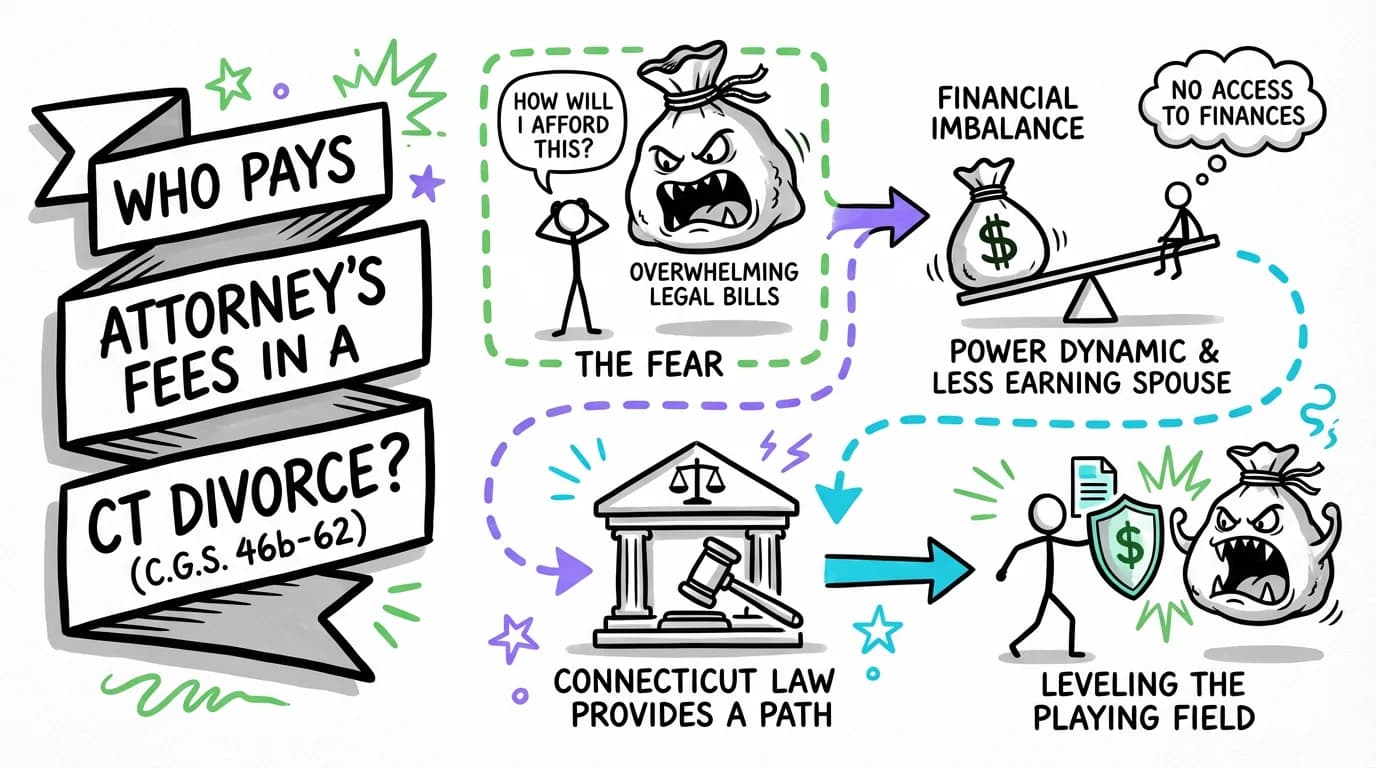
In Connecticut, each spouse often starts by paying their own lawyer. Under C.G.S. § 46b-62, however, the court may order one spouse to contribute to the other's attorney's fees. The key question is whether a fee award is needed for fairness and meaningful access to the litigation.
The Main Statute Is C.G.S. 46b-62
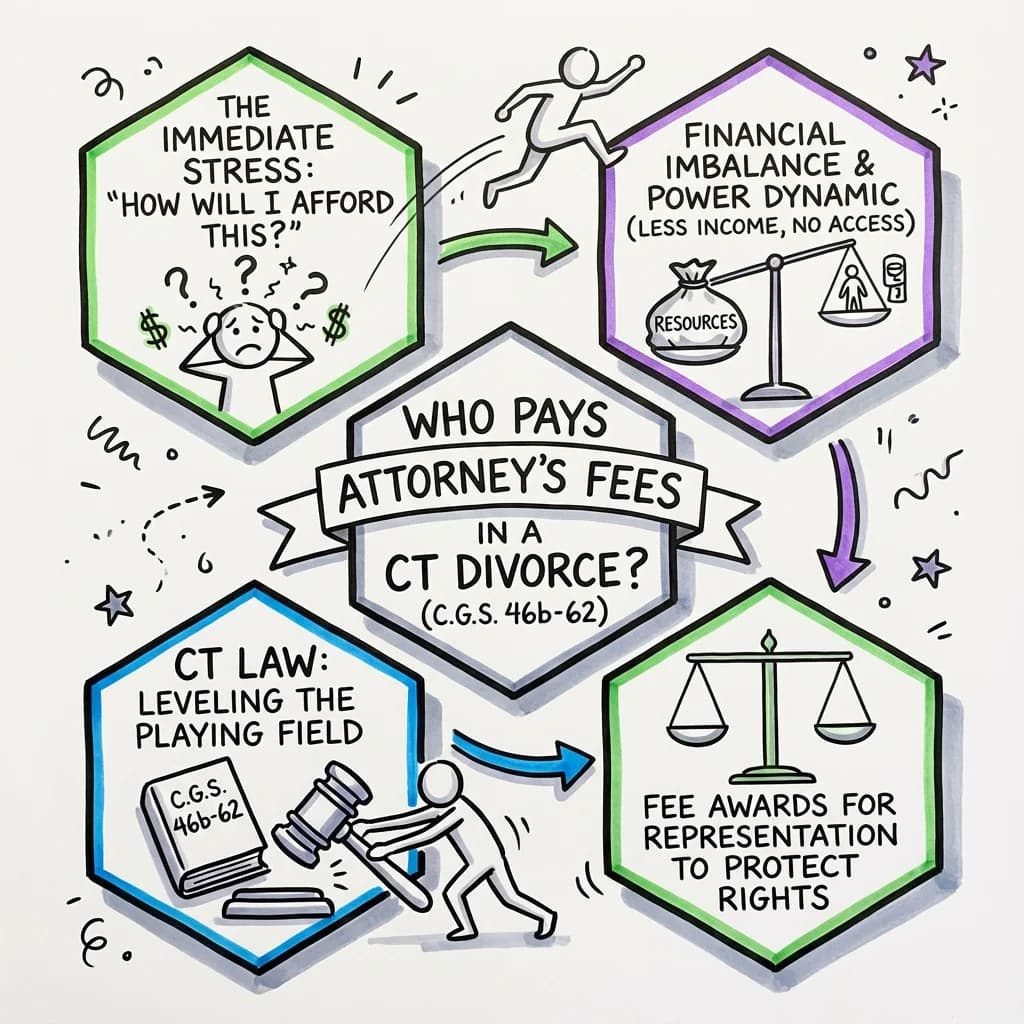
C.G.S. § 46b-62 gives the court authority to order a spouse to pay the reasonable attorney's fees of the other in a family matter. The statute also ties the analysis back to the same general factors used in C.G.S. § 46b-82, which is why fee decisions often track the broader financial realities of the divorce. The purpose is not simply to punish one party. It is often to prevent a major resource imbalance from distorting the case.
What The Court Usually Looks At
The court usually looks at relative income, access to funds, earning capacity, and whether one spouse can realistically participate in the case without assistance. A spouse with substantial liquid assets or much stronger income may be ordered to contribute to the other's fees if that is necessary to level the field. On the other hand, not every disparity produces a fee award. The court is still evaluating reasonableness, overall financial circumstances, and the structure of the other orders in the case.
When A Fee Request Is More Likely To Succeed
Fee requests are often strongest when one spouse cannot litigate or negotiate fairly without help, or when the other spouse's conduct has increased the cost of the case. That can happen in a contested divorce with large financial imbalance, or in an enforcement setting where contempt issues arise under C.G.S. § 46b-87. A court may also consider whether making one spouse pay all of their own fees would effectively undermine the other financial orders being entered. The practical theme is access and fairness, not automatic cost-shifting.
How You Usually Ask For Attorney's Fees
In practice, attorney's fees are generally requested through motion practice supported by current financial information and a concrete explanation of why the award is justified. The court will often want the same kind of current financial picture that appears elsewhere in the case, including the sworn financial affidavit required by Practice Book § 25-30. Linda Douglas, Chief Legal Officer at Untangle, often advises clients to treat fee requests like evidence problems, not fairness speeches. The stronger request usually shows the real financial gap, the actual need, and why a contribution is necessary now.
A Fee Award Is Not The Same As A Promise To Cover Everything
Even when the court orders a contribution, that does not always mean one spouse pays every dollar of the other spouse's legal bill. The award may cover only part of the fees, and timing matters too. Some awards are temporary while the case is pending. Others are part of the final judgment or an enforcement ruling. That is why the practical question is often whether the court will order a meaningful contribution, not whether it will wipe out every litigation cost the lower-resourced spouse has incurred.
Frequently Asked Questions
These are the questions people usually ask once they learn Connecticut can shift at least some legal fees in a divorce. The main misconception is that attorney's fees work like a civil “loser pays” system. They usually do not. Connecticut family courts are mostly looking at fairness, access, and the real effect of fees on each spouse's ability to participate in the case without being overwhelmed financially or forced into an unfair settlement position by the cost pressure.
Does the spouse who loses automatically pay the other side's lawyer?
No. Connecticut divorce cases do not generally operate on an automatic loser-pays rule. A fee award under C.G.S. § 46b-62 usually depends on financial circumstances, fairness, and the need to allow meaningful participation in the case. Outcome can matter indirectly, especially in enforcement settings, but the central question is normally whether a contribution is justified under the statutory framework rather than whether one spouse technically “lost.”
Can the court order temporary attorney's fees while the case is still open?
Yes. In the right circumstances, the court can order a fee contribution before the case is fully finished if one spouse needs help participating fairly during the litigation. That is especially important where there is a major access-to-counsel imbalance early in the case. Waiting until final judgment can sometimes defeat the purpose of the request, because the lower-resourced spouse may need the contribution in order to reach that final stage at all with effective representation.
Does bad behavior during the case affect attorney's fees?
It can. Financial disparity is still central, but conduct that drives up litigation cost may strengthen a fee request, particularly in enforcement or contempt settings. The court is still looking for a legally grounded basis, not just frustration with the other side. But if one spouse's conduct forces repeated motion practice, delays compliance, or creates unnecessary expense, that context can become relevant when the court evaluates whether a fee award is fair and necessary in the case.
Do I need to file a motion to ask for attorney's fees?
Usually yes. The court generally needs a concrete request, supporting facts, and current financial information before it can decide whether to order a contribution. That means timing, paperwork, and evidence all matter. Even when the court has broad authority, it still needs a usable record. If fees are likely to become an issue in your case, raise the question early enough that the request can be supported properly rather than improvised at the end of the litigation.

Author
Linda Douglas, Esq.
Chief Legal Officer, Untangle
Linda Douglas is a Divorce and Family Attorney with 38 years of experience handling nearly 2,000 cases in Connecticut and New Hampshire. She is licensed to practice law in Connecticut and New Hampshire.
Legal citations
- C.G.S. § 46b-62
- C.G.S. § 46b-82
- C.G.S. § 46b-87
- Practice Book § 25-30
Keep exploring
Get Help
Get help with your divorce
Get guided answers, organize your paperwork, and move through Connecticut divorce with a clearer plan.