
Should I hire a marshal or waive service in a Connecticut divorce?
Learn when to hire a Connecticut state marshal and when waiver of service may make sense in a divorce case. Covers key legal steps, forms, and timelines.
Quick answer: What to know first
In a Connecticut divorce, hiring a marshal is usually the safer choice when cooperation is low or service may be disputed, while waiver of service can save time and conflict when your spouse is willing to accept the papers voluntarily. The right option depends less on optimism and more on how reliable the other person's cooperation actually is.
- Why Service Matters
- When Hiring a Marshal Makes Sense
- When Waiver of Service Makes Sense
Get Help
Get help with your divorce
Get guided answers, organize your paperwork, and move through Connecticut divorce with a clearer plan.
In this guide
- Why Service Matters
- When Hiring a Marshal Makes Sense
- When Waiver of Service Makes Sense
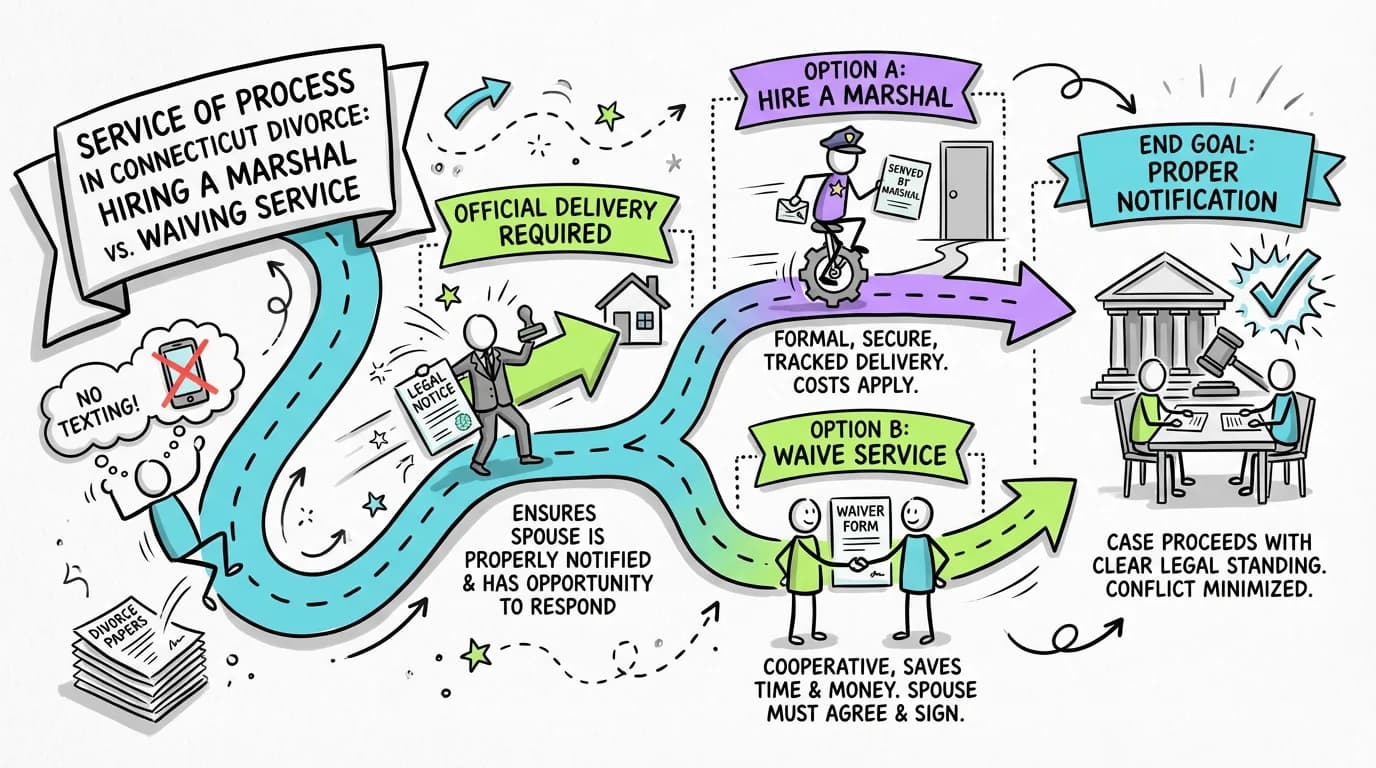
In a Connecticut divorce, hiring a marshal is usually the safer choice when cooperation is low or service may be disputed, while waiver of service can save time and conflict when your spouse is willing to accept the papers voluntarily. The right option depends less on optimism and more on how reliable the other person's cooperation actually is.
That choice matters because service is what puts the case on a legally defensible footing. If service is mishandled, the case can be delayed or challenged. A careful decision at the beginning often prevents a much more expensive problem later, especially when emotions are changing quickly or communication is already breaking down.
Why Service Matters
Service of process is the formal delivery of the divorce papers so the other spouse receives legally recognized notice of the case. Connecticut service rules are governed in part by C.G.S. § 52-57. In practical terms, the court wants a reliable record showing that the defendant got the papers through an approved method. That record protects due process and protects the plaintiff from later claims that the case moved forward without proper notice.
Because service is foundational, it should be treated as a strategic choice, not as a mere administrative detail. Linda Douglas often advises people to decide based on proof quality and predictability. If there is any serious chance the other spouse will delay, deny receipt, or shift positions later, formal service through a marshal often creates the cleaner record from day one.
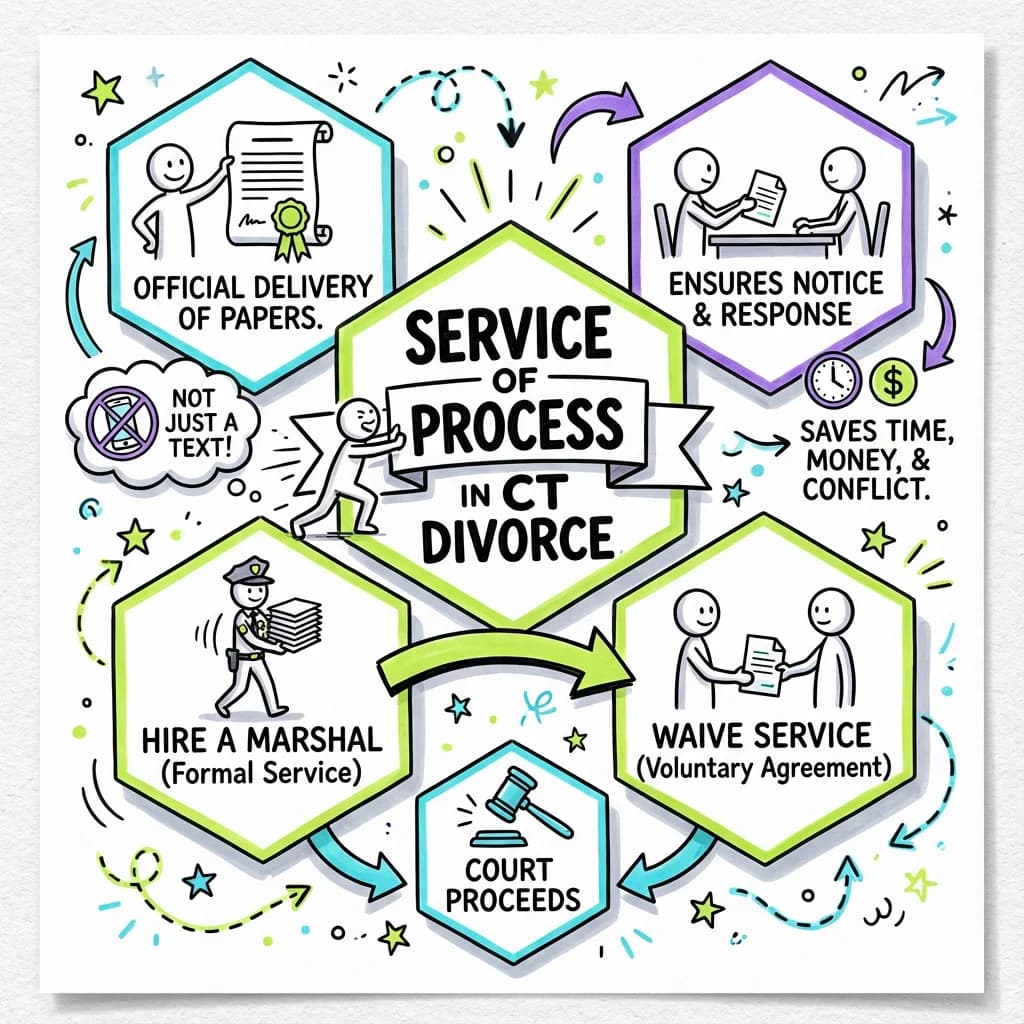
When Hiring a Marshal Makes Sense
Marshal service is usually the stronger option when the case is contested, the spouses are not communicating well, or you suspect the other side may avoid or later dispute service. A Connecticut marshal provides an independent proof-of-service record and can use approved methods such as personal or abode service under C.G.S. § 52-57. That often makes the file more durable if the other spouse becomes less cooperative after the case begins.
Marshal service also becomes important when location issues or resistance are already obvious. If the spouse is hard to find, lives unpredictably, or has already said they will not sign anything, a waiver strategy may waste time. Starting with a marshal can cost more upfront, but it often reduces downstream argument about whether the case was opened correctly and whether the defendant had valid notice of the divorce.
When Waiver of Service Makes Sense
Waiver of service works best when the spouses are genuinely cooperative and the defendant is willing to accept the complete filing packet voluntarily. In Connecticut family practice, that often means using the official JD-FM-249 waiver form together with an appearance so the court has a clear record of both notice and participation. Waiver can reduce cost, avoid the stress of formal service, and keep the tone of the case more constructive at the start.
The risk is false optimism. Waiver only helps if the other spouse actually follows through promptly and signs a proper form. If cooperation is uncertain, the supposed shortcut can turn into a delay. A waiver is a good option when trust is supported by behavior, documents are complete, and both sides are prepared to move quickly. It is a weaker option when you are relying on hope or on verbal promises alone.
How to Choose Between the Two
The simplest way to choose is to ask what proof you want if the relationship becomes more difficult next week than it is today. If you need certainty, use a marshal. If you have a reliably cooperative spouse who already reviewed the papers and is ready to sign promptly, waiver may be efficient and appropriate. The right answer is about predictability, not about avoiding an uncomfortable conversation or saving a smaller upfront cost.
If the other spouse cannot be found, or ordinary methods fail, more specialized service issues can arise, including publication under C.G.S. § 52-52. That is another reason to make the decision early. A slow failed waiver attempt can put you behind before you even begin solving the harder service problem. Good service planning is often the first real case-management decision in the divorce.
Common Mistakes to Avoid
One common mistake is having a friend or relative hand over the papers informally and assuming that counts as service. Usually it does not. Another mistake is sending the papers to the spouse casually and calling that a waiver before a proper signed form exists. Service is only as strong as the proof you can file with the court, and weak proof can create avoidable jurisdiction and scheduling problems later.
People also waste time by choosing waiver after clear warning signs that cooperation is unstable. If the spouse has already ignored deadlines, refused to discuss paperwork, or become evasive, a marshal is often the better path. Linda Douglas often points out that service decisions should be based on the likely behavior of the next thirty days, not on the friendliest conversation of the last thirty minutes.
Frequently Asked Questions
These are the practical questions most people ask when choosing between formal service and waiver. The common thread is reliability. The best method is usually the one that creates the clearest court record with the least chance of future dispute, even if it feels slightly slower or more formal at the beginning. Good service decisions usually look conservative in hindsight because they prevent bigger fights later in the case and keep the filing on track.
Can my spouse refuse to sign a waiver of service?
Yes. Waiver is voluntary, so your spouse can refuse to sign it or can simply delay long enough that waiver stops being useful. That refusal does not stop the divorce, but it usually means you should move to formal service through a marshal instead of waiting indefinitely. A waiver is a convenience tool, not a power to force cooperation where cooperation does not actually exist in the first place at filing time or soon after.
How long does marshal service usually take?
The timing varies with the marshal, the spouse's location, and how easy the person is to find, so there is no single guaranteed number of days. In straightforward cases it can move quickly, but avoid thinking of it as automatic same-day service. The important advantage is reliability of proof. Even if waiver might be faster in theory, marshal service is often faster in practice when cooperation is uncertain from the start of the case and likely to deteriorate.
What if my spouse lives out of state or I cannot find them?
Out-of-state location or uncertainty about where the spouse is living does not automatically end the case, but it usually makes service planning more important. A marshal may still be part of the solution, and in harder cases the court may permit alternative methods such as publication under C.G.S. § 52-52. The key is to move quickly once you see that ordinary waiver will probably not work.
Can I serve the divorce papers myself?
Usually, no. Self-service is exactly the kind of shortcut that creates future problems because the court wants a legally recognized proof-of-service record. Even if your spouse admits receiving the packet informally, that does not necessarily give you the court filing proof you need. If cooperation is real, use a proper waiver. If it is not, use a marshal and build the service record correctly from the beginning of the case without shortcuts or improvisation later.
Conclusion
Choosing between a marshal and waiver of service in a Connecticut divorce is really a choice about proof, predictability, and how much you trust the other side to follow through. Waiver can be efficient in a truly cooperative case, but marshal service is usually safer when cooperation is uncertain or emotions are shifting quickly. Untangle can help you weigh that choice early so service becomes a solid beginning to the case instead of the first avoidable problem.

Author
Linda Douglas, Esq.
Chief Legal Officer, Untangle
Linda Douglas is a Divorce and Family Attorney with 38 years of experience handling nearly 2,000 cases in Connecticut and New Hampshire. She is licensed to practice law in Connecticut and New Hampshire.
Legal citations
- C.G.S. § 52-52 (Service by Publication)
- C.G.S. § 52-57 (Service of Process)
- JD-FM-249 official form
Keep exploring
Get Help
Get help with your divorce
Get guided answers, organize your paperwork, and move through Connecticut divorce with a clearer plan.