
How do I file a motion for contempt in Connecticut family court?
Learn how to file a motion for contempt in Connecticut family court, what proof the court wants, and what remedies may be available.
Quick answer: What to know first
To file a motion for contempt in Connecticut family court, identify the exact order that was violated, describe the specific acts of noncompliance, and ask the same court for enforcement relief. A contempt motion works best when the order is clear, the violation is willful, and the proof is specific.
- Overview
- What You Must Prove
- Step-by-Step Filing Process
Get Help
Get help with your divorce
Get guided answers, organize your paperwork, and move through Connecticut divorce with a clearer plan.
In this guide
- Overview
- What You Must Prove
- Step-by-Step Filing Process
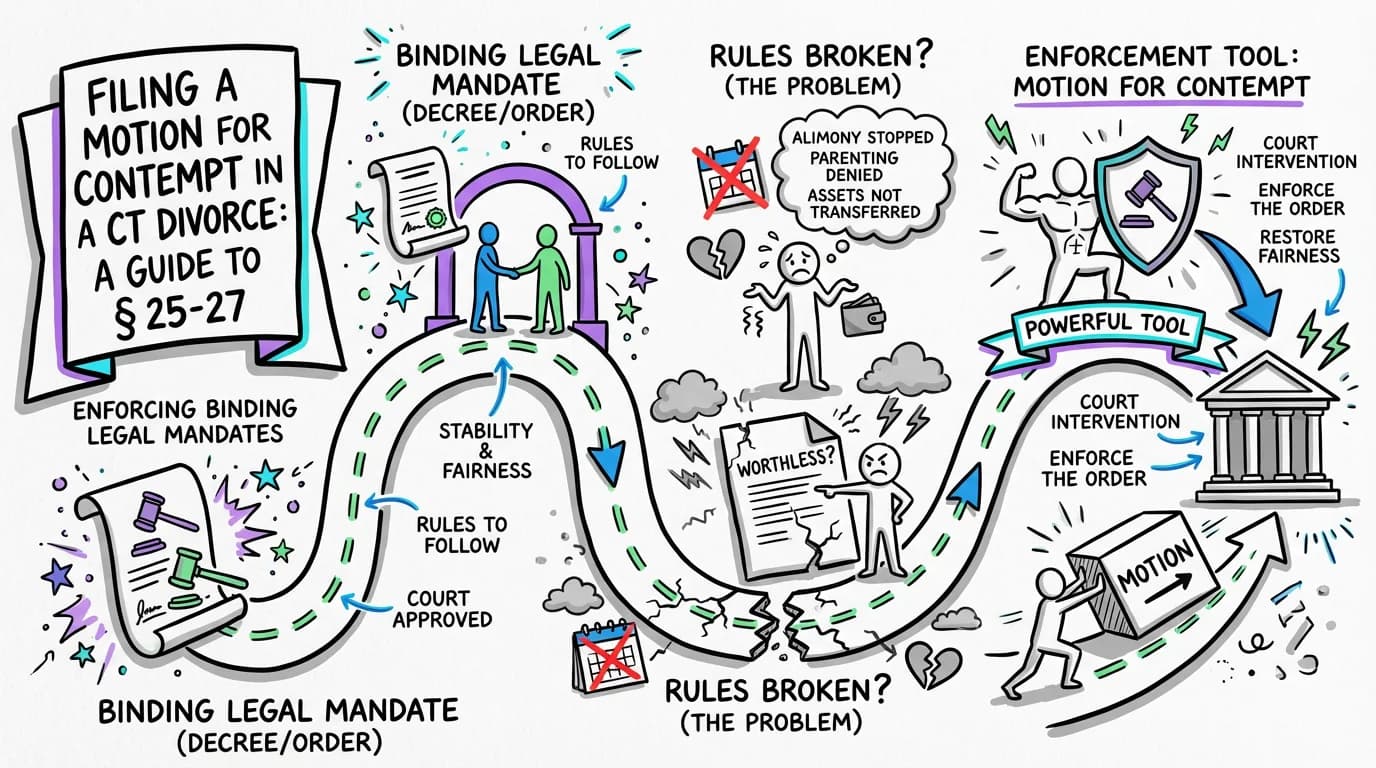
To file a motion for contempt in Connecticut family court, identify the exact order that was violated, describe the specific acts of noncompliance, and ask the same court for enforcement relief. A contempt motion works best when the order is clear, the violation is willful, and the proof is specific.
That matters because contempt is not just a complaint that something feels unfair. It is an enforcement request tied to a real court order. If the motion is vague, or if the underlying order is too blurry to enforce, the filing becomes much weaker before the judge ever hears testimony.
Overview
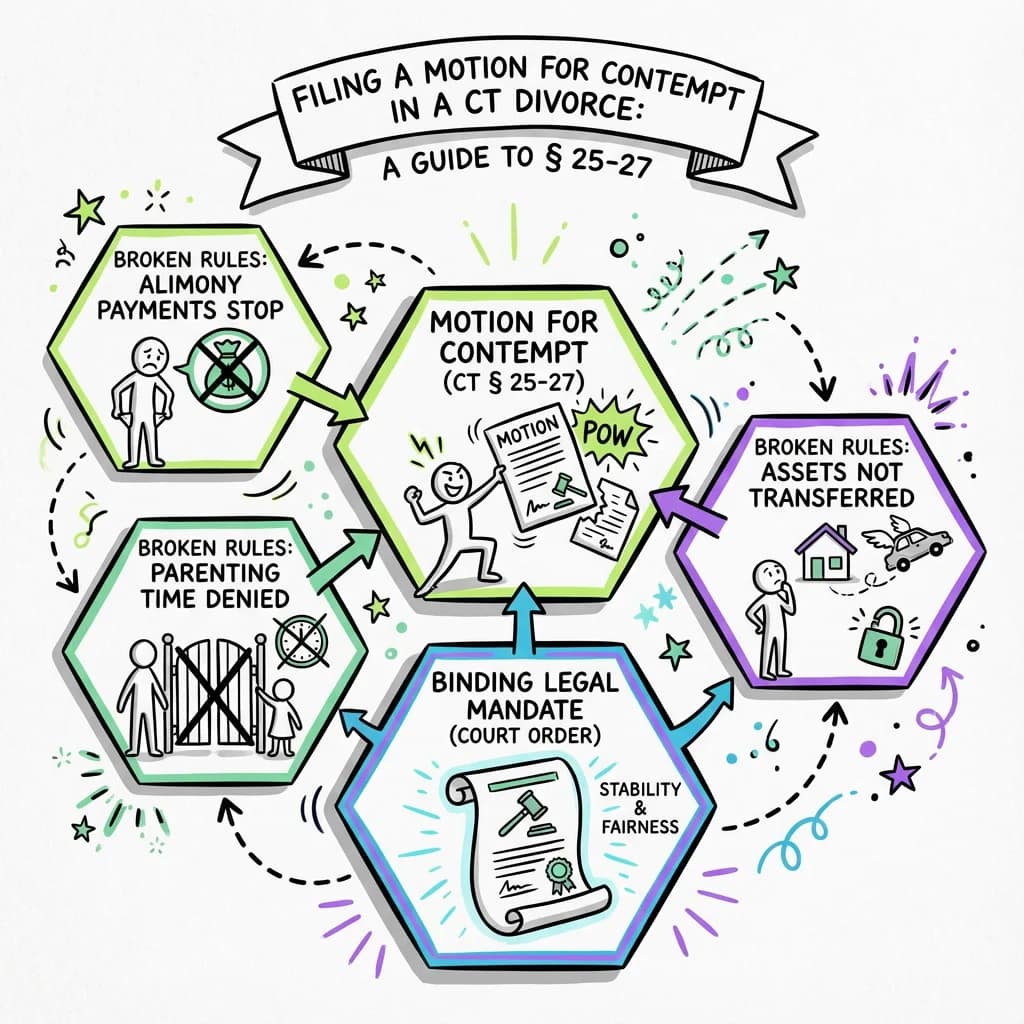
A motion for contempt is the main court tool for enforcing an existing family-court order in Connecticut. People use it when an ex-spouse or co-parent has allegedly ignored a financial order, parenting order, property-transfer requirement, or other clear command in the case. The contempt statute, C.G.S. § 46b-87, authorizes enforcement consequences when the violation is proven, while Practice Book Rule § 25-27 sets the procedural expectations for how the motion should be framed.
The key point is precision. Judges usually want the exact order language, the exact conduct that violated it, and the exact relief requested. Linda Douglas often notes that family-court contempt motions are won or lost on disciplined preparation more than on outrage. A careful timeline, supporting exhibits, and a motion built around the real wording of the order usually carry more weight than broad accusations about unfairness.
What You Must Prove
Contempt generally requires more than showing that something went wrong. The court usually needs to see a clear order, a violation of that order, and facts suggesting the violation was willful rather than accidental or impossible to avoid. If the order itself is ambiguous, the court may still address the problem through clarification or other relief, but contempt becomes harder because the respondent can argue the directive was not specific enough to enforce as written.
That is why evidence matters so much. Payment records, messages, calendars, signed agreements, and prior orders often decide the motion more than dramatic testimony does. If the issue is nonpayment, the numbers must line up. If the issue is denied parenting time, the dates and communications must line up. A good contempt motion gives the judge a simple proof path from order language to violation to requested remedy.
Step-by-Step Filing Process
Start by locating the exact order you believe was violated and reading it carefully. Then prepare the motion so it states the order, the conduct that violated it, and the relief you want. Under Practice Book Rule § 25-27, specificity matters. If money is owed, calculate it carefully. If the issue involves parenting time or property transfer, list the relevant dates, missed acts, and supporting documents instead of relying on general descriptions.
File the motion in the same Superior Court family case and follow the applicable notice, scheduling, and service requirements. Then prepare for the hearing like a proof presentation, not just an argument. Organize exhibits, create a timeline, and be ready to explain why the conduct was a willful violation of a clear order. The cleaner the filing record is, the easier it is for the judge to understand the contempt theory quickly and rule on the real dispute.
Possible Outcomes
If the court finds contempt, it can order a range of remedies depending on the violation. Those may include payment of arrears, compliance deadlines, attorney's fees, makeup parenting time, or other orders designed to enforce the original judgment. Under C.G.S. § 46b-87, attorney's fees can become part of the remedy when contempt is proven, which is one reason sloppy noncompliance can become financially expensive fast.
In some cases incarceration may be discussed, especially if the court sees deliberate noncompliance and other remedies have failed. When loss of liberty is genuinely on the table, Practice Book Rule § 25-63 becomes important because the respondent may have a right to counsel. Even when jail is unlikely, the possibility underscores how seriously Connecticut family courts can treat a willful refusal to obey clear orders.
Common Situations That Lead to Contempt Motions
Contempt motions often arise from unpaid alimony or child support, ignored property-transfer terms, denied parenting time, violations of automatic orders, or failure to comply with a post-judgment agreement incorporated into the decree. The theory is the same in each setting: the court already told someone to do something, and that person allegedly did not do it. The facts change, but the discipline of proof does not.
The strongest filings usually focus on repeated or well-documented violations instead of one vague episode. That does not mean a single event can never matter. It means the judge will usually understand the motion more quickly when the movant shows a pattern, a timeline, or a specific measurable loss. Linda Douglas often advises clients to prepare contempt motions as if a skeptical reader must be able to follow every step without guessing.
Frequently Asked Questions
These questions come up when people move from being angry about noncompliance to deciding whether they actually have a strong contempt filing. The common thread is proof. A contempt motion becomes more credible when the movant knows the exact order language, the exact conduct, and the exact remedy being requested before filing anything with the court. That preparation usually changes the case immediately and improves the hearing record later in court for everyone involved there.
What if the other side says they could not comply with the order?
That defense can matter because contempt usually turns on willful noncompliance, not merely on a bad result. If someone truly lacked the ability to comply, the court may treat the case differently than a situation involving deliberate refusal. That is why both sides' evidence matters. The movant should document the violation carefully, and the respondent should be prepared to prove any claimed inability with real records instead of vague explanations or broad excuses alone in testimony.
Do I need the exact order language in my motion?
Practically speaking, yes. A contempt motion is much stronger when it quotes or precisely identifies the order that was violated rather than referring only to its general subject. Judges want to know exactly what command the respondent allegedly disobeyed. Including the specific language also reduces arguments about ambiguity and helps the court connect your requested remedy to the actual text already in the case file from the start of the motion and hearing process itself.
Can the court award attorney's fees in a contempt case?
Yes, it can. Under C.G.S. § 46b-87, attorney's fees may be awarded when contempt is found. That does not mean they are automatic in every case, but it does mean contempt can become more expensive than the underlying dispute alone. Fee exposure is one reason people should take family-court orders seriously even when they assume the other side will never pursue formal enforcement.
Can someone go to jail for family-court contempt?
In serious cases, yes, although incarceration is not the routine result in every family contempt hearing. When the court is considering a liberty-restricting sanction, Practice Book Rule § 25-63 becomes important because the respondent may have a right to counsel. Even if jail never happens in your case, the possibility shows why a contempt motion should be treated as a serious legal event, not a paperwork annoyance.
Get Help with Your Connecticut Divorce
A contempt motion is often straightforward in principle and technical in execution. If you need to enforce an order, or if someone filed a contempt motion against you, careful organization usually matters more than dramatic language. Untangle can help you gather the order text, build the event timeline, and prepare the supporting records so the court sees a clear, specific enforcement story instead of a pile of frustration and scattered accusations from both sides at hearing time.

Author
Linda Douglas, Esq.
Chief Legal Officer, Untangle
Linda Douglas is a Divorce and Family Attorney with 38 years of experience handling nearly 2,000 cases in Connecticut and New Hampshire. She is licensed to practice law in Connecticut and New Hampshire.
Legal citations
- C.G.S. § 46b-87 (Contempt of Orders)
- Practice Book Rule § 25-27
- Practice Book Rule § 25-63
Keep exploring
Get Help
Get help with your divorce
Get guided answers, organize your paperwork, and move through Connecticut divorce with a clearer plan.