
How to Get a Quick Divorce in Connecticut
Learn the fastest lawful way to get divorced in Connecticut, including who qualifies for nonadversarial divorce and what to file.
Quick answer: What to know first
The quickest lawful divorce in Connecticut is a nonadversarial divorce, but only couples who meet every requirement in C.G.S. § 46b44a can use it. If you do not qualify, there is no instant shortcut; the best way to move faster is to prepare a complete standard case.
- What is the fastest way to get divorced in Connecticut?
- Who qualifies for a nonadversarial divorce in Connecticut?
- How fast can the court enter the divorce decree?
Get Help
Get help with your divorce
Get guided answers, organize your paperwork, and move through Connecticut divorce with a clearer plan.
In this guide
- What is the fastest way to get divorced in Connecticut?
- Who qualifies for a nonadversarial divorce in Connecticut?
- How fast can the court enter the divorce decree?
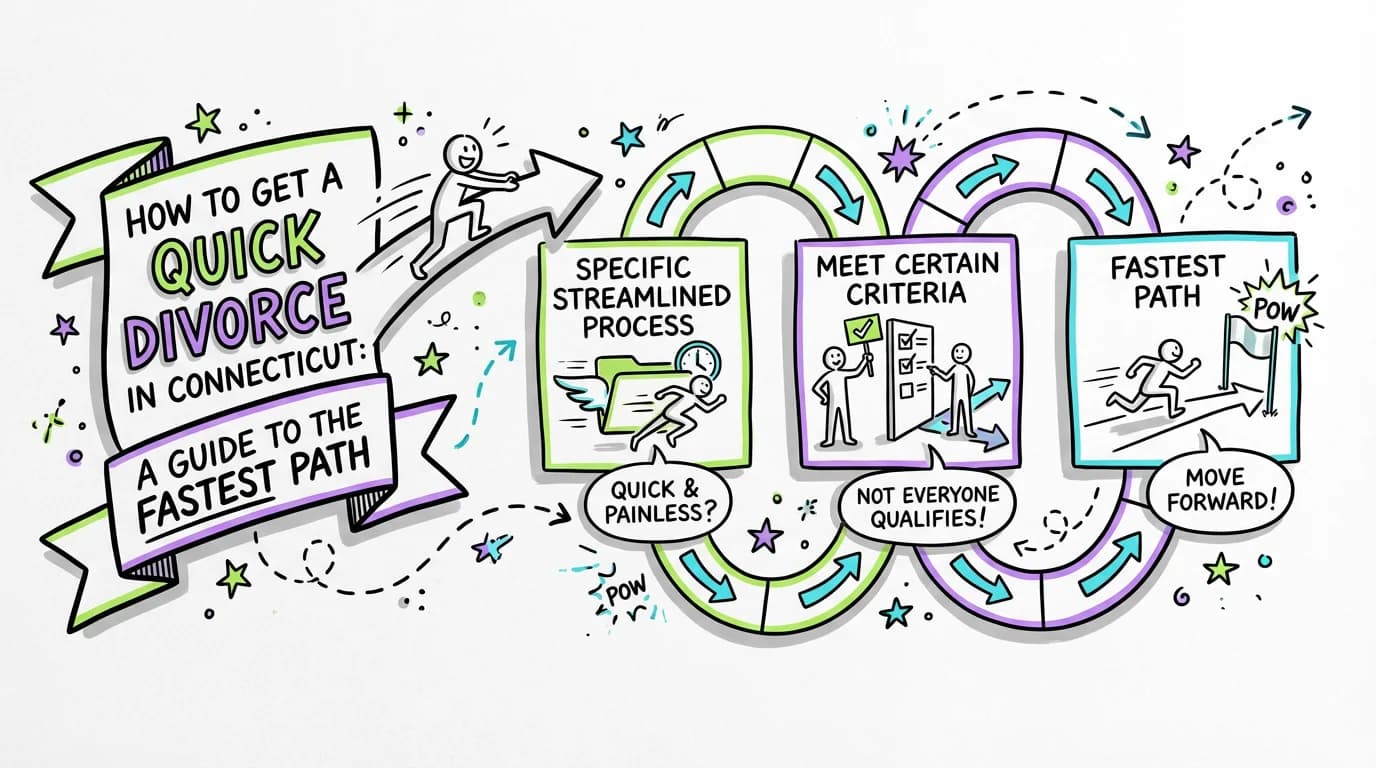
The quickest lawful divorce in Connecticut is a nonadversarial divorce, but only couples who meet every requirement in C.G.S. § 46b-44a can use it. If you do not qualify, there is no instant shortcut; the best way to move faster is to prepare a complete standard case.
What is the fastest way to get divorced in Connecticut?
Connecticut's fastest formal path is the nonadversarial dissolution process. The Judicial Branch describes it as a simplified process for eligible spouses who can obtain a divorce within 35 days or less without appearing before a judge, compared with the regular process that takes at least three months (JDP-FM-251). The statute assigns a disposition date at least 30 days after the joint petition is filed, and the court may enter the decree on that date or within five days after it if the filing qualifies (C.G.S. § 46b-44c).
That fast track is narrow. It is not the same as every uncontested divorce, and it is not available just because both spouses agree. Linda Douglas, Chief Legal Officer at Untangle, recommends asking the speed question in this order: first, do the facts qualify under the statute; second, are the required forms complete; third, is the agreement clear enough for court review.
Who qualifies for a nonadversarial divorce in Connecticut?
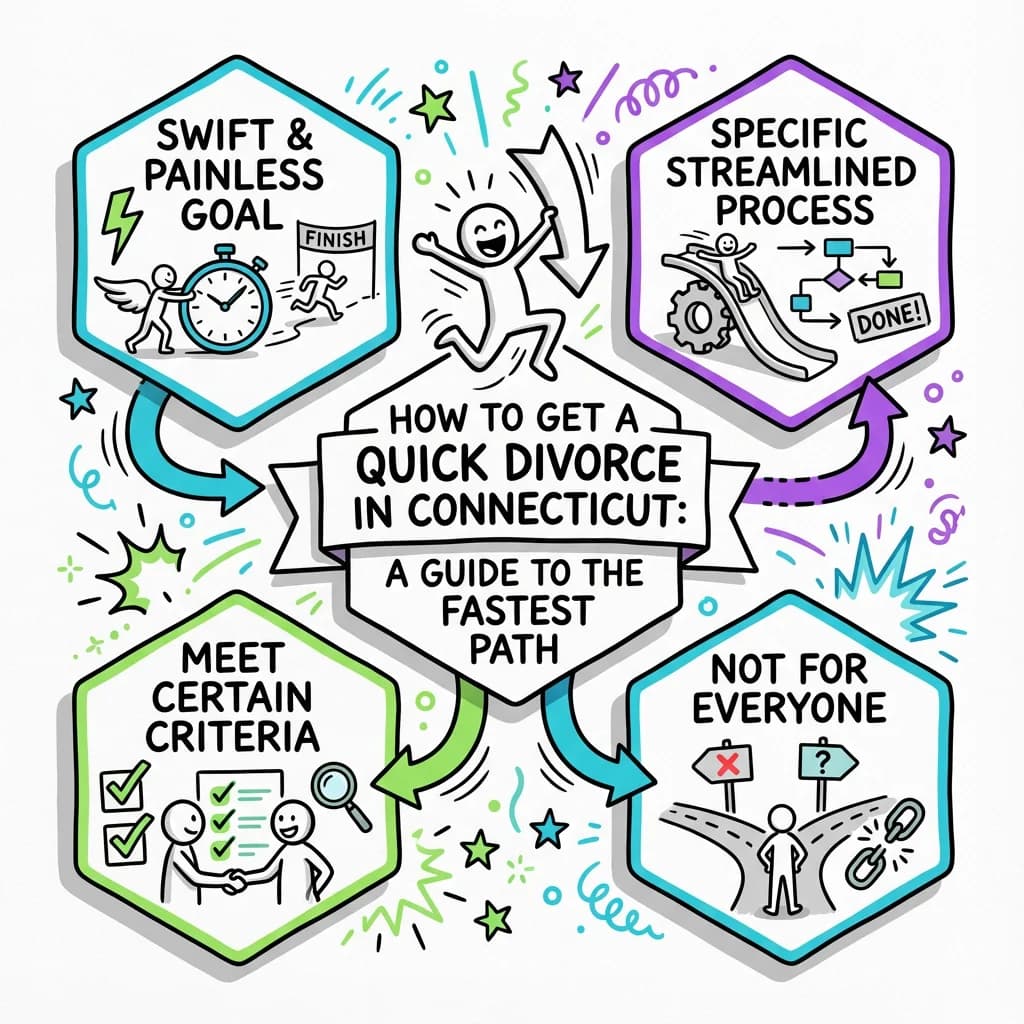
To use the fastest process, both spouses file a notarized joint petition and attest under oath that all statutory conditions exist (C.G.S. § 46b-44a). The marriage must have broken down irretrievably, lasted nine years or less, involve no pregnancy, and involve no children born to or adopted by the spouses before or during the marriage. Neither spouse can have any interest or title in real property, a defined benefit pension plan, a pending bankruptcy, or a restraining or protective order between them.
The property limit is also strict: the total combined fair market value of all property owned by either spouse, minus amounts owed on that property, must be less than $80,000 (C.G.S. § 46b-44a). Connecticut residency must also be satisfied before judgment can enter under C.G.S. § 46b-44. If a qualifying condition changes after filing and before the decree, one or both spouses must promptly notify the court.
How fast can the court enter the divorce decree?
For a qualifying nonadversarial case, the court assigns a disposition date not less than 30 days after the joint petition is filed (C.G.S. § 46b-44c). If no notice of revocation has been filed, the parties have not been notified otherwise, and the court finds the eligibility conditions and any settlement agreement sufficient, the court may enter the decree on the disposition date or not later than five days afterward without a hearing.
For standard divorce cases, speed depends on the filing posture. Connecticut law says a contested dissolution trial cannot start until at least 90 days after the return date, while full agreements and defaults have their own timing rules under C.G.S. § 46b-67. That is why a couple can be fully cooperative but still not have access to the nonadversarial timeline.
How to file for the quickest Connecticut divorce
The fastest filing is not a rushed filing. It is a correct joint petition with the required attachments, accurate sworn information, and a settlement agreement only when the spouses want one incorporated into the decree. The Judicial Branch's nonadversarial forms supplement lists the core packet and warns that incomplete forms can be returned for missing information (JDP-FM-251). Use the packet like a checklist before either spouse signs under oath.
Step 1: Confirm eligibility before choosing the forms
Start with the statutory checklist, not with the word "uncontested." Confirm the nine-year marriage limit, no pregnancy, no children, no real property, less than $80,000 in net combined property, no defined benefit pension, no pending bankruptcy, no other pending dissolution action, no restraining or protective order, and Connecticut residency (C.G.S. § 46b-44a). If any answer is uncertain, pause before filing because the court reviews eligibility before entering the decree. A mistaken joint petition can cost more time than choosing the standard path first.
Step 2: Complete the joint petition accurately
The filing starts with the Joint Petition - Nonadversarial Divorce, form JD-FM-242 (JD-FM-242). The petition must be notarized and include each spouse's sworn attestation that the statutory conditions exist. It also asks for marriage information, residential addresses, residency facts, requested name restoration if any, and public-assistance information that may require notice to the Attorney General. Review every checkbox against your records before notarizing and filing the form, especially the property, pension, bankruptcy, and residency statements.
Step 3: Attach the required financial and appearance forms
JD-FM-242 instructs spouses to attach a financial affidavit from each petitioner, the Notice of Automatic Orders - Nonadversarial Divorce, and a completed Appearance form from each petitioner (JD-FM-242). If the spouses want a settlement agreement incorporated into the decree, the agreement must be filed with the joint petition, and each spouse must attest that its terms are fair and equitable (C.G.S. § 46b-44a). A complete financial picture helps the court evaluate whether the agreement matches the spouses' sworn disclosures.
Step 4: File jointly and follow the automatic orders
Because both spouses file together, the automatic court orders for nonadversarial divorce apply when the joint petition is filed (Practice Book § 25-5B). The Judicial Branch form JD-FM-260 lists restraints involving property, debts, insurance, beneficiaries, and related conduct while the case is pending (JD-FM-260). Treat those orders as active court orders, not optional suggestions, until the court changes them or the case ends. Avoid unusual transfers, new debts, or insurance changes while the petition is pending.
Step 5: Watch for revocation, review, or regular-docket transfer
Either spouse may revoke the nonadversarial action before the court enters the decree by filing a notice of revocation, which terminates the nonadversarial action (C.G.S. § 46b-44b). If the court cannot determine that the agreement is fair and equitable, or cannot confirm the statutory criteria, it may docket the matter for review and may terminate the nonadversarial action or place it on the regular family docket (C.G.S. § 46b-44d). Monitor court notices after filing so a review request or transfer does not surprise either spouse.
What if you do not qualify for the fast track?
If you do not qualify, the right answer is usually a clean standard divorce case, not forcing a nonadversarial packet. A regular dissolution action generally starts by service and filing of a complaint in the Superior Court judicial district where one spouse resides, unless service is waived in the form allowed by statute (C.G.S. § 46b-45). If the spouses settle every issue, the case may still be uncontested even though it is not nonadversarial.
Linda Douglas, Chief Legal Officer at Untangle, recommends treating disqualification as a routing issue, not a failure. Couples with children, real estate, higher property value, pension complexity, support questions, or safety-order history can still reduce delay by exchanging financial information early, using the correct standard forms, and drafting proposed orders that resolve every required issue before the final court date.
Common mistakes that slow down a quick Connecticut divorce
The most common mistake is confusing cooperation with eligibility. A couple can agree on everything and still be disqualified by children, real estate, property value, a defined benefit pension, bankruptcy, or a protective order (C.G.S. § 46b-44a). Another mistake is filing the nonadversarial packet without complete financial affidavits, appearances, automatic orders, or a clear settlement agreement when one is being submitted (JD-FM-242).
The third mistake is using the 35-day figure as a promise. The Judicial Branch describes that timing for eligible nonadversarial cases (JDP-FM-251), but court review still matters. A vague agreement or questionable eligibility fact can trigger review under C.G.S. § 46b-44d, which is why preparation often saves more time than rushing.
Frequently Asked Questions
Can you get a divorce in 35 days or less in Connecticut?
Yes, but only through the nonadversarial process if every statutory condition is met. The Judicial Branch says eligible spouses can obtain a nonadversarial divorce within 35 days or less, and C.G.S. § 46b-44c sets the disposition date at least 30 days after filing.
Do both spouses have to agree to use the fastest divorce process?
Yes. A nonadversarial divorce starts with a joint petition signed by both spouses, and each spouse must attest under oath that the required conditions exist. If one spouse will not file jointly, the case cannot use this specific process and should be evaluated as a standard dissolution case.
What disqualifies a Connecticut nonadversarial divorce?
Common disqualifiers include a marriage longer than nine years, pregnancy, children born to or adopted by the spouses, any real property interest, $80,000 or more in net combined property, a defined benefit pension, pending bankruptcy, another pending dissolution action, or an active restraining or protective order between the spouses.
What forms do we need for a quick nonadversarial divorce?
The core packet includes the Joint Petition - Nonadversarial Divorce, financial affidavits for both spouses, the Notice of Automatic Court Orders - Nonadversarial Divorce, and appearances for both spouses. If you want a settlement agreement incorporated into the decree, file the nonadversarial agreement with the joint petition.
Can we avoid going to court if we qualify?
Often, yes. C.G.S. § 46b-44c allows the court to enter a nonadversarial decree without a hearing if the requirements are met and the parties are not notified otherwise. But the court may require review if eligibility or agreement terms are unclear.
What happens if the court rejects the nonadversarial filing?
The court may docket the matter for review, terminate the nonadversarial action, or place the matter on the regular family docket if the criteria are not met or the agreement cannot be found fair and equitable. Under C.G.S. § 46b-44d, no new filing fee is imposed when it is transferred.
What should you do next?
Start by sorting your case into the right lane. If every nonadversarial requirement fits, gather the joint petition packet and check each attachment before filing. If one requirement does not fit, focus on building a standard uncontested case with complete financial disclosure, service or waiver handled correctly, and a written agreement that resolves all open issues. Untangle can help you organize that decision early so you do not lose time filing the wrong paperwork first.

Author
Linda Douglas, Esq.
Chief Legal Officer, Untangle
Linda Douglas is a Divorce and Family Attorney with 38 years of experience handling nearly 2,000 cases in Connecticut and New Hampshire. She is licensed to practice law in Connecticut and New Hampshire.
Legal citations
- C.G.S. § 46b-44 (Residency Requirement)
- C.G.S. § 46b-44a (Nonadversarial Dissolution of Marriage)
- C.G.S. § 46b-44b (Revocation of Joint Petition)
- C.G.S. § 46b-44c (Disposition of Nonadversarial Dissolution)
- C.G.S. § 46b-44d (Review of Settlement Agreement)
- C.G.S. § 46b-45 (Service, Filing, and Waiver of Service)
- C.G.S. § 46b-67 (Time Frame for Court to Proceed)
- Connecticut Judicial Branch Nonadversarial Divorce Forms Supplement (JDP-FM-251)
- Joint Petition - Nonadversarial Divorce (JD-FM-242)
- Notice of Automatic Court Orders - Nonadversarial Divorce (JD-FM-260)
- Connecticut Judicial Branch Divorce Options (FM274)
Related guides
What is an Uncontested Divorce in Connecticut?
Learn more about uncontested divorce in Connecticut
How long does a divorce take in Connecticut?
Understand typical CT divorce timelines and the 90-day trial rule
What forms do I need to file for divorce in Connecticut?
Compare the standard divorce forms with the nonadversarial packet
Keep exploring
Get Help
Get help with your divorce
Get guided answers, organize your paperwork, and move through Connecticut divorce with a clearer plan.