
What does JD-FM-172 cover in a Connecticut uncontested divorce?
Learn what Connecticut's JD-FM-172 dissolution agreement covers, what to review before signing, and how it fits into an uncontested divorce.
Quick answer: What to know first
JDFM172 is the Connecticut settlement form for divorce or legal separation agreements. It covers alimony, property, debts, insurance, name change, and childrelated education terms, and both parties must sign it voluntarily. Before using the shorthand code, focus on whether the deal is complete, internally consistent, and ready for court review.
- Fast read before you start typing
- The sections people should review most carefully
- How JD-FM-172 fits with the rest of the filing packet
Get Help
Get help with your divorce
Get guided answers, organize your paperwork, and move through Connecticut divorce with a clearer plan.
In this guide
- Fast read before you start typing
- The sections people should review most carefully
- How JD-FM-172 fits with the rest of the filing packet
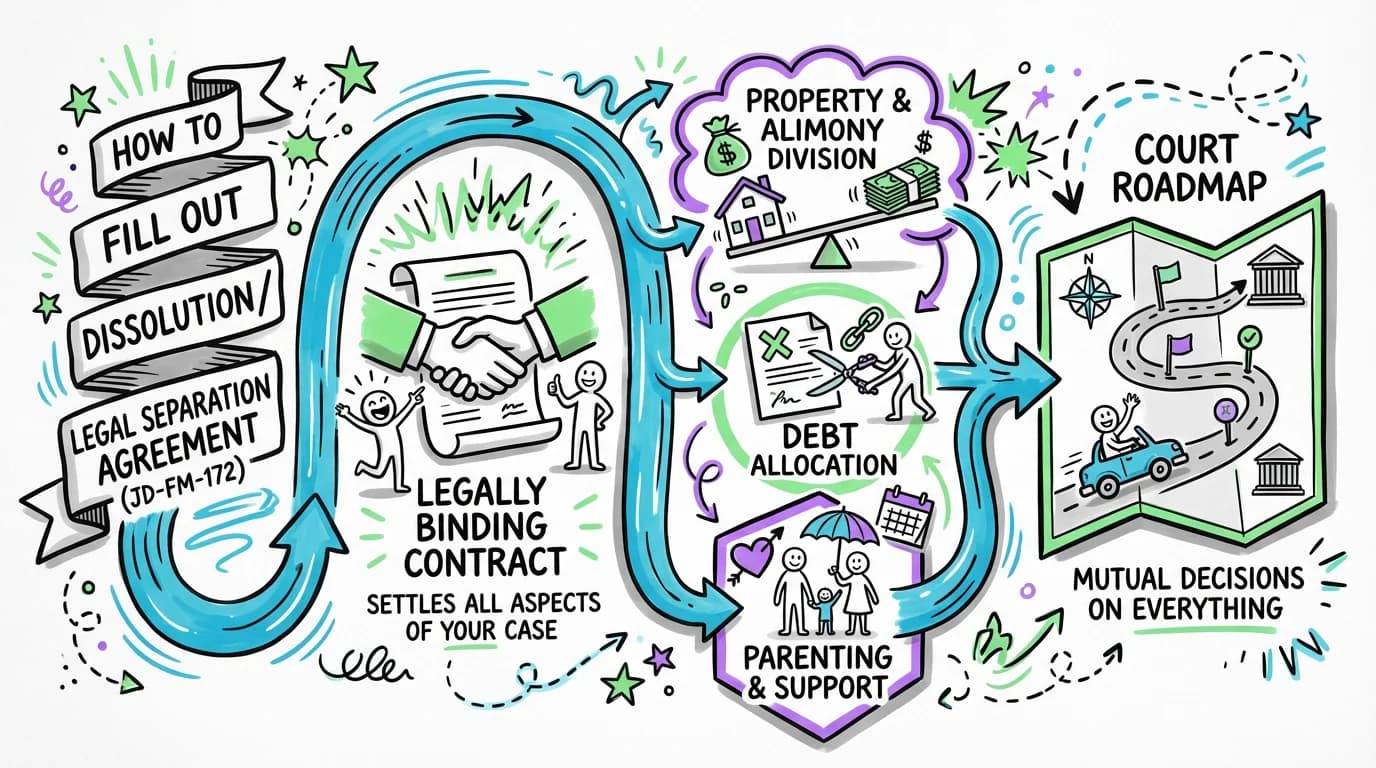
JD-FM-172 is the Connecticut settlement form for divorce or legal separation agreements. It covers alimony, property, debts, insurance, name change, and child-related education terms, and both parties must sign it voluntarily. Before using the shorthand code, focus on whether the deal is complete, internally consistent, and ready for court review.
Fast read before you start typing
Think of JD-FM-172 as the written version of the settlement itself. The official form is not just a summary cover sheet. It is where the parties state who keeps property, who pays debts, whether alimony exists, what happens with insurance, and what child-related education terms apply. Once filed, the court reviews that agreement under C.G.S. § 46b-66. If the document is incomplete or contradictory, the problem is no longer abstract. It becomes a barrier to the judge approving the uncontested case on the terms the parties thought they had resolved.
The sections people should review most carefully
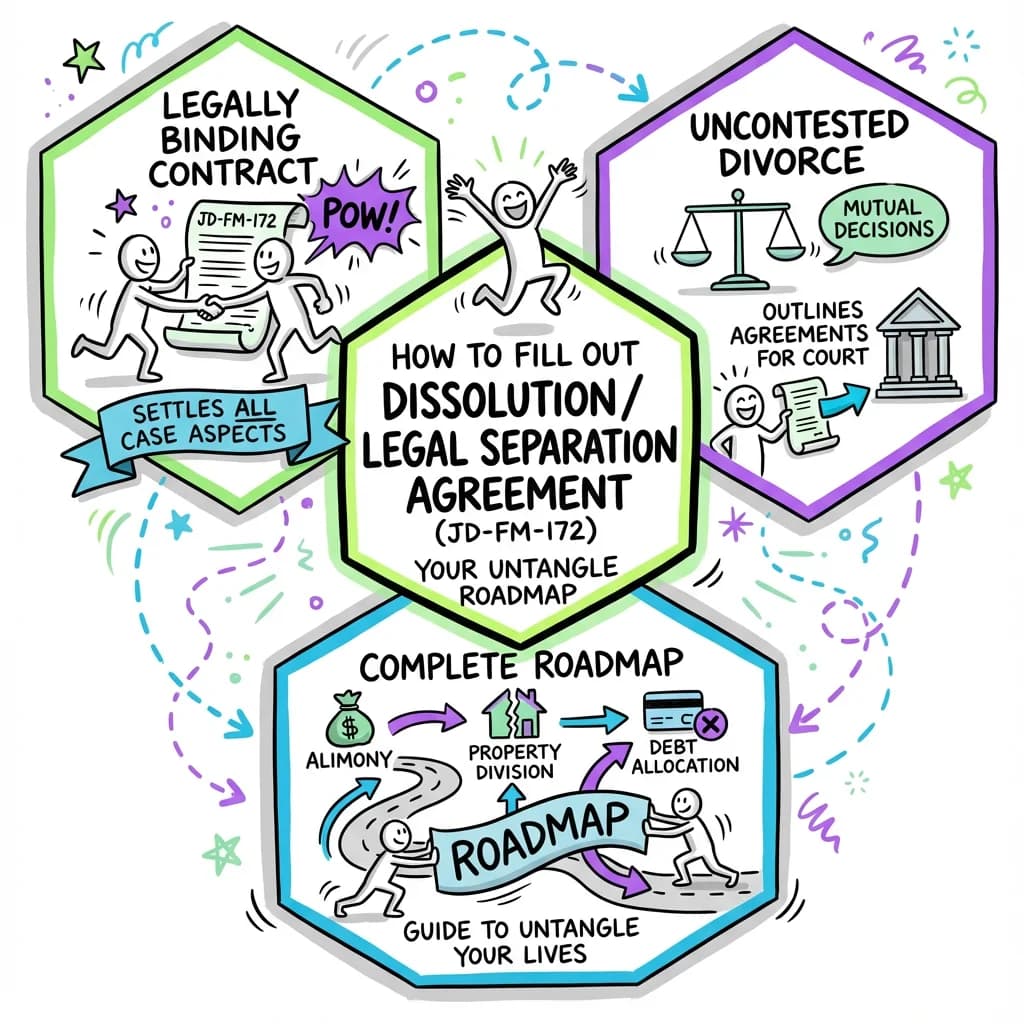
The most important sections are usually alimony, real estate, retirement, debt allocation, and the final signature page. Those are the places where a single checkbox can permanently waive a right or assign a long-term obligation. The JD-FM-172 PDF also includes sections on bank accounts, investments, vehicles, life insurance, medical insurance, personal property, and change of name, so a short code search should not trick you into thinking the form covers only one topic. The form is broad because the court wants one agreement that resolves the major financial and family consequences of the case in a coherent way.
How JD-FM-172 fits with the rest of the filing packet
Connecticut's divorce-with-agreement filing guidance treats the settlement agreement as one part of a larger package that usually also includes financial affidavits and other case-specific forms. That is why JD-FM-172 should match the numbers and responsibilities already shown elsewhere in the file. If the agreement says one spouse keeps the house, the affidavits and related sections should not imply the opposite. If the agreement divides retirement or debt, the supporting financial paperwork should make that division understandable. A clean uncontested file usually reads like each document was drafted with the others on the table.
Mistakes that make a settlement look unfinished
The most common mistake is leaving crucial terms implied instead of stated. People say one spouse keeps the house but forget refinance timing, or they divide a debt without saying who will protect the other party from later collection efforts. Linda Douglas, Chief Legal Officer at Untangle, recommends reading JD-FM-172 as if you were the future judge or collection lawyer, not the current spouse who already knows what was intended. If the meaning depends on background conversations, the agreement is probably too vague. The form works best when every important obligation can be understood by someone who never heard the settlement discussions.
Why the signature warning deserves attention
The last page of JD-FM-172 warns that both parties should sign only if they have read the agreement carefully, understand every part of it, and are signing voluntarily. That language matters because the court is being asked to transform the agreement into enforceable orders. Signing a form you only half understand can lock in a waiver or payment term that is hard to unwind later. The safest habit is to pause before signing, compare the form to the financial affidavits, and confirm that both parties would describe the same deal in the same words if the judge asked for an explanation.
Frequently Asked Questions
People who search by code usually want a short answer about what JD-FM-172 actually does and what makes it court-ready. These questions focus on the scope of the form, whether it must match the financial affidavits, what counts as an unfinished agreement, and why both signatures matter. Read them as a final review pass, because JD-FM-172 should sound like a complete deal rather than a draft outline of one before the judge sees it at hearing.
Does JD-FM-172 only deal with property division?
No. The form covers far more than property. It includes alimony, real estate, vehicles, bank and investment accounts, retirement assets, insurance, debts, personal property, name change, and child-related post-majority education terms. Property division may be the most visible part, but the form is meant to capture the broader settlement. If you read JD-FM-172 as only a property sheet, you are likely to miss waivers or responsibilities elsewhere in the agreement.
Should the agreement line up with the financial affidavits?
Yes, in substance. The agreement and the financial affidavits do different jobs, but they should describe the same financial reality. If JD-FM-172 assigns an account, debt, or insurance duty that the affidavits never mention, the court may question whether the file is complete. Reviewing the affidavits while you draft the agreement is a simple way to catch inconsistencies before they become a hearing problem or clerk question. That cross-check also makes judge questions easier to answer.
What makes JD-FM-172 look unfinished to the court?
Major unanswered questions usually do it. An agreement can look unfinished if it leaves important issues vague, includes contradictory terms, or pushes essential details into a future conversation. Saying a house will be handled later, or that debts will be split fairly, is weaker than specifying who pays what and by when. A court-ready JD-FM-172 should let the judge see an actual settlement rather than a promise that the parties will eventually settle. Judges notice quickly.
Why do both parties need to sign JD-FM-172?
Because the form is being offered as a joint, voluntary settlement agreement. The final page says both parties must sign after reading and understanding the agreement. That helps the court treat the document as a consensual resolution instead of a disputed proposal. If one party has not signed, the form no longer shows the same level of shared assent the uncontested process depends on. That shared assent matters.

Author
Linda Douglas, Esq.
Chief Legal Officer, Untangle
Linda Douglas is a Divorce and Family Attorney with 38 years of experience handling nearly 2,000 cases in Connecticut and New Hampshire. She is licensed to practice law in Connecticut and New Hampshire.
Legal citations
- Connecticut Judicial Branch form JD-FM-172
- C.G.S. § 46b-66
- Connecticut Judicial Branch Divorce with an Agreement filing guide
Related guides
How do you fill out Connecticut's JD-FM-172 dissolution or legal separation agreement?
Open the long-name walkthrough for the fuller clause-by-clause explanation of the agreement form.
How do you fill out Connecticut's JD-FM-006 short financial affidavit?
The short financial affidavit often supplies the numbers that support the agreement's support and property terms.
Keep exploring
Get Help
Get help with your divorce
Get guided answers, organize your paperwork, and move through Connecticut divorce with a clearer plan.