
How do you fill out JD-FM-006 Long in Connecticut divorce cases?
Clear JD-FM-006 Long guide: when Connecticut requires the long financial affidavit, how to convert weekly figures, and what records to gather.
Quick answer: What to know first
JDFM006 Long is Connecticut's detailed financial affidavit for divorce and other family cases. Use it when your own gross annual income is more than $75,000 or your own total net assets are more than $75,000. The form requires weekly income, weekly expenses, complete assets and debts, and a sworn certification.
- What JD-FM-006 Long is and when to use it
- What to gather before you start
- How to fill out JD-FM-006 Long step by step
Get Help
Get help with your divorce
Get guided answers, organize your paperwork, and move through Connecticut divorce with a clearer plan.
In this guide
- What JD-FM-006 Long is and when to use it
- What to gather before you start
- How to fill out JD-FM-006 Long step by step
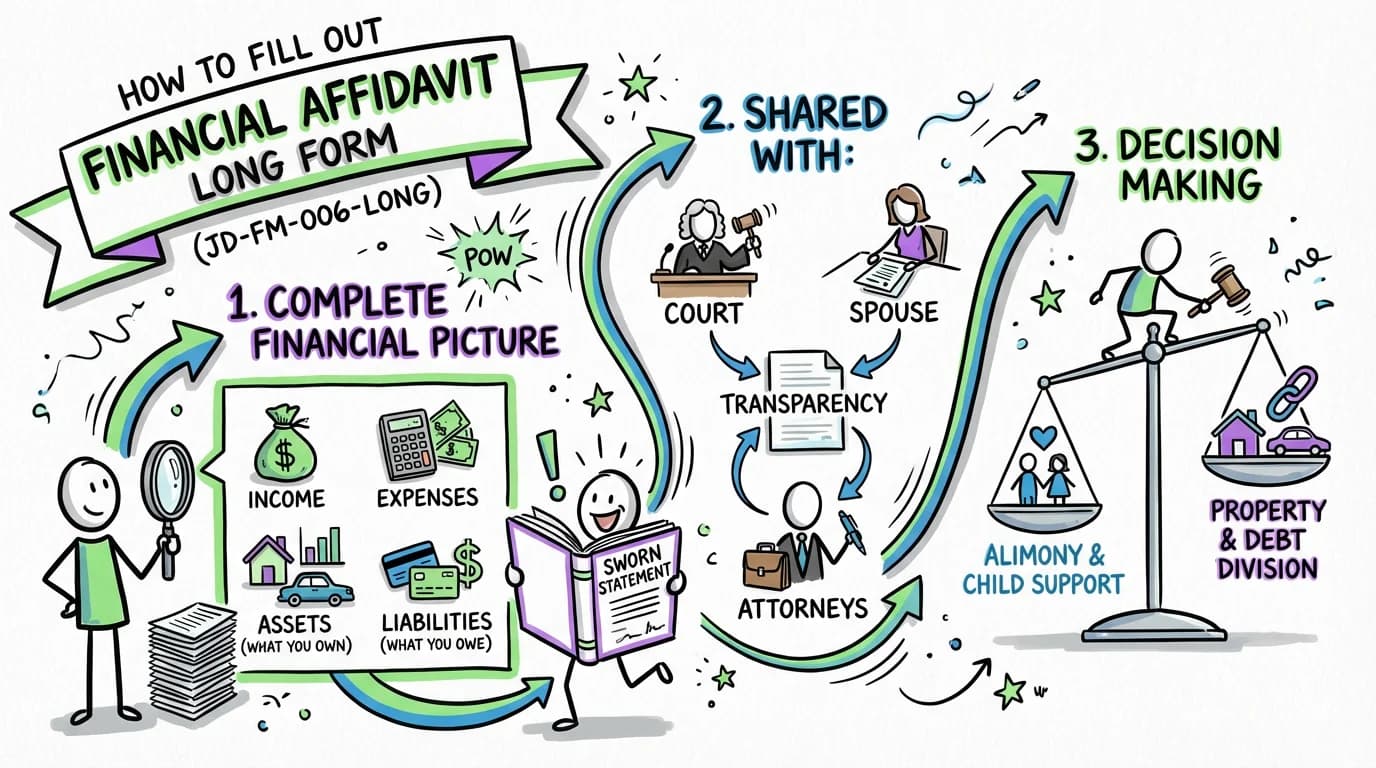
JD-FM-006 Long is Connecticut's detailed financial affidavit for divorce and other family cases. Use it when your own gross annual income is more than $75,000 or your own total net assets are more than $75,000. The form requires weekly income, weekly expenses, complete assets and debts, and a sworn certification.
What JD-FM-006 Long is and when to use it
JD-FM-006 Long is the shorthand search name for the Connecticut Judicial Branch long financial affidavit, officially labeled JD-FM-6-LONG. The form instructions say to use the long version if either your gross annual income is more than $75,000 or your total net assets are more than $75,000; otherwise, the short version may apply. The threshold is measured for the individual person signing the affidavit, not the couple combined.
This affidavit matters because Connecticut family courts use sworn financial statements to evaluate income, expenses, assets, liabilities, support, and settlement proposals. Practice Book § 25-30 requires sworn financial statements in the Judicial Branch format before hearings involving alimony, support, or counsel fees and before judgment unless the court orders otherwise. That makes JD-FM-006 Long both a disclosure document and a practical roadmap for negotiations.
What to gather before you start
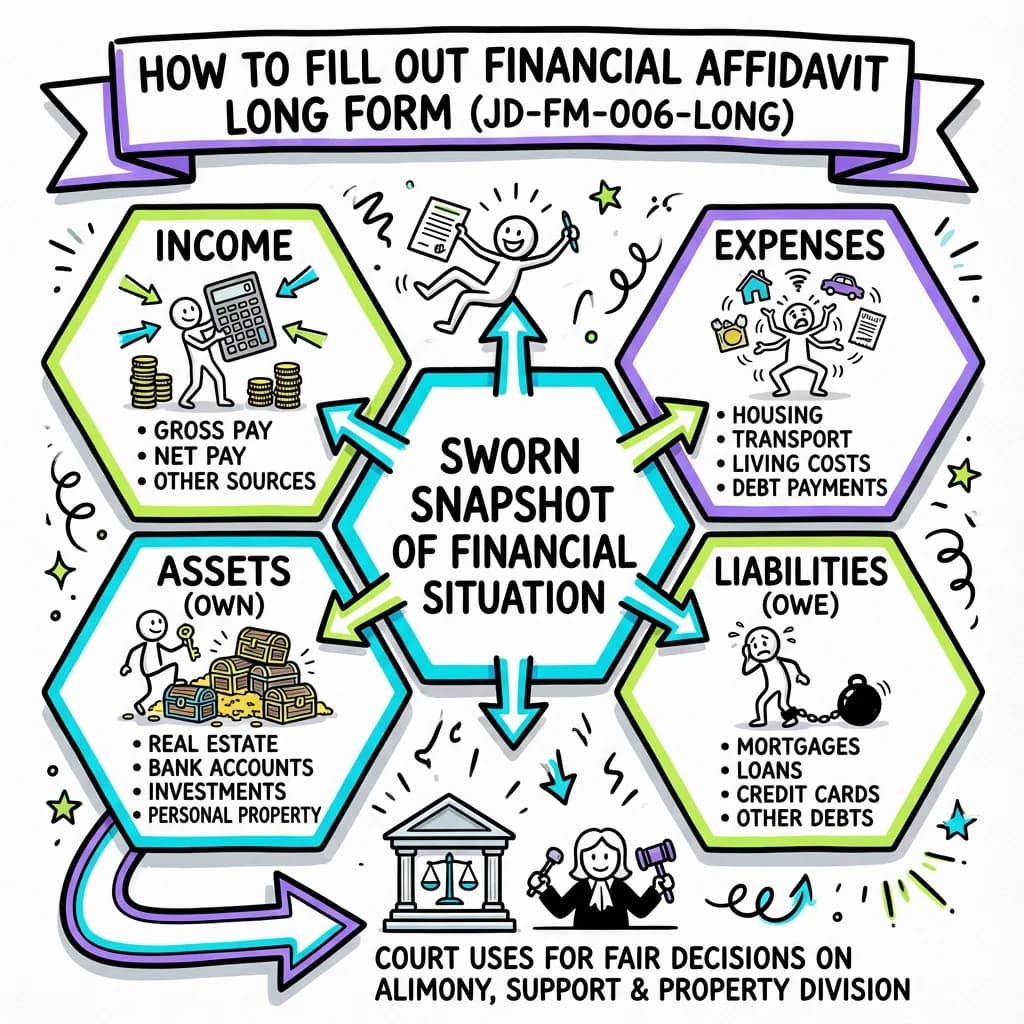
Start with records, not memory. Gather recent pay records, year-to-date income, the prior year's gross income, tax returns, bank and retirement statements, loan balances, insurance costs, childcare costs, and a realistic record of recurring household expenses. The official form says income should be computed from year-to-date information, but no less than the last 13 weeks unless you explain why a shorter period or different computation is more accurate.
Because the form uses weekly numbers throughout, set up a simple conversion worksheet before typing into the PDF. The Judicial Branch gives the basic conversions on the form: biweekly amounts divide by 2, semi-monthly amounts multiply by 2, then by 12, then divide by 52, monthly amounts multiply by 12 and divide by 52, and annual amounts divide by 52. Keep the source documents with your worksheet so the numbers can be explained later.
How to fill out JD-FM-006 Long step by step
Work through JD-FM-006 Long in the same order a judge or mediator will usually read it: eligibility, income, deductions, expenses, liabilities, assets, and certification. Do not treat each page as isolated. The income section should support the support calculations, the expenses should match the household story, and the asset and debt schedules should explain what exists, who owns it, and what is owed. That connected review catches many errors before the form is sworn, especially when several accounts or income sources overlap.
Step 1: Confirm the long form is required
Compare your own gross annual income and your own total net assets against the official long-form instructions. If either number is more than $75,000, the long form is the safer version because the short form is for people whose gross annual income and total net assets are both less than $75,000. If you are close to the threshold, do not guess. Save the calculation you used and ask a clerk or attorney if the exact facts are unclear.
Step 2: Complete gross weekly income first
Enter gross weekly income from all sources before deductions. JD-FM-006 Long asks for salary, wages, overtime, self-employment, tips, commissions, bonuses, dividends, interest, trusts, annuities, pensions, tax-deferred funds, Social Security, disability, unemployment, workers' compensation, public assistance, actually received child support or alimony, rental income, household contributions, cash income, veterans benefits, and other income. Use the form's weekly conversions rather than take-home pay. If year-to-date income is misleading, explain why in the space provided so the average does not look arbitrary.
Step 3: Separate mandatory deductions from other deductions
The form separates mandatory deductions from other paycheck deductions. Mandatory deductions include federal income tax, Social Security or mandatory retirement, state income tax, Medicare, health insurance, union dues, and prior court-ordered child support or alimony. Other deductions include items such as credit union loans, savings, retirement, later court orders, health savings accounts, deferred compensation or 401(k) contributions, other pre-tax deductions, and wage executions. Keeping those categories separate helps the court see the difference between required deductions and choices that affect available cash.
Step 4: Convert expenses into weekly amounts
Weekly expenses are often where affidavits become inconsistent. Convert rent or mortgage, property taxes, utilities, groceries, transportation, insurance, medical costs, childcare, children's activities, education, alimony, employment expenses, charitable contributions, and other recurring costs to weekly amounts using the conversion rules printed on the form. If you are not currently paying an expense, or someone else is paying it, mark the box the form provides instead of silently listing a number that could be misunderstood later.
Step 5: List debts and assets so they explain each other
JD-FM-006 Long asks for liabilities and a detailed asset schedule. Do not list a debt balance in one place while omitting the related asset somewhere else. For example, a vehicle loan usually belongs with a vehicle value, and a mortgage should line up with real estate. Connecticut property division law directs the court to consider each party's estate, liabilities, needs, income, and future acquisition opportunities when assigning property under C.G.S. § 46b-81, so incomplete asset or debt reporting can distort the whole financial picture.
Step 6: Review, update, and sign only when ready
Before signing, read the affidavit as one connected financial story. The certification on the official form says the information is complete, true, and accurate, and warns that willful misrepresentation can lead to sanctions and possible criminal charges. Practice Book § 25-30 also requires updated sworn statements within 30 days before judgment unless the court orders otherwise. Wait to sign until you are ready to swear to the form before the proper official, and update it if material numbers change.
How judges and spouses use JD-FM-006 Long
The affidavit does not decide support or property division by itself, but it supplies the numbers those decisions depend on. Alimony decisions require the court to consider factors that include income sources, earning capacity, estate, needs, and any property award under C.G.S. § 46b-82. Child support decisions also look at each parent's ability to maintain the child and financial circumstances under C.G.S. § 46b-84, along with the child support guidelines worksheet when child support is at issue.
In practice, the other spouse, lawyers, mediators, and judges often compare the affidavit against pay stubs, tax returns, bank statements, discovery responses, and settlement proposals. Linda Douglas, Chief Legal Officer at Untangle, recommends treating the affidavit as evidence rather than intake paperwork, because unexplained changes between versions can become negotiation or credibility issues later.
Quick review before you file or exchange it
Check the threshold, income period, weekly conversions, deductions, expenses, debts, assets, ownership labels, and certification before you file or exchange the affidavit. Make sure each important number can be traced to a record or a reasonable calculation. If a value is estimated, make the estimate good-faith and update it when better information arrives.
Also compare JD-FM-006 Long against the other documents in your case. Proposed orders, support worksheets, settlement drafts, and testimony should not tell a different financial story without a clear explanation. If you discover an error after exchange, correct it promptly rather than hoping it stays buried. A clean correction is usually easier to explain than a stale affidavit that everyone relied on for weeks.
Frequently Asked Questions
Is JD-FM-006 Long only for very high-income divorces?
No. The official long form applies when your own gross annual income is more than $75,000 or your own total net assets are more than $75,000. That threshold can include ordinary homeowners, retirement savers, or people with steady professional income, even if they do not think of the divorce as a high-net-worth case.
Why does JD-FM-006 Long ask for weekly numbers instead of monthly ones?
Weekly numbers let the court compare income, deductions, expenses, and support on one time scale. The form gives conversion rules for biweekly, semi-monthly, monthly, and annual amounts. Using mixed time periods makes the affidavit harder to evaluate and easier to challenge, especially when support, cash flow, or affordability is disputed.
Can I estimate values on JD-FM-006 Long if I do not have every statement yet?
Use good-faith current information rather than leaving major categories blank, but ground estimates in real records such as recent statements, payoff letters, tax documents, or market value sources. If a number is approximate, be honest about it and update the affidavit when better information arrives. Unsupported precision is usually riskier than a transparent estimate.
What happens if I use the short form by mistake?
If your income or assets require the long form, you may need to redo the affidavit and exchange or file the correct version. The bigger risk is delay and credibility damage, because the first affidavit may already have shaped negotiations. If you discover the problem early, correct it before the other side or the court relies on it.
Does each spouse file the same version of JD-FM-006?
Not always. The threshold is based on the individual affiant's gross annual income and total net assets. One spouse may need JD-FM-006 Long while the other qualifies for JD-FM-006 Short. What matters is that each person uses the form that fits that person's finances and signs a complete, accurate sworn statement.
Do I need a new affidavit if my income changes before court?
Often, yes. Practice Book § 25-30 requires updated sworn statements within 30 days before judgment unless the court orders otherwise, and material changes may require a fresh affidavit sooner. Judges care about current financial reality. Updating promptly is safer than waiting for the other side to discover a change and argue that your disclosure is stale.

Author
Linda Douglas, Esq.
Chief Legal Officer, Untangle
Linda Douglas is a Divorce and Family Attorney with 38 years of experience handling nearly 2,000 cases in Connecticut and New Hampshire. She is licensed to practice law in Connecticut and New Hampshire.
Legal citations
- JD-FM-006-LONG Financial Affidavit
- JD-FM-006-SHORT Financial Affidavit
- Connecticut Practice Book § 25-30
- Connecticut General Statutes § 46b-81
- Connecticut General Statutes § 46b-82
- Connecticut General Statutes § 46b-84
Related guides
Keep exploring
Get Help
Get help with your divorce
Get guided answers, organize your paperwork, and move through Connecticut divorce with a clearer plan.