
How do you fill out JD-FM-003 in Connecticut divorce cases?
Fill out Connecticut JD-FM-003 correctly: return date, court location, service packet, marshal filing deadline, and common summons mistakes.
Quick answer: What to know first
JDFM003 is Connecticut's family summons for starting a divorce, legal separation, or annulment case. To fill it out correctly, match it to the complaint, choose a valid Tuesday return date, list the right court and party information, sign the plaintiff sections, and build the service packet before a proper officer serves it.
- What JD-FM-003 is and what it is not
- What to gather before you fill it out
- How to complete the key fields
Get Help
Get help with your divorce
Get guided answers, organize your paperwork, and move through Connecticut divorce with a clearer plan.
In this guide
- What JD-FM-003 is and what it is not
- What to gather before you fill it out
- How to complete the key fields
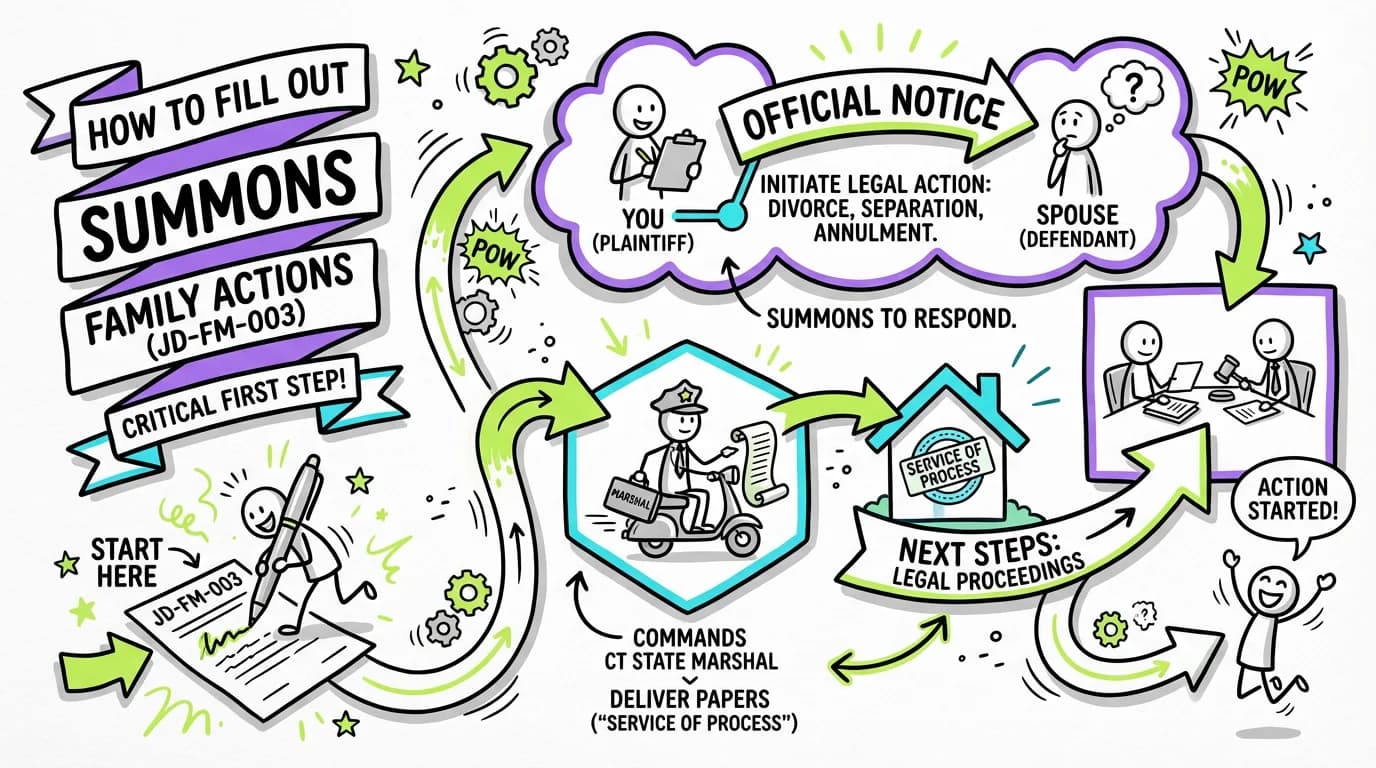
JD-FM-003 is Connecticut's family summons for starting a divorce, legal separation, or annulment case. To fill it out correctly, match it to the complaint, choose a valid Tuesday return date, list the right court and party information, sign the plaintiff sections, and build the service packet before a proper officer serves it.
What JD-FM-003 is and what it is not
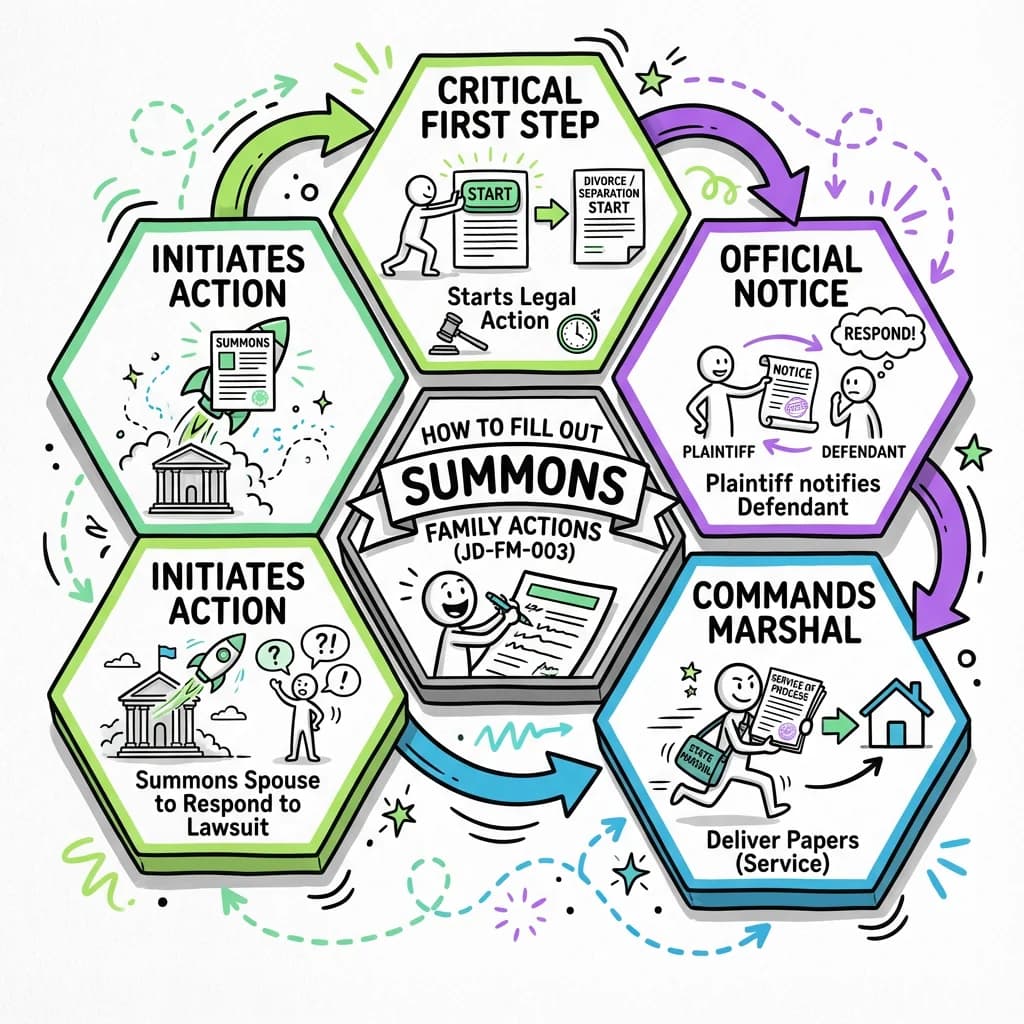
JD-FM-003, also labeled JD-FM-3 on the official form, is the Summons Family Actions form published by the Connecticut Judicial Branch. It is the notice document that tells the defendant they are being sued, identifies the court, lists the return date, and commands a proper officer to serve the summons with the attached complaint, automatic orders notice, and blank appearance form. The complaint is different: Connecticut starts a dissolution, legal separation, or annulment proceeding by service and filing of a complaint under C.G.S. § 46b-45. JD-FM-003 connects that complaint to formal service. If the summons date, court, or names do not match the complaint, the packet may look unreliable before the other spouse ever responds.
What to gather before you fill it out
Have the completed or near-final JD-FM-159 divorce complaint in front of you before typing anything onto JD-FM-003, because both forms ask for the judicial district, courthouse town, return date, party names, and party addresses. You also need the defendant's best service address, your own mailing address, phone number, and email address. The summons asks whether the plaintiff or plaintiff's attorney will accept electronic service, and the form notes that attorneys who are not exempt from e-filing must accept electronic delivery under Practice Book § 10-13. If you do not want to use your regular email address, the form says you may create a separate email account for the case. Treat these contact details as service information, not casual profile fields.
How to complete the key fields
Start with the top court section. Enter the judicial district and courthouse town that match the divorce complaint, then add the court address. Choose the case type that matches the family action, such as dissolution of marriage, legal separation, or annulment; the current JD-FM-003 form says not to use this summons for several other case types, including custody applications, visitation applications, parentage petitions, support petitions, and relief from physical abuse. Next, enter the plaintiff and defendant names exactly as they appear on the complaint, followed by the plaintiff and defendant addresses. In the plaintiff appearance section, add the mailing address, phone number, email address, electronic-service selection, signature, and date. A self-represented plaintiff also signs the certification block confirming that they read and understand the notice.
How to choose the return date
The return date is the date the case is officially in court; the JD-FM-003 defendant notice says it is not a court appearance date unless another notice says to come to court that day. The form also tells the defendant to file an appearance on or before the second day after the return date. Choose a Tuesday return date far enough away for service and filing. JD-FM-003's instructions say that, after service by a proper officer, the original papers and officer's return must be filed with the clerk at least six days before the return date. Linda Douglas, Chief Legal Officer at Untangle, recommends choosing the return date by working backward from service logistics, not by grabbing the next Tuesday that looks available.
What goes in the service packet
The summons does not travel alone. JD-FM-003's instructions say to attach the original summons to the original complaint, Notice of Automatic Court Orders JD-FM-158, and a blank Appearance JD-CL-12. The form also says to attach copies of the summons, automatic orders notice, and blank appearance to each copy of the complaint. That matches C.G.S. § 46b-45, which requires the plaintiff to have a blank appearance form served with the complaint. The automatic orders matter immediately because Practice Book § 25-5 and JD-FM-158 say those orders become effective for the plaintiff upon signing and for the defendant upon service, unless a prior contradictory court order applies.
What happens after service
After the marshal or other proper officer completes service, the officer's return and original papers must get back to the clerk at least six days before the return date listed on JD-FM-003. The return date then anchors several early events. JD-FM-003 says the court will send notice of a Resolution Plan Date approximately five days after the return date. Practice Book § 25-50A describes the Resolution Plan Date as the early Pathways event where the parties meet with Family Services, identify disputed and undisputed issues, and receive a case track or scheduling order. C.G.S. § 46b-67 also ties important timing rules, including default and contested-trial timing, to the return date.
Common mistakes to avoid
The biggest mistakes are treating JD-FM-003 like a cover sheet, picking a return date without checking the six-day filing rule, or copying party names differently from the complaint. Other problems include using the wrong courthouse town, leaving the self-represented plaintiff signature or certification blank, forgetting the blank appearance form, and serving a packet that does not include JD-FM-158. If the defendant is out of state, absent, or cannot be found, do not guess at ordinary service; C.G.S. § 46b-46 allows a judge or clerk to issue an order of notice in those situations. Fix obvious summons problems before service whenever possible, because correcting notice defects after service usually costs more time than careful packet review at the start.
Frequently Asked Questions
People who search by code usually want to know what the summons does, how the return date works, and what must be served with it. These answers focus on the practical details that most often affect whether the Connecticut divorce case starts cleanly.
Is JD-FM-003 the same thing as the divorce complaint?
No. JD-FM-003 is the summons, while JD-FM-159 is the complaint that asks the court for divorce-related relief. The summons gives notice, identifies the court, directs proper service, and sets the return date. The complaint explains the case facts and requested orders.
Why does the return date on JD-FM-003 have to be a Tuesday?
Connecticut family summonses use Tuesday return dates, and the official JD-FM-003 form has a specific return-date box for that date. The return date is not automatically a court appearance date. It is the case-opening date that drives service filing, appearance, default, and Pathways scheduling deadlines.
Do I still need a marshal if I have a signed summons?
Usually, yes. A signed summons does not replace service. JD-FM-003 commands a proper officer to serve the summons, complaint, automatic orders notice, and blank appearance. Connecticut also allows waiver of service in some dissolution, legal separation, and annulment cases if the other party signs the prescribed waiver and files an appearance.
What should be attached to JD-FM-003 before service?
Attach the complaint, JD-FM-158 Notice of Automatic Court Orders, and a blank JD-CL-12 Appearance form. JD-FM-003 says to attach the original summons to the original packet and copies to each complaint copy. Serving the full packet helps avoid notice disputes and re-service.
What if I made a mistake on JD-FM-003?
If you catch the mistake before service, correct the summons before the officer serves the packet. If service already happened, ask the clerk or a Connecticut family-law attorney how to correct the defect. Return-date, court-location, and party-name errors can affect notice and timing, so do not assume they are harmless.

Author
Linda Douglas, Esq.
Chief Legal Officer, Untangle
Linda Douglas is a Divorce and Family Attorney with 38 years of experience handling nearly 2,000 cases in Connecticut and New Hampshire. She is licensed to practice law in Connecticut and New Hampshire.
Legal citations
- JD-FM-003 Summons Family Actions
- JD-FM-159 Divorce Complaint (Dissolution of Marriage)
- JD-FM-158 Notice of Automatic Court Orders
- JD-CL-12 Appearance
- C.G.S. § 46b-45, service and filing of complaint
- C.G.S. § 46b-46, order of notice
- C.G.S. § 46b-67, time frame for court to proceed
- Connecticut Practice Book § 10-13, electronic delivery
- Connecticut Practice Book § 25-5, automatic orders
- Connecticut Practice Book § 25-50A, Pathways case management
Related guides
How to Fill Out JD-FM-003 Summons Family Actions
Use the full-title version if you want a more descriptive walkthrough of the official summons name.
How to Fill Out JD-FM-159
The divorce complaint and the summons should be drafted as one opening packet.
How to Use JD-FM-158
The automatic orders notice travels with the summons and complaint when the case begins.
How to Serve Divorce Papers in Connecticut
Use this after the summons packet is ready for formal service.
Keep exploring
Get Help
Get help with your divorce
Get guided answers, organize your paperwork, and move through Connecticut divorce with a clearer plan.