
How do I file for divorce in Connecticut?
How to file for divorce in Connecticut: 12-month residency, forms JD-FM-3, 159, 158, 164, marshal service, statutory waiting period, financial affidavits.
Quick answer: What to know first
Deciding to end a marriage is one of life's most challenging and personal choices. If you've reached this point, you're likely feeling overwhelmed and unsure about what comes next. The process to file for divorce in Connecticut is at least structured, even when it feels emotionally hard. While every family story is different, the court steps follow a predictable path.
- Quick answer
- Understanding the Basics: Legal Foundation for Divorce in CT
- Step-by-Step Process to File for Divorce in Connecticut
Get Help
Get help with your divorce
Get guided answers, organize your paperwork, and move through Connecticut divorce with a clearer plan.
In this guide
- Quick answer
- Understanding the Basics: Legal Foundation for Divorce in CT
- Step-by-Step Process to File for Divorce in Connecticut
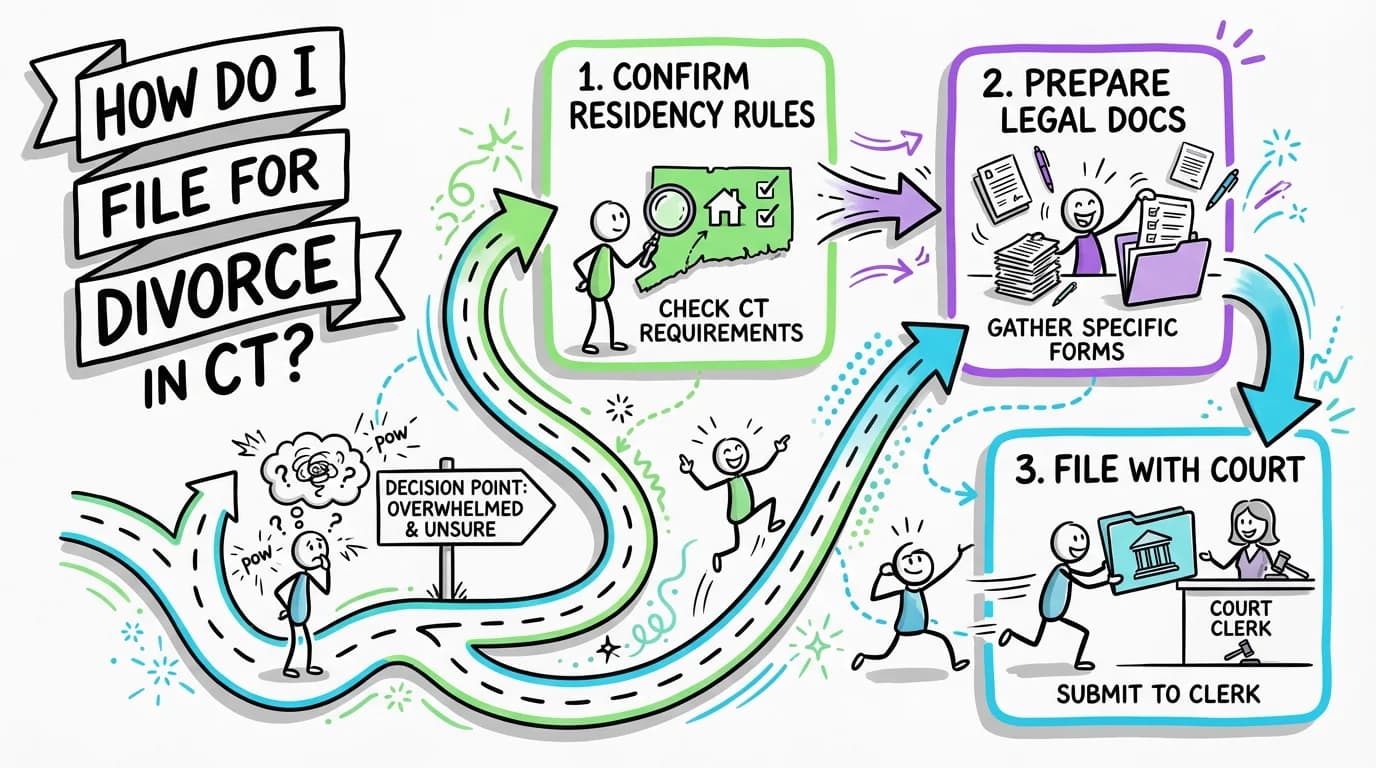
Deciding to end a marriage is one of life's most challenging and personal choices. If you've reached this point, you're likely feeling overwhelmed and unsure about what comes next. The process to file for divorce in Connecticut is at least structured, even when it feels emotionally hard. While every family story is different, the court steps follow a predictable path.
Quick answer
To file for divorce in Connecticut: (1) confirm you meet the 12-month residency rule under C.G.S. § 46b-44; (2) prepare Forms JD-FM-3 (Summons), JD-FM-159 (Complaint), JD-FM-158 (Automatic Orders), and JD-FM-164 (Affidavit Concerning Children) if minor children are involved; (3) file with the Superior Court clerk and pay the filing fee; (4) have a State Marshal serve your spouse; and (5) wait the statutory period set by C.G.S. § 46b-67 before judgment can enter. Most uncontested filings resolve 30–90 days after the return date.
The basic process involves confirming you meet Connecticut's residency rules, preparing a set of specific legal documents, filing them with the correct Superior Court, and formally notifying your spouse. From there, your path will depend on whether you and your spouse agree on the major issues (an uncontested divorce) or have disagreements that need to be resolved by the court (a contested divorce).
This guide will walk you through each step of initiating a divorce in Connecticut, explaining the key requirements and what you can expect along the way. We'll break down the legal jargon into plain English to help you feel more in control during this difficult time.
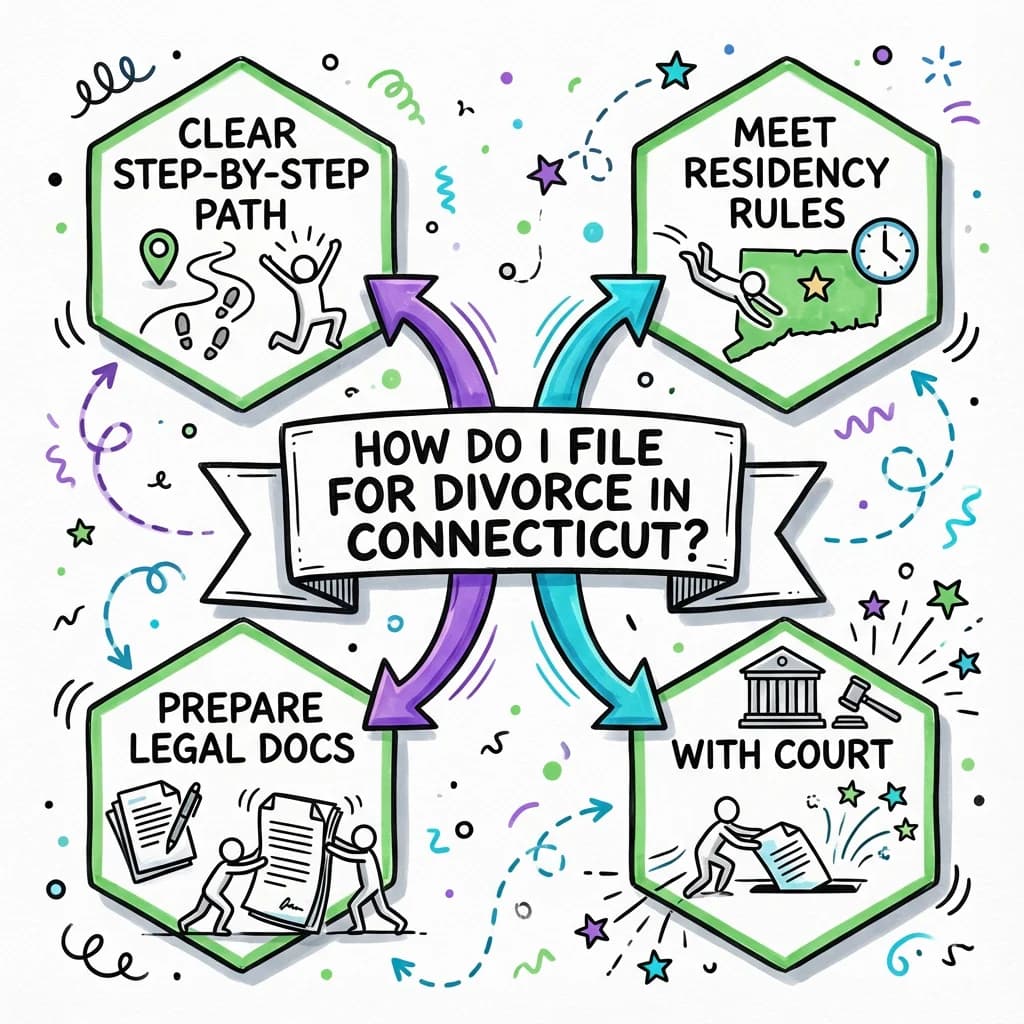
Understanding the Basics: Legal Foundation for Divorce in CT
Before diving into the paperwork, it’s helpful to understand a few core concepts that govern how to get divorced in Connecticut. The legal term for divorce in the state is "dissolution of marriage," but we'll use the more common term "divorce" here.
These basics matter because the filing paperwork asks you to make several legal choices immediately, including your ground for divorce, whether children are involved, and whether Connecticut has jurisdiction. Linda Douglas, Chief Legal Officer at Untangle, recommends understanding the legal framework first so your first filing is accurate and you do not lose time correcting avoidable paperwork or service mistakes.
Connecticut is a "No-Fault" Divorce State
The most important thing to know is that Connecticut is primarily a "no-fault" state. This means you do not have to prove that your spouse did something wrong to cause the end of the marriage. The vast majority of people who file for divorce in Connecticut do so on the grounds that the marriage has "broken down irretrievably" (C.G.S. § 46b-40(c)(1)). This simply means there is no reasonable hope of reconciliation.
While the law does list fault-based grounds like adultery or willful desertion, they are rarely used to start a case. The court will, however, consider the causes of the breakdown when making decisions about alimony and property division (C.G.S. § 46b-81 and C.G.S. § 46b-82).
The Residency Requirement
You can't file for divorce in Connecticut just because you want to. The state must have jurisdiction, or legal authority, over your marriage. To get divorced in Connecticut, you must meet the state's residency requirement.
According to Connecticut law (C.G.S. § 46b-44(c)), a divorce decree can be granted if:
- One of the parties has been a resident of Connecticut for at least the 12 months before filing the complaint or before the final divorce decree is issued; OR
- One of the parties was living in Connecticut at the time of the marriage and returned with the intention of staying permanently before filing the complaint; OR
- The reason the marriage broke down happened after either you or your spouse moved to Connecticut.
The 12-month rule is the most common way people meet this requirement. As long as one of you has lived here for a year, you can file for divorce in Connecticut.
Step-by-Step Process to File for Divorce in Connecticut
Once you've confirmed you meet the residency requirement, you can begin the formal process of initiating a divorce. Here is a step-by-step guide.
The easiest way to think about filing is that you are opening a court case, not finishing one. The complaint, summons, and service papers start the process, and the later stages are what determine whether the case resolves by agreement, mediation, default, or trial. Keeping that distinction in mind makes the timeline and the required forms much easier to follow.
Step 1: Prepare the Initial Paperwork
Starting a divorce requires filling out several specific legal forms. These documents tell the court who you are, who your spouse is, and what you are asking for. The primary forms include:
- Summons (Form JD-FM-3): This is an official notice to your spouse that you have started a divorce action. It tells them they need to respond by a specific date, known as the "Return Date."
- Divorce Complaint (Form JD-FM-159): This is the core document that starts the divorce. It provides the court with basic information, such as the date and place of your marriage, the names and birthdates of any minor children, and the legal grounds for the divorce (usually "irretrievable breakdown"). According to the Connecticut Practice Book § 25-2, this document must state these jurisdictional facts.
- Notice of Automatic Court Orders (Form JD-FM-158): This is a critical document. In Connecticut, as soon as a divorce is filed and served, a set of automatic orders goes into effect for both spouses. We'll discuss these in more detail below.
- Affidavit Concerning Children (Form JD-FM-164): If you and your spouse have minor children together, you must file this form. It provides the court with information required under state and federal law to make decisions about custody (Practice Book § 25-57).
Step 2: File the Documents with the Court
After you have completed the initial paperwork, you will take it to the Superior Court clerk's office in the judicial district where you or your spouse lives (C.G.S. § 46b-45(a)). You will need to pay the required court filing fee at this time. The clerk will sign your Summons, assign a docket number to your case, and give you back the documents. At that point, you have opened the case, but you still must complete service correctly before the matter can move forward in a normal way.
Step 3: Serve Your Spouse (Service of Process)
You cannot just hand the papers to your spouse yourself. The law requires formal "service of process" to ensure your spouse has officially received notice of the divorce.
- Using a State Marshal: The standard method is to hire a Connecticut State Marshal to deliver the documents to your spouse. The marshal will complete a "Return of Service" document and file it with the court to prove that service was completed.
- Waiver of Service: If your divorce is amicable and your spouse agrees to cooperate, they can sign a Waiver of Service form (C.G.S. § 46b-45(b)). This allows them to accept the divorce papers without needing a marshal, which can save time and money. The responding spouse must also file an "Appearance" form with the court to show they are participating in the case.
Step 4: The Waiting Period
Connecticut no longer uses a single 90-day waiting period for every divorce. Under C.G.S. § 46b-67(a), the minimum timing depends on how the case is moving:
- Full agreement: When both spouses reach a complete written agreement, the case can usually move more quickly than the contested-trial timeline once the agreement and required papers are before the court.
- Default after personal or abode service: A default judgment cannot enter until at least 30 days after the return date.
- Service by publication or another nonpersonal method: Requires a hearing at least 60 days after the return date.
- Contested trial: Cannot begin until at least 90 days after the return date.
Even when the statute allows a case to move sooner, most divorces still take longer because the parties need to exchange financial information, complete any required parenting class, and resolve remaining custody or financial disputes.
Step 5: Exchange Financial Information
Both spouses are required to provide a complete and honest picture of their financial situation. This is done using a financial statement (also called a Financial Affidavit).
Under Practice Book § 25-5(c), each party must exchange a sworn financial statement within 30 days of the return date. This document details your income, expenses, assets (like bank accounts, real estate, retirement funds) and liabilities (like mortgages, car loans, credit card debt). This is one of the most important documents in your divorce, as the court will use it to make decisions about property division and alimony.
Important Considerations When Filing for Divorce
These issues do not always stop a filing, but they shape what happens right after the complaint is served. In many cases, the first practical problems are not about whether the court accepted the paperwork. They are about whether either spouse is violating the automatic orders, whether the case qualifies for a simpler path, and whether children create additional course or scheduling requirements. Those details often influence the early pace of the case and its cost.
The Automatic Orders
As mentioned in Step 1, a set of automatic court orders goes into effect the moment you file for divorce in Connecticut. These orders are designed to keep the situation stable while the divorce is pending. According to Practice Book § 25-5, these orders prohibit both you and your spouse from:
- Selling, hiding, or borrowing against property without the other's consent, except for usual expenses or legal fees.
- Removing your children from the state of Connecticut.
- Taking your spouse or children off existing health insurance policies.
- Changing beneficiaries on life insurance policies.
- Incurring unreasonable new debts.
The complaint you file must include a warning that states: "Failure to obey these orders may be punishable by contempt of court." It is crucial that you understand and follow these rules from day one.
The "Nonadversarial" Divorce Option
For couples with very simple situations, Connecticut offers a streamlined process called a nonadversarial divorce. This is an even faster and simpler path than a standard uncontested divorce, but you must meet very strict criteria.
Under C.G.S. § 46b-44a, you may be eligible if you and your spouse attest that:
- The marriage is nine years or less in duration.
- Neither party is pregnant.
- You have no children together.
- You do not own any real estate.
- The total value of all your property is less than $80,000.
- Neither party has a defined benefit pension plan.
- There are no active restraining or protective orders between you.
If you meet all these conditions, you can file a joint petition and may be able to get divorced in as little as 30 days without ever having to appear in court.
The Mandatory Parenting Education Program
If you have minor children, Connecticut law requires both parents to attend a parenting education program (C.G.S. § 46b-69b). This program is designed to help parents understand the impact of divorce on children and learn strategies for effective co-parenting. You must complete this six-hour course within 60 days of the return date. Missing the requirement can slow the case down and create unnecessary friction with the court, so it is worth scheduling early instead of treating it like an afterthought.
Frequently Asked Questions About Filing for Divorce in CT
These are the questions people usually ask after they understand the filing sequence but before they decide whether to handle the case themselves or get legal help. The answers often turn on the difference between opening the case and finishing it. Filing can be quick; resolving service, financial disclosure, and settlement is what usually determines how hard the case becomes. That distinction helps set realistic expectations early for most filers in Connecticut family court every year.
How long does it take to file for divorce in Connecticut?
The act of filing the initial paperwork can be done in a day, but finishing the case takes longer. Under C.G.S. § 46b-67, spouses with a full agreement can usually move faster than contested cases, default cases usually have a 30-day or 60-day minimum depending on service, and contested trials cannot begin until at least 90 days after the return date. Complex cases often take many additional months.
How much does it cost to file for divorce in Connecticut?
The costs can vary significantly. There are fixed costs, such as the court filing fee and the state marshal's fee for serving the papers. Beyond that, the total cost depends on the complexity of your case and whether you hire an attorney. An amicable, uncontested divorce will usually cost far less than a contested case that requires repeated motions, financial discovery, parenting disputes, or trial preparation. Attorney involvement changes the budget quickly in contested cases.
Do I need a lawyer to file for divorce in Connecticut?
You are not legally required to have a lawyer. You can represent yourself, which is called appearing pro se. However, divorce law is complex, and the decisions you make can affect property rights, parenting orders, retirement assets, and support obligations for years. Even if you plan to handle the filing yourself, it is often wise to get at least a limited consultation if children, real estate, or significant finances are involved. Early advice can prevent expensive mistakes.
What are the "automatic orders" I keep hearing about?
The automatic orders are a set of rules that immediately apply to both you and your spouse once a divorce is filed and served. As outlined in Practice Book § 25-5, they are designed to prevent either person from making major changes to finances or the children's lives while the case is ongoing. They automatically restrict actions like selling assets, changing insurance, or moving the children out of state. Violating them can create contempt issues before the main divorce questions end.
Can I get divorced in CT if my spouse lives in another state?
Yes. As long as you meet Connecticut's residency requirement under C.G.S. § 46b-44, you can file for divorce here even if your spouse lives elsewhere or has never lived in Connecticut. You still need to complete service correctly and may need to think separately about whether Connecticut has personal jurisdiction to enter certain financial orders against an out-of-state spouse, but the divorce itself can often still be filed here. Jurisdiction questions can still affect money issues.
What is a "no-fault" divorce?
A "no-fault" divorce means you do not have to prove adultery, cruelty, abandonment, or another specific wrong to end the marriage. The court only needs to find that the marriage has broken down irretrievably under C.G.S. § 46b-40(c)(1), with no reasonable chance of reconciliation. That is why no-fault is used in the overwhelming majority of Connecticut divorces, even when the relationship ended for painful and disputed reasons. It keeps the filing process simpler.
What if my spouse and I agree on everything?
If you and your spouse agree on all issues—property division, alimony, and a parenting plan (if you have children)—you can proceed with an uncontested divorce. You will still need to file the initial paperwork and your financial statements, but you can submit a written settlement agreement to the court. If the judge finds the agreement is fair and equitable, it can be approved and become the final judgment, often making the process much faster and less stressful.
Do I have to live in Connecticut to file for divorce there?
Yes, at least one spouse must satisfy C.G.S. § 46b-44(c). The most common path is the 12-month rule: one spouse has lived in Connecticut for at least the year before filing or before the final decree. You also qualify if one spouse lived in Connecticut at the time of the marriage and returned intending to stay, or if the cause of the breakdown arose after either spouse moved to Connecticut.
What happens if my spouse won't sign the divorce papers?
You do not need your spouse's signature to get divorced in Connecticut. Once the Summons and Complaint are properly served by a State Marshal, the case moves forward even if your spouse ignores it. If no Appearance is filed by the return date, you can pursue a default judgment under the 30-day minimum in C.G.S. § 46b-67. See our detailed walkthrough of the Connecticut default divorce process.
Can I file for divorce online in Connecticut?
Connecticut allows electronic filing of most family matters through the Judicial Branch's E-Services portal, but you must first open the case with a paper Summons and Complaint and arrange marshal service. Self-represented filers can use the Judicial Branch self-help center for the current forms, and Untangle's guided form tools can help you prepare the JD-FM-3, 159, 158, and 164 packet before you file.
Getting Help
Navigating the Connecticut divorce process can be daunting, but you don't have to do it alone. This article provides general information, but it is not a substitute for legal advice tailored to your specific situation. The decisions made during your divorce will affect your future for years to come.
An experienced Connecticut family law attorney can help you understand your rights, protect your interests, and guide you toward the most efficient and effective resolution possible. If you are considering whether to file for divorce in Connecticut, we encourage you to schedule a consultation to discuss your options.
Conclusion
To file for divorce in Connecticut, you must meet the residency requirements, prepare and file the correct legal forms with the Superior Court, and ensure your spouse is properly served. From there, the path your divorce takes will depend on your ability to cooperate and reach agreements on key issues. Understanding the process, from the initial paperwork and automatic orders to the post-return-date timing rules and financial disclosures, can empower you to move forward with confidence. Remember to be patient with yourself and seek out the professional support you need to navigate this transition successfully.

Author
Linda Douglas, Esq.
Chief Legal Officer, Untangle
Linda Douglas is a Divorce and Family Attorney with 38 years of experience handling nearly 2,000 cases in Connecticut and New Hampshire. She is licensed to practice law in Connecticut and New Hampshire.
Legal citations
- Practice Book § 25-2
- Practice Book § 25-5
- Practice Book § 25-57
- C.G.S. § 46b-40 (Grounds for dissolution of marriage)
- C.G.S. § 46b-44 (Residency requirement)
- C.G.S. § 46b-44a (Nonadversarial Dissolution of Marriage)
- C.G.S. § 46b-45 (Service and Filing of Complaint)
- C.G.S. § 46b-67 (Time Frame for Court to Proceed)
- C.G.S. § 46b-69b (Parenting Education Program)
- C.G.S. § 46b-81 (Assignment of Property)
- C.G.S. § 46b-82 (Alimony)
Related guides
What happens when a CT spouse won't respond to a divorce
For the procedural path when service is complete but no Appearance is filed
Alimony in Connecticut — factors under §46b-82
For how Connecticut courts decide alimony after a divorce is filed
Property division in Connecticut under §46b-81
For the equitable-distribution factors that apply once the case is pending
Grounds for divorce in Connecticut
For the no-fault and fault-based grounds you choose on the Complaint
How to fill out JD-FM-159 (Divorce Complaint)
For how to complete the Complaint that starts the dissolution case
How much does it cost to file for divorce in Connecticut
For the current Superior Court filing fee and marshal service ranges
Keep exploring
Get Help
Get help with your divorce
Get guided answers, organize your paperwork, and move through Connecticut divorce with a clearer plan.