
How to Get an Emergency Ex Parte Custody Order in Connecticut (C.G.S. 46b-56f)
Learn about how to Get an Emergency Ex Parte Custody Order in Connecticut (C.G.S. § 46b-56f). Covers key legal steps, forms, timelines, and requirements.
Quick answer: What to know first
When you believe your child is in immediate danger, every second counts. The fear and helplessness can be overwhelming, and navigating the legal system in a crisis feels impossible. In Connecticut, the law provides a powerful but specific tool for these dire situations: the Emergency Ex Parte Order of Custody.
- What is an Emergency Ex Parte Custody Order?
- The Legal Standard: "Immediate and Present Risk" Under C.G.S. § 46b-56f
- Step-by-Step Guide to Filing for an Emergency Ex Parte Custody Order
Get Help
Get help with your divorce
Get guided answers, organize your paperwork, and move through Connecticut divorce with a clearer plan.
In this guide
- What is an Emergency Ex Parte Custody Order?
- The Legal Standard: "Immediate and Present Risk" Under C.G.S. § 46b-56f
- Step-by-Step Guide to Filing for an Emergency Ex Parte Custody Order
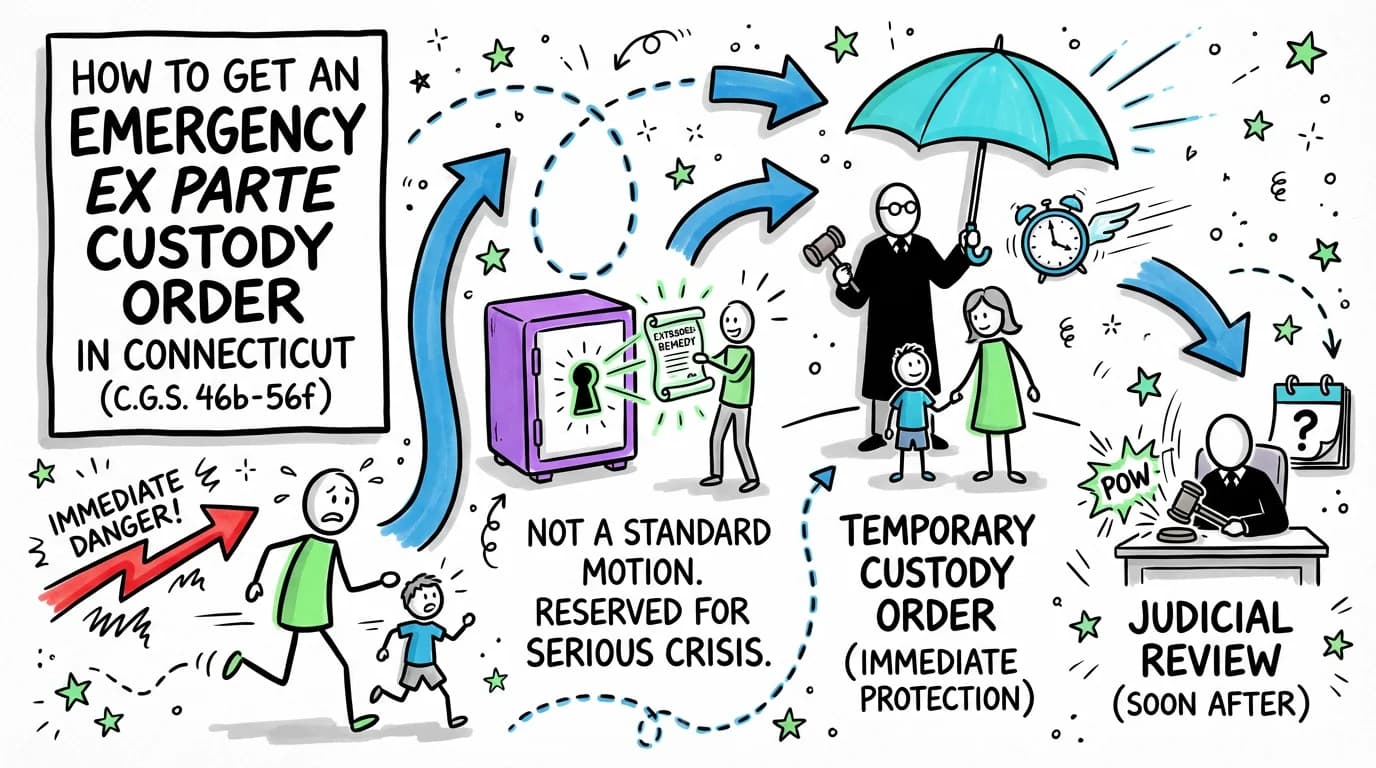
When you believe your child is in immediate danger, every second counts. The fear and helplessness can be overwhelming, and navigating the legal system in a crisis feels impossible. In Connecticut, the law provides a powerful but specific tool for these dire situations: the Emergency Ex Parte Order of Custody.
This is not a standard custody motion. It is an extraordinary remedy reserved for the most serious circumstances, allowing a parent to get a temporary custody order from a judge immediately, without the other parent being present or even notified beforehand.
This comprehensive guide will walk you through the entire process of seeking an ex parte custody ct order. We will explain the extremely high legal standard you must meet, detail how to draft the critical affidavit that forms the basis of your request, and prepare you for what happens after you file. Understanding these steps is crucial for protecting your child when they need it most.
You will learn:
- What an Emergency Ex Parte Custody Order is and when it is appropriate.
- The precise legal standard of "immediate and present risk" under Connecticut General Statutes (C.G.S.) § 46b-56f.
- A step-by-step guide to filing the necessary court forms, including the Application for Emergency Ex Parte Order of Custody (JD-FM-200).
- How to write a compelling, fact-based affidavit that meets the court's strict requirements.
- What to expect during the judge's initial review and the critical follow-up hearing.
- Common mistakes that can cause your emergency motion to be denied.
While our main guide on how to get divorced in CT covers the standard process for determining custody, this article focuses exclusively on the emergency steps you can take when you believe there is an immediate physical danger to your child in CT.
What is an Emergency Ex Parte Custody Order?
The term "ex parte" is Latin for "from one party." In a legal context, it means the court is hearing from and making a decision based on the request of only one side of a dispute.
An Emergency Ex Parte Custody Order is a temporary court order that grants one parent sole legal and/or physical custody of a child on an immediate, emergency basis. The defining feature is that a judge can issue it without the other parent being present or having an opportunity to respond first.
The court system is built on the principle of due process, which means both parties have a right to be heard. An ex parte order temporarily suspends that right for the other parent because the risk of harm to the child is so severe that waiting for a standard hearing is not an option.
It is crucial to distinguish this from a standard temporary custody order:
- Standard Temporary Custody Motion: A parent files a motion, serves it on the other parent, and the court schedules a hearing where both parents can present evidence and arguments before a judge makes a decision. This process can take several weeks or months.
- Emergency Ex Parte Custody Motion: A parent files a motion and a sworn affidavit. A judge reviews the documents immediately. If the high legal standard is met, the judge grants a temporary order that day. A hearing with both parents is then scheduled very quickly (usually within 14 days) to review the decision.
Because it is such a drastic measure, judges scrutinize these requests with extreme care. Filing an emergency motion for custody in CT should be reserved for true emergencies only.
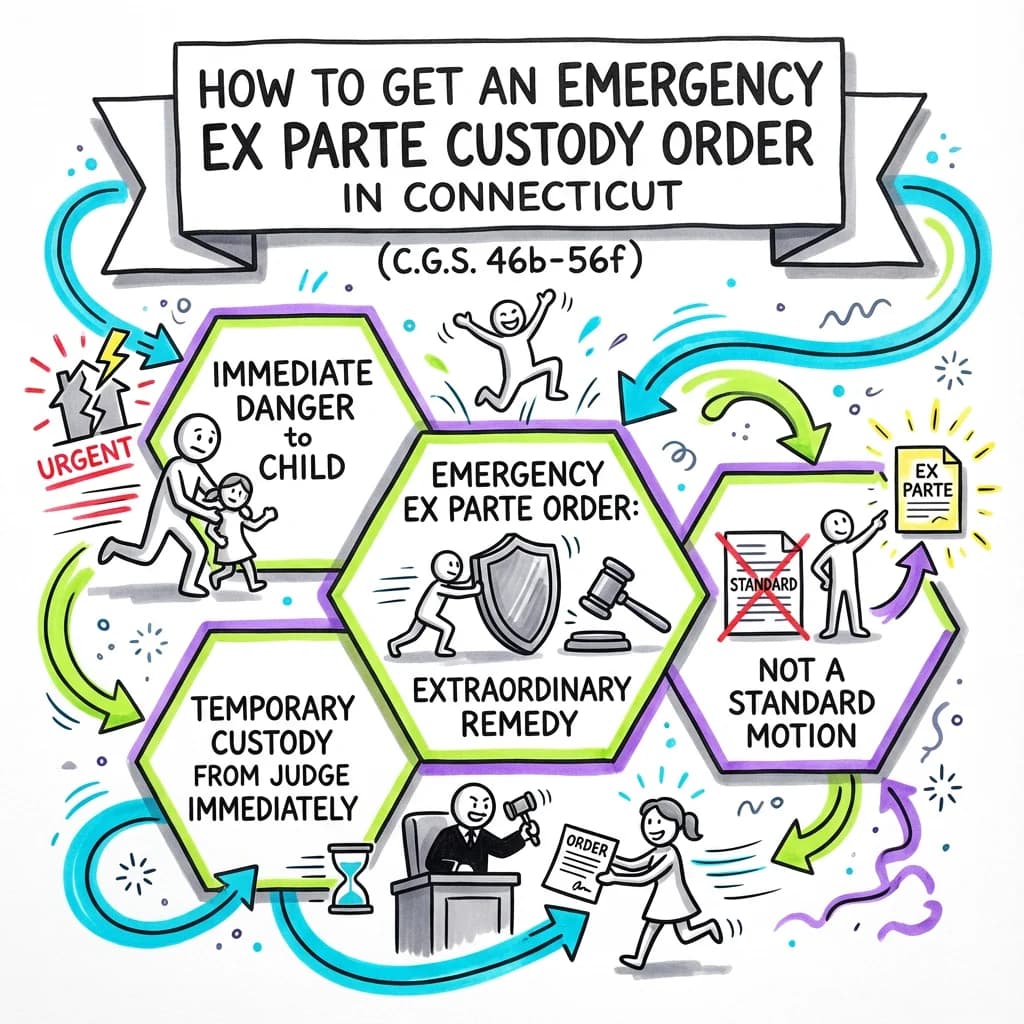
The Legal Standard: "Immediate and Present Risk" Under C.G.S. § 46b-56f
The entire foundation of your request rests on a specific legal standard defined in Connecticut General Statutes § 46b-56f. The statute explicitly states that a judge may grant an ex parte custody order only if there is a sworn affidavit alleging that "there is an immediate and present risk of physical danger or psychological harm to the child."
Let's break down what this means in practical terms. Courts read this language narrowly because the order is granted before the other parent can respond.
What Constitutes "Immediate and Present Risk"?
The key words are immediate and present. This means the danger is happening now, is about to happen, or is ongoing. A past incident, while concerning, may not be enough unless you can demonstrate it is part of a pattern that creates a current risk.
Examples of Physical Danger:
The court is most likely to grant an order based on a clear and present risk of physical harm. This is the most straightforward part of the statute to prove.
- Physical or Sexual Abuse: Documented or credibly alleged instances of the other parent physically or sexually harming the child.
- Severe Substance Abuse: The other parent's active, uncontrolled drug or alcohol addiction creates a dangerous environment (e.g., driving with the child while intoxicated, leaving drugs accessible, passing out and leaving the child unsupervised).
- Serious Mental Health Crisis: The other parent is experiencing a severe, untreated mental health episode that causes them to behave erratically, make threats, or be unable to care for the child safely.
- Exposure to Domestic Violence: The other parent has been violent towards you or others in the child's presence, creating a risk of the child being caught in the crossfire or directly harmed.
- Credible Threats of Harm or Abduction: The other parent has made specific, believable threats to harm the child or flee the state or country with them.
- Extreme Neglect: Leaving a very young child home alone for extended periods, failing to provide necessary food or medical care for a serious condition, or keeping the child in a dangerously unsanitary or unsafe home (e.g., no heat in winter, exposed wiring, presence of dangerous individuals).
What Constitutes "Psychological Harm"?
Proving an immediate risk of psychological harm is more challenging. The harm must be severe and demonstrable, not just a matter of parental disagreement or poor choices.
- Extreme Emotional Abuse: A pattern of terrorizing, isolating, or corrupting the child. For example, consistently telling a child they are worthless, threatening to harm the child's pet to control them, or forcing the child to participate in criminal activity.
- Direct Exposure to Traumatic Events: Forcing a child to witness severe domestic violence or other brutal acts.
- Coaching a Child to Make False Allegations: This can be seen as a severe form of psychological manipulation that puts the child in an untenable position.
What Does NOT Meet the Standard?
It is equally important to understand what judges will likely not consider an immediate and present risk warranting an ex parte order. Filing a motion for these reasons can damage your credibility with the court.
- Disagreements on Parenting: Arguments over bedtime, diet, screen time, or discipline methods.
- A New Romantic Partner: Disliking the other parent's new boyfriend or girlfriend is not enough, unless that specific individual has a documented history of violence or poses a direct threat to the child.
- General Instability: The other parent moving frequently or having financial trouble, without more, is not an immediate danger.
- Refusal to Communicate: The other parent being difficult, uncooperative, or refusing to co-parent effectively is a matter for a standard custody motion, not an emergency one.
- Past, Isolated Incidents: An incident of concern that happened six months ago with no subsequent issues is unlikely to be seen as an "immediate and present" risk.
The court's primary goal is to prevent imminent harm. If your situation does not rise to that level, you should pursue a standard temporary custody order in Connecticut instead.
Step-by-Step Guide to Filing for an Emergency Ex Parte Custody Order
Emergency custody requests move quickly, but they still succeed or fail on preparation. The judge is not investigating for you, and the clerk is not allowed to turn vague fears into admissible facts. Your job is to present a complete, credible packet that shows why the danger is immediate, what order you want entered, and why the court must act before ordinary notice procedures can run. The steps below are designed to help you build that packet in the right order.
If you are certain your child is in immediate danger, you must act quickly and precisely. Follow these steps carefully.
Step 1: Obtain and Draft the Correct Forms
The primary form for this action is the JD-FM-200, Application for Emergency Ex Parte Order of Custody. This two-page form is where you formally ask the judge to grant you temporary custody.
You will also need to draft an Affidavit. This is not a standard court form but a document you create yourself. It is the single most important part of your application. (More on this in Step 2).
Depending on your situation, you may need other forms:
- If you are starting a new divorce or custody case, you will also need a Summons (JD-FM-3) and a Divorce/Custody Complaint (JD-FM-159 or JD-FM-160).
- You will also need to complete an Affidavit Concerning Children (JD-FM-164).
Step 2: Write a Powerful, Fact-Based Affidavit
An affidavit is a written statement of facts that you swear under oath is true. The judge will decide whether to grant your emergency order based solely on what is written in your affidavit. It must be compelling, specific, and factual. Think of it as the evidence packet that must persuade the judge without live testimony from you at the first stage. At the ex parte review, the affidavit is the court's only window into the emergency.
Structure the Affidavit in Numbered Paragraphs
- Title: Start with the case name, docket number (if you have one), and the title "AFFIDAVIT IN SUPPORT OF APPLICATION FOR EMERGENCY EX PARTE ORDER OF CUSTODY."
- Introduction: Begin with "I, [Your Name], being duly sworn, depose and say:"
- Numbered Paragraphs: Lay out your facts in separate, numbered paragraphs. This makes it easy for the judge to read and reference.
- Stick to the Facts: Your affidavit is not the place for opinions, feelings, or speculation. Every sentence should describe a factual event.
- Be Specific (Who, What, When, Where, Why): Vague allegations are useless. Provide concrete details.
This structure matters because the judge needs to see a clean timeline immediately. Numbered paragraphs also make it easier to attach exhibits, point to recent incidents, and show exactly why the risk is current rather than historical. If your affidavit jumps around, mixes arguments with facts, or never identifies who saw what and when, the court may conclude that the emergency is not proven even if the underlying situation is serious.
Use Facts, Not Conclusions
The most common affidavit mistake is substituting labels for evidence. Saying the other parent is "dangerous," "unstable," or "an alcoholic" does not tell the judge what happened. Instead, describe dates, statements, physical observations, injuries, police involvement, or medical treatment. Concrete facts help the judge connect the events to the statute and see why an order is needed before the next parenting contact.
-
BAD (Vague and Emotional): "The father is an alcoholic and a danger to our son. He is always drunk and I am scared for my child's safety. He is an unfit parent."
- This is ineffective because it is opinion, not evidence.
-
GOOD (Specific and Factual):
- "On Friday, June 7, 2024, at approximately 6:00 PM, the child's father, John Smith, was scheduled to pick up our 7-year-old son, Michael, from my home at 123 Main Street, Hartford, CT."
- "When Mr. Smith arrived, I observed that his speech was slurred, he was unsteady on his feet, and I smelled a strong odor of alcohol on his breath."
- "I refused to let Michael get in the car. Mr. Smith became belligerent and shouted, 'I'll drive with my son if I want to!' before getting into his car and speeding away."
- "At 8:15 PM that same evening, I received a phone call from the Connecticut State Police. Trooper Davis informed me that Mr. Smith had been arrested for DUI after being involved in a single-car accident. A copy of the police report is attached as Exhibit A."
- "Mr. Smith's next scheduled parenting time is this Friday, June 14, 2024. Based on his behavior and recent arrest, I believe he presents an immediate and present risk of physical danger to our son if he is allowed to exercise his parenting time."
Final Affidavit Checks Before Filing
- Focus on Recent Events: Prioritize events from the last few days or weeks that demonstrate the immediate nature of the threat.
- Attach Exhibits: If you have photos, text messages, emails, police reports, or medical records that support your claims, refer to them in the affidavit and attach them as numbered or lettered exhibits.
- Explain the "Why Now": Clearly connect the facts to the legal standard. Explain why these facts mean the child is in danger right now.
- Sign and Swear: You must sign the affidavit in front of a notary public or a court clerk, swearing that the contents are true to the best of your knowledge. Lying in an affidavit is perjury, a serious crime.
Those final checks are more than formatting. They show the court that you understand how extraordinary the remedy is and that you are not filing casually. A clean affidavit with attached proof, a clear explanation of the immediate risk, and a properly notarized signature gives the judge something concrete to act on. A rushed affidavit full of general fears often gets converted into a regular motion instead of producing same-day relief.
Step 3: File the Paperwork with the Court Clerk
Once your Application and Affidavit are complete, take them to the clerk's office at the Superior Court that handles family matters for your town.
- Inform the clerk that you are filing an Application for an Emergency Ex Parte Order of Custody.
- The clerk will review your paperwork to ensure it's complete.
- They will take the documents and immediately deliver them to a judge for review. This is often called a "chambers review."
You will need to wait at the courthouse while the judge reviews your application. This can take anywhere from a few minutes to a few hours.
Step 4: The Judge's Initial Review
The judge will read your Application and, most importantly, your Affidavit. They will not hear from you or the other parent at this stage. Their decision will be based entirely on the written words you provided.
There are two possible outcomes.
Outcome 1: The Emergency Motion is GRANTED
If the judge agrees that your affidavit establishes an "immediate and present risk of physical danger or psychological harm," they will sign the order.
- The Order: The order will grant you temporary sole custody and will likely specify that the other parent is to have no contact with the child until the court hearing.
- The Hearing: The judge will immediately schedule a hearing. By law, this hearing must take place within 14 days.
- Service of Process: You are now responsible for having a State Marshal serve the other parent. The marshal must deliver a copy of your Application, your Affidavit, the signed Judge's Order, and the Notice of Hearing to the other parent. This officially notifies them of the situation and commands them to appear in court. This step is not optional. The follow-up hearing cannot proceed unless the other parent has been properly served.
Outcome 2: The Emergency Motion is DENIED
If the judge does not believe your affidavit meets the high legal standard, they will deny the ex parte request.
- This does not mean your case is over.
- The judge will typically "convert" your emergency motion into a standard motion for temporary custody.
- The court will schedule a regular hearing date, likely several weeks or months away.
- You will still need to have the other parent served with the motion and the notice of the future hearing date. The difference is that no emergency orders are in place in the meantime.
Preparing for the Follow-Up Hearing
Whether your motion was granted or denied, the follow-up hearing is where the real battle often takes place. This is the other parent's opportunity to respond to your allegations. You must be prepared.
What to Expect at the Hearing:
- Both Parties Present: Unlike the initial review, both you and the other parent (and your attorneys, if you have them) will be in court.
- Testimony and Evidence: The judge will hear testimony from both of you. The other parent will have the chance to deny your allegations and present their own version of events. You should be prepared to testify under oath and be cross-examined by the other parent or their attorney.
- Witnesses: You can bring witnesses who have firsthand knowledge of the events described in your affidavit.
- The Judge's Decision: After hearing from both sides, the judge will make a decision on temporary custody moving forward. The judge may:
- Uphold the Order: Keep the ex parte order in place as a temporary order.
- Modify the Order: Change the terms, perhaps allowing supervised visitation for the other parent.
- Vacate the Order: Cancel the ex parte order if they believe the danger was not proven, returning to the previous custody arrangement.
- Appoint Professionals: The judge may appoint a Guardian Ad Litem (GAL) or an Attorney for the Minor Child (AMC) to represent the child's best interests and investigate the situation. They may also order substance abuse evaluations, psychological assessments, or participation in parenting programs.
Common Mistakes to Avoid
Filing an emergency motion is a high-stakes action. Avoid these common pitfalls that can undermine your case and your credibility.
- Exaggerating or Lying in the Affidavit: This is the cardinal sin. If a judge discovers you have been untruthful, your entire case will be compromised. You will lose all credibility, and it could severely impact the final outcome of your custody case.
- Using the Motion for Tactical Advantage: Judges are experts at spotting when a parent is using an "emergency" motion to gain leverage in a divorce, to retaliate against an ex-partner, or to prevent the child from seeing a new romantic partner. This abuse of the process will backfire spectacularly.
- Being Vague: Failing to provide specific dates, times, locations, and factual details will result in a denial. The judge cannot connect the dots for you.
- Delaying Action: If the "emergency" event happened a month ago and you did nothing, it's hard to argue the risk is "immediate and present." You must act as soon as you become aware of the danger.
- Forgetting to Serve the Other Parent: If the judge grants your order, the case stalls until you have a State Marshal properly serve the other parent. This is your responsibility.
Frequently Asked Questions About Emergency Custody Orders in Connecticut
Parents considering an ex parte filing usually have the same practical concerns: whether the danger is serious enough, how quickly the judge will act, and what happens if the request is denied. Those questions matter because emergency custody is not just a faster version of an ordinary motion. It is a narrow procedure built for urgent risk. The answers below help separate true emergencies from situations that still need court intervention but belong on the normal temporary-custody track.
Is an emergency ex parte custody order available for any custody dispute?
No. Connecticut reserves ex parte custody orders for situations involving an immediate and present risk of physical danger or psychological harm to the child under C.G.S. § 46b-56f. Ordinary disagreements about schedules, parenting style, or communication problems usually do not qualify. If the problem is serious but not truly imminent, the court may convert your filing into a regular motion for temporary custody rather than issuing same-day emergency relief without hearing from the other parent first.
How quickly will the other parent get a hearing if the order is granted?
Very quickly. If the judge signs the emergency order, the court must schedule a prompt follow-up hearing, usually within fourteen days. That hearing is the other parent's chance to challenge your allegations, present their own evidence, and argue that the order should be changed or dissolved. Because the timeline is short, you should start preparing for that hearing immediately after filing, not assume the emergency order will remain in place without further proof at that hearing.
What happens if the judge denies the ex parte request?
Denial of the emergency request does not necessarily end the case. In many situations, the judge will treat the filing as a standard motion for temporary custody and set a regular hearing where both parents can be heard. You still may obtain court protection, just not on an immediate ex parte basis. A denial usually means the affidavit did not prove a present emergency, not that the court decided the underlying parenting concerns are irrelevant.
Do I need a lawyer to file an emergency custody motion?
You can file on your own, but legal help is strongly recommended. Emergency custody motions require you to match a very specific statute with accurate forms, a properly sworn affidavit, and fast follow-up service on the other parent. Small drafting mistakes can undermine a legitimate emergency by making the facts sound vague or stale. If a lawyer is not immediately available, getting even a short consultation before filing can materially improve the quality of the paperwork.
Summary and Next Steps
Seeking an emergency ex parte custody order is one of the most serious and intense actions a parent can take in the Connecticut family court system. It is a vital tool for protecting children from legitimate, imminent harm, but it is governed by a very high and specific legal standard.
Key Takeaways:
- The Standard is High: You must prove an "immediate and present risk of physical danger or psychological harm" as required by
CGS 46b-56f. - The Affidavit is Everything: Your success depends almost entirely on a well-drafted, specific, and factual sworn affidavit.
- The Process is Fast: If your motion is granted, a full hearing will be scheduled within 14 days where the other parent will have their say.
- This is Not a DIY Project: The stakes are incredibly high. The outcome will have a profound impact on your child and your parental rights. It is strongly recommended that you seek guidance from an experienced Connecticut family law attorney to navigate this complex process.
Facing a situation where you fear for your child's safety is terrifying. The legal process can feel like an additional burden during an already stressful time. At Untangle, we are dedicated to providing clarity and support to individuals navigating the complexities of divorce and custody in Connecticut. While we empower you with knowledge, we always advocate for seeking professional legal counsel in high-conflict and emergency situations like the one described here. Use our resources to understand the landscape, but please consult with an attorney to protect your child and your rights.

Author
Linda Douglas, Esq.
Chief Legal Officer, Untangle
Linda Douglas is a Divorce and Family Attorney with 38 years of experience handling nearly 2,000 cases in Connecticut and New Hampshire. She is licensed to practice law in Connecticut and New Hampshire.
Legal citations
- C.G.S. § 46b-56f (Emergency Ex Parte Order of Custody)
Keep exploring
Get Help
Get help with your divorce
Get guided answers, organize your paperwork, and move through Connecticut divorce with a clearer plan.