
How do I prepare for a CT divorce hearing?
Preparing for a CT divorce hearing: what Practice Book § 25-30 covers, when five-business-day deadlines apply, and which forms to bring.
Quick answer: What to know first
Prepare for a Connecticut divorce hearing by reading the notice for your specific court date, updating any financial affidavit, preparing proposed orders and a child support worksheet if needed, and bringing the forms listed for that hearing type. Practice Book § 2530 covers some filings, but standing orders can add more.
- Understanding Practice Book § 25-30 and the Family Standing Orders
- When the 5-business-day deadline applies
- Your hearing-preparation checklist: document by document
Get Help
Get help with your divorce
Get guided answers, organize your paperwork, and move through Connecticut divorce with a clearer plan.
In this guide
- Understanding Practice Book § 25-30 and the Family Standing Orders
- When the 5-business-day deadline applies
- Your hearing-preparation checklist: document by document
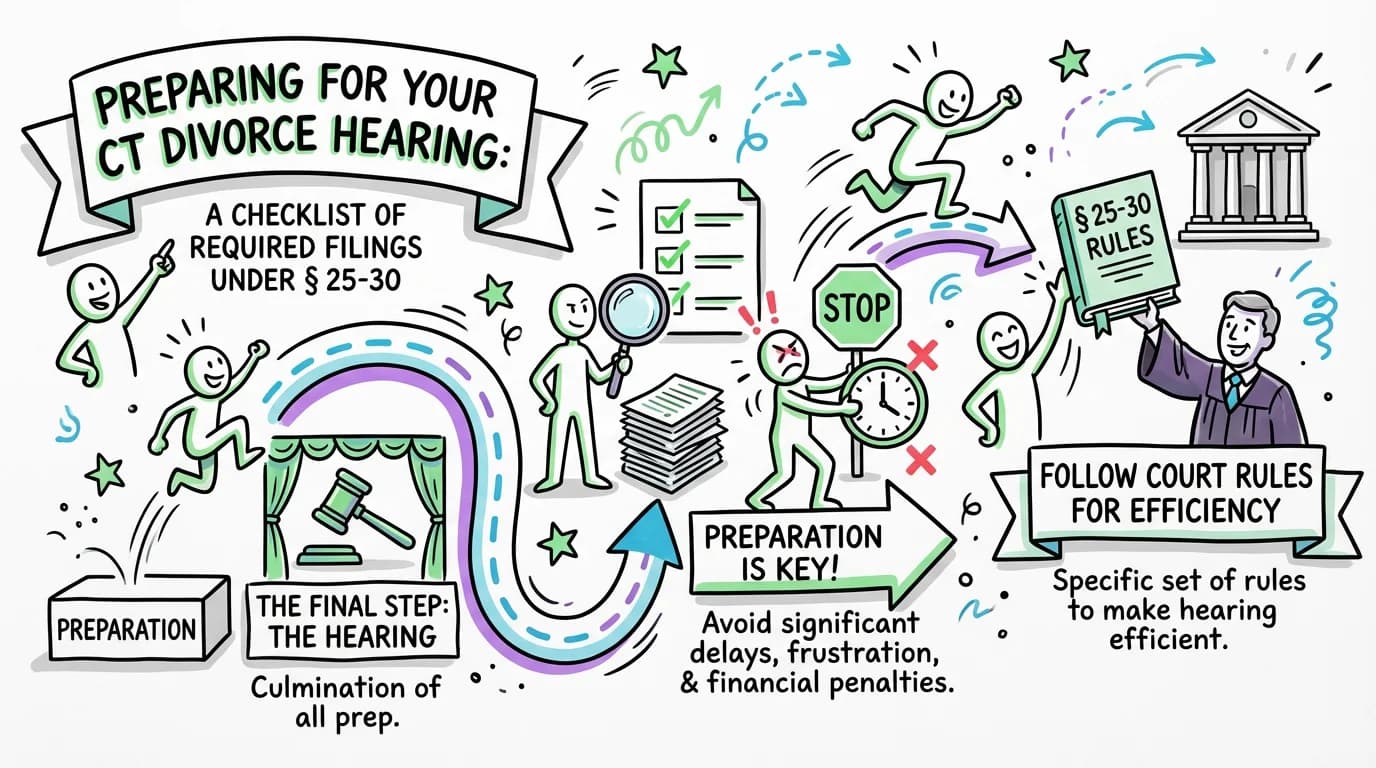
Prepare for a Connecticut divorce hearing by reading the notice for your specific court date, updating any financial affidavit, preparing proposed orders and a child support worksheet if needed, and bringing the forms listed for that hearing type. Practice Book § 25-30 covers some filings, but standing orders can add more.
The Connecticut rules matter here, but they do not all do the same job. Section 25-30 focuses on sworn financial statements, written proposed orders, and child support worksheets. The standing order for family trials and hearings adds broader pre-hearing exchange requirements in many assigned matters, including witness and exhibit materials. The Judicial Branch's divorce-with-agreement instructions also list forms that self-represented parties commonly need for uncontested cases.
This article gives you a practical checklist that separates those sources instead of treating them as one rule. That distinction matters, because a filing that is required five business days before one type of hearing may be due at the hearing itself in another.
You will learn:
- When the 5-business-day deadline applies and when it does not.
- A detailed breakdown of the core hearing documents: the Sworn Financial Affidavit, Written Proposed Orders, the Child Support Worksheet, and other forms that may apply to your hearing type.
- Practical tips and common mistakes to avoid for each filing.
- The potential consequences of missing a Practice Book or standing-order deadline.
By following this guide, you can approach your final hearing with the confidence that your paperwork is in perfect order, allowing the judge to focus on the substance of your case and move you toward a final resolution.
Understanding Practice Book § 25-30 and the Family Standing Orders
Before diving into the checklist, it helps to separate the rules that lawyers and self-represented parties often collapse together.
Practice Book § 25-30 is titled "Statements To Be Filed." In family matters, it addresses three main categories of paperwork:
- current sworn financial statements,
- written proposed orders, and
- completed child support and arrearage guidelines worksheets where support is at issue.
The January 1, 2025 statewide family management order is different. For many assigned trials and hearings, it requires parties to exchange and file a larger packet at least five business days before the court date, including financial affidavits, proposed orders, child support worksheets when applicable, pending-motion lists, witness lists, exhibit lists, and exhibit copies.
That means hearing preparation usually depends on three layers of instruction:
- The notice for your specific hearing.
- The Practice Book section that applies to the issue being heard.
- Any standing order or clerk instruction for that court event.
As Linda Douglas, Chief Legal Officer at Untangle, often explains, the practical goal is simple: show up with current financial information, clear requests for relief, and the exact forms your hearing type requires, so the judge can decide the case without stopping to reconstruct missing facts.
When the 5-business-day deadline applies
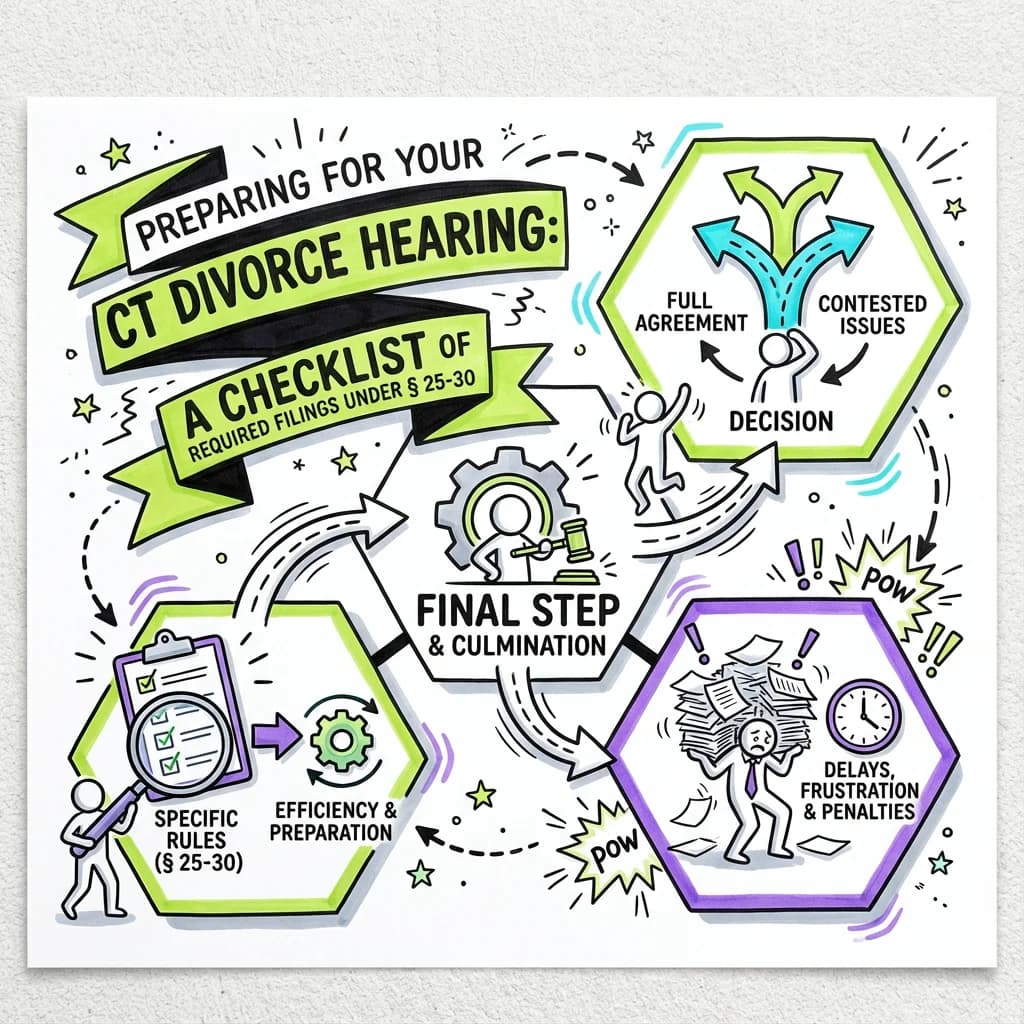
There is no single universal five-business-day rule for every divorce hearing form. The deadline depends on both the document and the court event.
Practice Book § 25-30(a) requires current sworn financial statements five business days before hearings on motions or orders to show cause concerning alimony, support, or counsel fees. For dissolution, legal separation, annulment, custody, or visitation matters, that same subsection says the sworn statement is filed when the case is scheduled for hearing.
Practice Book § 25-30(b) requires written proposed orders five business days before a final hearing or trial unless the matter is uncontested or the defendant has not appeared. Section 25-30(e) requires the child support worksheet at the hearing itself, although the statewide family standing order can require earlier exchange for assigned hearings.
So confirm which rule controls your hearing before you count backward. If a five-business-day deadline applies, use court business days only and exclude weekends and holidays.
Your hearing-preparation checklist: document by document
Once you know which rule applies to your hearing, turn that requirement into a filing plan you can actually execute. Each document serves a different purpose: one tells the court your finances, another tells the judge what orders you want, another gives the support calculation, and some hearing types require additional forms or exhibit packets. Treat this section like a pre-hearing assembly list so nothing important gets left unfinished, outdated, or unsigned in the final week.
1. The Sworn Financial Affidavit (Form JD-FM-6)
The Financial Affidavit is the single most important financial document in your divorce. It is a comprehensive statement, made under oath, that details your entire financial life.
- What It Is: A multi-page form where you list all your weekly income, weekly expenses, assets (like real estate, bank accounts, retirement funds), and liabilities (like mortgages, car loans, credit card debt).
- Why It's Required: This document is the bedrock of all financial orders. A judge legally cannot enter orders regarding property division, alimony, or child support without a current, accurate Financial Affidavit from both parties. It provides the factual basis for the court's decisions.
- The Deadline: For a motion or order to show cause concerning alimony, support, or counsel fees, § 25-30(a) uses a 5-business-day deadline. For other family hearing dates, the controlling deadline may come from the hearing notice or the statewide standing order.
- Answering the Question: "When to file financial affidavit CT?" You usually file an initial affidavit early in the case, then update it whenever the court is about to decide financial issues. The important point is not to rely on an old version when your hearing notice or the applicable rule expects current numbers.
Choosing the Correct Financial Affidavit Form
Connecticut offers a short form and a long form, and using the wrong one slows everything down. JD-FM-6-SHORT is designed for people with total gross annual income under $75,000 and total assets, net of debt, under $75,000. Everyone else should use JD-FM-6-LONG. If you are close to the threshold or uncertain about how to count assets, use the long form. It is better to provide more detail than to show up with a form the clerk or judge views as incomplete.
Financial Affidavit Mistakes to Avoid
The most common mistakes are old numbers, rough guesses, and missing signatures. A stale affidavit filed months earlier does not satisfy the pre-hearing requirement if your finances have changed. Estimating expenses without checking statements often creates credibility problems on cross-examination. Omitting an account or misstating income can be treated as a serious disclosure failure because the affidavit is sworn under penalty of perjury. Before filing, compare it against recent pay records, bank statements, debt balances, and the date line on the signature block.
2. Written proposed orders
If the Financial Affidavit is the "what" (your financial facts), the Proposed Orders are the "who, what, and when" (what you want the judge to do with those facts).
- What They Are: This is your formal, written request to the judge. It is a document that outlines, in specific detail, every single order you want to be included in the final divorce decree. It is your "wish list" presented in the formal language of a court order.
- Why They're Required: Proposed Orders frame the issues for the judge. By comparing your proposed orders with your spouse's, the judge can instantly see what you agree on and where the disagreements lie. This allows the hearing to focus only on the contested matters. For uncontested divorces, your joint proposals form the basis of the final agreement.
- The Deadline: § 25-30(b) requires proposed orders 5 business days before a final hearing or trial unless the matter is uncontested or the defendant has not appeared. The same subsection also uses a five-business-day service deadline before family special masters, ADR sessions, and judicial pretrials.
What to Include in Your Proposed Orders
Your document should be organized by topic and written like an actual court order the judge could sign with minimal editing. Cover alimony, property division, custody, parenting schedules, child support, health insurance, uninsured expenses, tax exemptions, and any name restoration request. Precision matters. It is better to say who pays, how much, when payment is due, and what event ends the obligation than to describe a vague goal. Specific language helps the court identify the real disputes and reduces post-judgment confusion.
Proposed Orders Drafting Tips
Reasonableness and detail give proposed orders credibility. If your requested terms track the evidence in your financial affidavit and the applicable statutes, the judge can evaluate them quickly. If they read like slogans or leave important logistics unresolved, they are harder to adopt. Before filing, ask whether a third party could follow the order without guessing who acts, by what deadline, and what happens if the property is sold, support changes, or the parties disagree about implementation.
3. The Child Support and Arrearage Guidelines Worksheet (Form CCSG-1)
If you and your spouse have minor children together, this document is usually essential.
- What It Is: The child support guidelines worksheet CT calculates the presumptive support amount from each parent's weekly net income and certain child-related costs.
- Why It's Required: The court needs it before entering or modifying support.
- The Deadline: § 25-30(e) requires it at the time of any hearing about child support or at the final hearing in a dissolution, legal separation, annulment, custody, or visitation action. Assigned hearings may require earlier exchange under the statewide standing order.
- Common Mistakes: Math errors, using gross instead of net income, omitting health-insurance or daycare figures, and asking for a deviation without explaining why.
4. Other hearing-day forms and materials
Not every divorce hearing uses the same fourth document. This is where people often get tripped up, because hearing packets, standing orders, and uncontested-divorce instructions do not always match one another exactly.
One example is JD-FM-71, which is Advisement of Rights Re: Income Withholding, not a contempt advisement. The Judicial Branch's Divorce with an Agreement page lists that form when the spouses have minor children. That makes it relevant in many uncontested cases involving support, but it is not the source of the broader five-business-day filing rule and it is not itself Practice Book § 25-30.
If your hearing is governed by the statewide standing order, you may also need a pending-motion list, witness list, exhibit list, and exhibit copies. Those items are separate from the three core categories in § 25-30.
The practical lesson is to compare your hearing notice, any standing order, and the Judicial Branch page for your hearing type. If a form is listed there, complete it before court rather than scrambling in the hallway.
Frequently Asked Questions About Connecticut Divorce Hearing Preparation
Most last-minute problems come from timing, not from misunderstanding the merits of the divorce itself. People usually know they need forms, but they are less sure about when an update is required, how the five-day rule is counted, or whether the court will forgive a missing filing. These are the practical questions that determine whether your hearing goes forward as scheduled or turns into another delay, so it helps to answer them before the final week begins.
Do I always have to file everything five business days before the hearing?
No. That timing depends on the document and the hearing. Financial affidavits, proposed orders, and child support worksheets do not all share one statewide deadline under § 25-30. Some are due five business days before certain hearings, some are due at the hearing itself, and assigned trials or hearings may also be controlled by the statewide family standing order. Check the hearing notice before you count backwards.
Do I need a new financial affidavit if nothing major has changed?
Usually yes. If the hearing involves financial issues, bring a fresh affidavit that reflects current income, expenses, assets, and debts, even if little has changed. Reusing an old version invites arguments that your numbers are stale or incomplete. Review recent pay records, account balances, and bills before you sign.
How do I count the five business days before my hearing?
Only use this calculation after you confirm that a five-business-day rule actually applies to your document. Then count backward from the hearing date using court business days only, excluding weekends and court holidays. Do not wait until the last possible afternoon. E-filing problems, rejected submissions, or a missing signature can turn an on-time plan into a late filing very quickly.
Can the judge continue the hearing if one of the required documents is missing?
Yes. If the court lacks a current financial affidavit, proposed orders, or a required child support worksheet, the judge may continue the hearing, refuse to consider late material, or shift costs to the noncompliant party. Missing paperwork also hurts credibility because it signals the case was not ready for decision.
Should I complete JD-FM-71 before I get to court?
If your hearing instructions require it, yes. JD-FM-71 is the Advisement of Rights Re: Income Withholding, and the Judicial Branch lists it for agreed divorces with minor children. Completing it in advance is the practical move, but only after you confirm that your hearing type actually calls for it. That keeps you from bringing the wrong form or assuming every divorce hearing uses the same packet.
What happens if you miss a Practice Book or standing-order deadline?
Failing to follow the court's rules is a serious matter. A judge has several options if you or your spouse arrive at the final hearing without having filed the required documents on time.
- Continuance (Postponement): The most common outcome. The judge will refuse to hear your case and will schedule a new hearing date several weeks or months in the future. This prolongs the emotional and financial strain of the divorce process.
- Sanctions (Fines): The judge can order the non-compliant party to pay the other party's attorney's fees for the time wasted preparing for and attending the cancelled hearing. This can amount to hundreds or even thousands of dollars.
- Preclusion of Evidence: A judge has the discretion to refuse to consider any documents that were not filed on time. This means your Proposed Orders might be ignored, and the judge will only have the other party's requests to consider when making a decision.
- Negative Inference: The judge may assume that your failure to file a timely and accurate Financial Affidavit is an attempt to hide information. This can severely damage your credibility and negatively impact the judge's decisions on all financial matters.
Preparing for the Hearing Day Itself: Beyond the Paperwork
Once your documents are filed, your preparation isn't quite finished. Use the final few days to prepare for the court appearance itself.
- Review Everything: Carefully read your own filings and, just as importantly, the documents filed by your spouse. Make notes on where you agree and where the key disagreements are.
- Organize Your Binder: Bring at least three copies of every document you filed to court: one for you, one for the judge (in case they need it), and one for the other party. Organize them in a binder with tabs for easy access.
- Dress for Success: Treat your court appearance like a serious job interview. Business casual attire (slacks, a collared shirt, a blouse, a skirt) shows respect for the court and the process. Avoid jeans, t-shirts, shorts, and hats.
- Practice Courtroom Etiquette: Arrive at the courthouse at least 30 minutes early. When the judge enters, you will be asked to rise. Address the judge only as "Your Honor." Be polite to the court staff, your spouse, and their attorney. Do not interrupt when someone else is speaking.
- Be Ready to Testify: The judge will likely place you under oath and ask you questions. Most questions will be to confirm the information in your Financial Affidavit and to ensure you understand the terms of your agreement or proposals. Answer truthfully and directly.
Summary and Next Steps
Navigating the end of a divorce can be daunting, but ct divorce hearing preparation is manageable when you break it down into a clear checklist. The key is to separate what Practice Book § 25-30 actually requires from what the statewide family standing order or your hearing notice may require in addition.
Remember the key takeaways:
- The 5-Day Rule is Not Universal: Confirm which document is governed by § 25-30 and which deadline comes from a standing order or hearing notice.
- Accuracy is Everything: Your Financial Affidavit must be current, complete, and truthful.
- Specificity Wins: Your Proposed Orders should be detailed and clear, leaving no room for ambiguity.
- Preparation Prevents Problems: Being organized and ready prevents delays, sanctions, and unnecessary stress.
While this guide provides a comprehensive overview of the rules, every divorce has its own unique complexities. Ensuring your documents are prepared correctly and strategically is vital to achieving a fair outcome.

Author
Linda Douglas, Esq.
Chief Legal Officer, Untangle
Linda Douglas is a Divorce and Family Attorney with 38 years of experience handling nearly 2,000 cases in Connecticut and New Hampshire. She is licensed to practice law in Connecticut and New Hampshire.
Legal citations
- Practice Book § 25-30
- Superior Court for Family Matters Standing Orders - Management Order for Trials, Hearings, Case Dates, and Resolution Plan Dates
- Divorce with an Agreement - CT Judicial Branch
- Advisement of Rights Re: Income Withholding (JD-FM-71)
Keep exploring
Get Help
Get help with your divorce
Get guided answers, organize your paperwork, and move through Connecticut divorce with a clearer plan.