
How Is Property Divided in a Connecticut Divorce Under C.G.S. § 46b-81?
Learn how Connecticut courts divide assets and debts in divorce under C.G.S. § 46b-81, including all-property rules, factors, and evidence.
Quick answer: What to know first
Connecticut divides property in divorce by equitable distribution, not an automatic 50/50 split. Under C.G.S. § 46b81, the court may assign property from either spouse to the other after considering the evidence, the marriage history, each spouse's financial position, and each person's future needs.
- What does C.G.S. § 46b-81 let a Connecticut divorce court do?
- Is Connecticut a 50/50 property division state?
- What property can be divided in a Connecticut divorce?
Get Help
Get help with your divorce
Get guided answers, organize your paperwork, and move through Connecticut divorce with a clearer plan.
In this guide
- What does C.G.S. § 46b-81 let a Connecticut divorce court do?
- Is Connecticut a 50/50 property division state?
- What property can be divided in a Connecticut divorce?
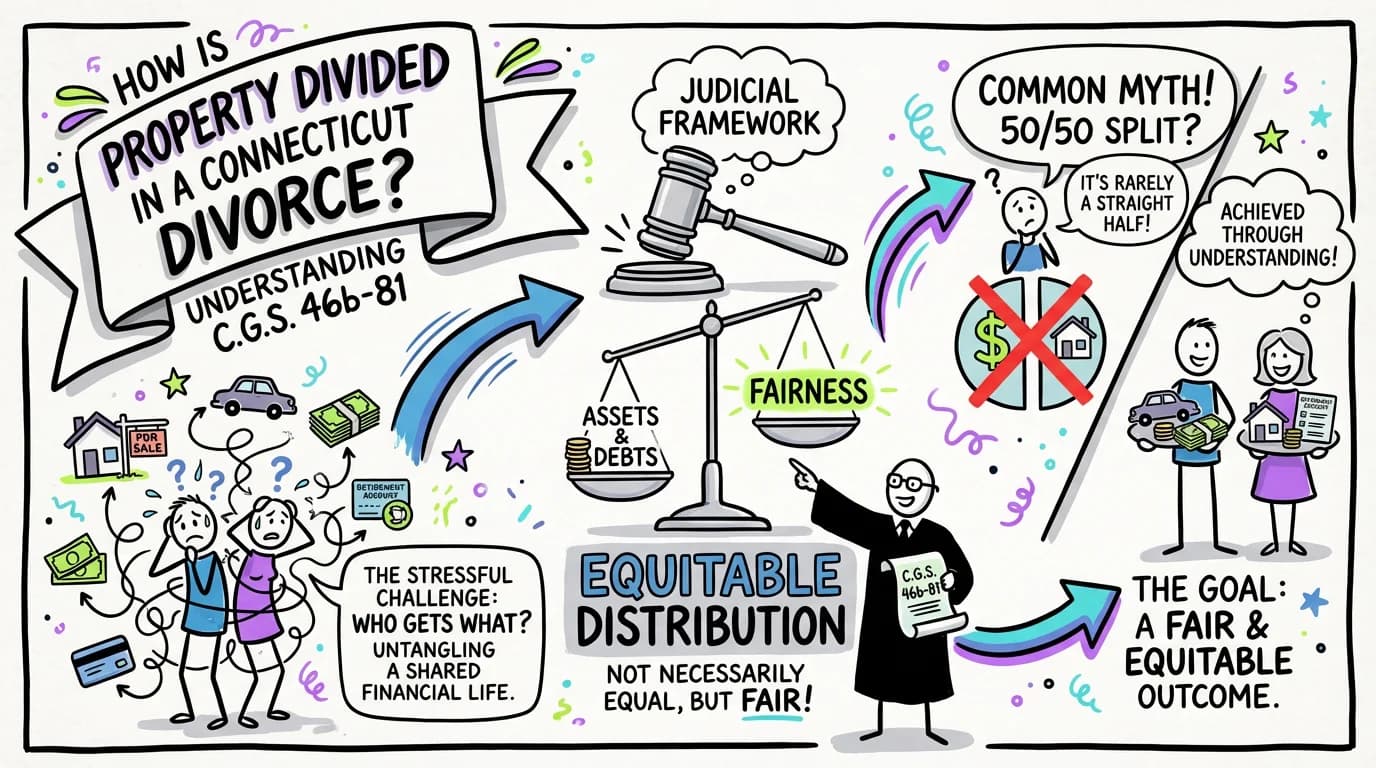
Connecticut divides property in divorce by equitable distribution, not an automatic 50/50 split. Under C.G.S. § 46b-81, the court may assign property from either spouse to the other after considering the evidence, the marriage history, each spouse's financial position, and each person's future needs.
That means the most useful question is not "What percentage do I get?" It is "What facts make this proposed division fair under Connecticut law?" C.G.S. § 46b-81 gives the court broad power to assign all or part of one spouse's estate to the other, pass title to real estate, or order a sale when necessary to carry out the divorce decree.
What does C.G.S. § 46b-81 let a Connecticut divorce court do?
C.G.S. § 46b-81 is the Connecticut property-division statute. It applies when the Superior Court enters a decree dissolving or annulling a marriage, or granting legal separation. The statute says the court may assign to either spouse "all or any part of the estate of the other spouse" and may transfer or sell real property when that is the proper way to carry out the decree. That is why Connecticut property division is flexible, fact-specific, and sometimes very different from a simple equal split. The court must consider the evidence presented by each party and the statutory factors listed in the statute before fixing the nature and value of the property to be assigned.
Is Connecticut a 50/50 property division state?
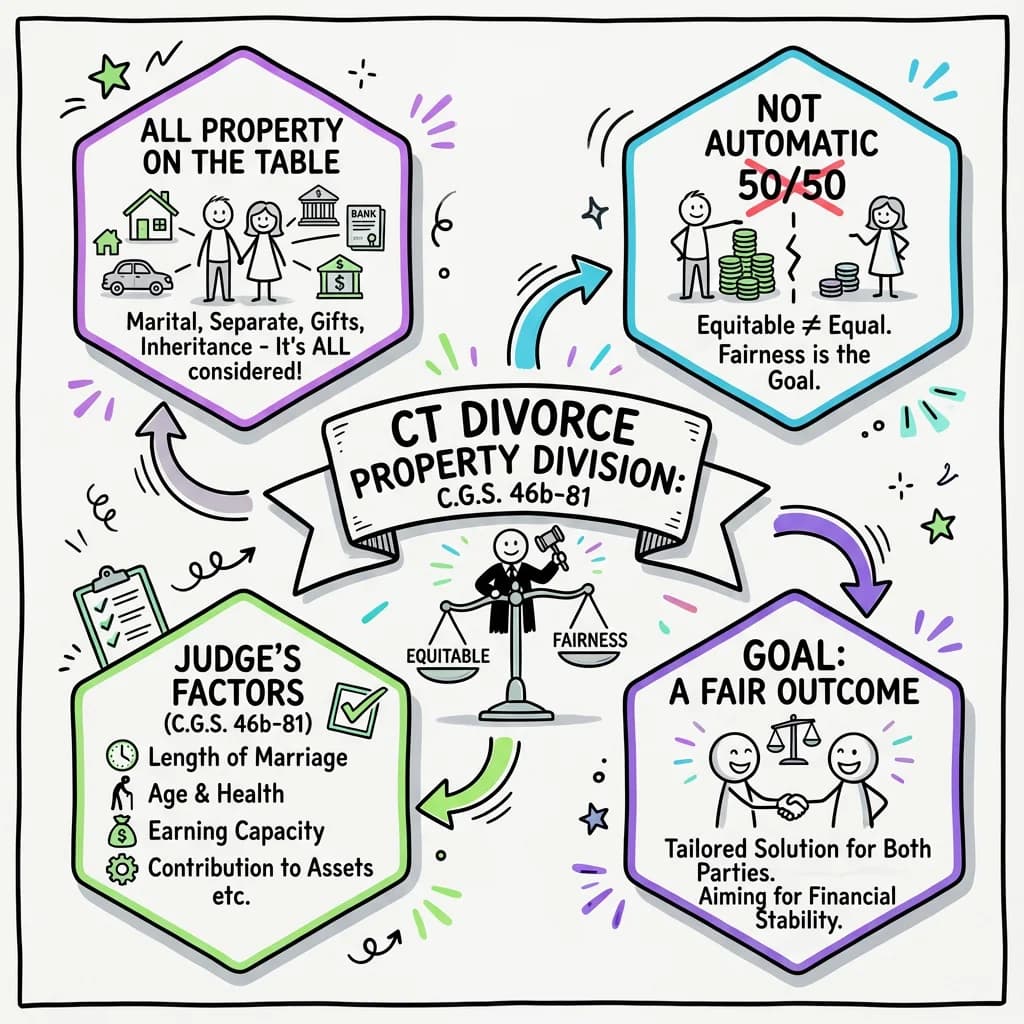
No. Connecticut is usually described as an equitable distribution state, which means the court seeks a fair result under the statutory factors rather than an automatic half-and-half division. A roughly equal division may happen in some cases, but it is not required by C.G.S. § 46b-81. The same statute also makes property division different from Connecticut alimony: alimony under C.G.S. § 46b-82 can be ordered in addition to or instead of a property award. In practice, the property division, debt allocation, and any alimony order are usually evaluated together.
What property can be divided in a Connecticut divorce?
Connecticut has a broad "all-property" approach because C.G.S. § 46b-81 lets the court assign all or any part of either spouse's estate. That can include real estate, bank accounts, retirement accounts, investments, business interests, vehicles, valuable personal property, deferred compensation, and life-insurance cash value. It can also include property acquired before the marriage or received by inheritance or gift. The source and timing of an asset still matter, but they do not automatically remove the asset from the court's reach. For deeper asset-specific guidance, see Untangle's guides to the marital home, 401(k) division, and business valuation.
How do debts fit into Connecticut property division?
Debts matter because C.G.S. § 46b-81 requires the court to consider each party's liabilities and needs. Mortgages, home-equity loans, credit cards, tax debt, student loans, car loans, and personal loans can all affect whether the final distribution is workable. A spouse who receives an asset may also need to receive the debt tied to it, but that is not automatic. The court can look at who incurred the debt, what purpose it served, who benefited, and who is better able to pay it after divorce. For more detail, read Untangle's separate guide to how debts are divided in Connecticut divorce.
What financial records does the court use?
The property division starts with sworn financial disclosure. Practice Book § 25-30 requires parties to file sworn financial statements showing current income, expenses, assets, and liabilities before key family-court hearings and before judgment. The official JD-FM-6-LONG financial affidavit is used when gross annual income or total net assets exceed $75,000; the JD-FM-6-SHORT financial affidavit is used when both are below that threshold. Practice Book § 25-32 also requires mandatory disclosure of tax returns, W-2s, 1099s, pay stubs, financial-account statements, retirement statements, life-insurance information, medical-insurance summaries, and written appraisals.
Which C.G.S. § 46b-81 factors matter most?
No single factor controls every case. The statute lists required considerations, but it does not assign points or create a formula. Some people call them the "12 factors," but the better way to read C.G.S. § 46b-81 is as a connected set of questions about the marriage, each spouse's condition, the source and value of the property, and each person's future economic reality. The court must consider the evidence presented by each party, so the factor that matters most is often the one you can prove clearly with records, testimony, and credible valuations.
1. Marriage history and cause of the divorce
The court considers the length of the marriage and the causes for the dissolution, annulment, or legal separation. A short marriage with mostly separate finances may call for a different result than a long marriage where the spouses built one economic life over decades. Cause can also matter when the reason for the breakdown connects to money, credibility, or harm to the estate. The practical point is evidence: dates, account records, and specific financial impact matter more than broad accusations.
2. Age, health, station, and occupation of each spouse
C.G.S. § 46b-81 directs the court to consider each party's age, health, station, and occupation. These factors help the judge understand present stability and future risk. A spouse nearing retirement, living with a serious illness, or working in unstable seasonal employment may need a different mix of cash, retirement assets, home equity, or debt responsibility than a younger spouse with steady income. "Station" is not a guarantee that both households will keep the same lifestyle, but it helps explain the economic context of the marriage.
3. Income, earning capacity, education, and employability
The statute separately names amount and sources of income, earning capacity, vocational skills, education, and employability. That means the court can look beyond today's paycheck. A spouse with a professional license, recent work history, and strong advancement prospects may have a very different future than a spouse who left the workforce for caregiving or needs retraining. This is where property division and alimony often overlap, because a cash award, retirement offset, or asset allocation may be used with or without alimony to address the gap.
4. Estate, liabilities, needs, and future acquisition
The court must consider each spouse's estate, liabilities, needs, and opportunity for future acquisition of capital assets and income. This is the forward-looking part of the analysis. A fair division on paper can still fail if one spouse receives illiquid assets but cannot pay monthly bills, taxes, or debt. The judge may also consider whether one spouse is much more likely to rebuild wealth after divorce through income, investments, family resources, or career growth. Liquidity, debt load, and realistic living costs are often central.
5. Contributions to acquisition, preservation, or appreciation
C.G.S. § 46b-81 also requires the court to consider each spouse's contribution to acquiring, preserving, or increasing the value of their estates. Contributions can be financial, but they are not limited to paychecks. Homemaking, childcare, supporting a spouse's career, managing household finances, maintaining real estate, or helping preserve a business can all be relevant. The same evidence can cut the other way if a spouse reduced the estate through wasteful spending, poor records, or conduct that damaged marital assets.
How do judges balance the factors in real cases?
Judges do not run a calculator that converts the C.G.S. § 46b-81 factors into a fixed percentage. They evaluate the evidence and decide what assignment of property is fair in the full context of the case. As Linda Douglas, Chief Legal Officer at Untangle, advises, the strongest property-division arguments usually connect three things: the statutory factor, the document proving the fact, and the exact order you want the court to enter. For example, "I need more cash" is weaker than "I should receive this account because the affidavit, mortgage statement, and medical bills show a short-term liquidity need that my spouse's income can absorb."
How should you prepare for property division?
Good preparation turns the statute into proof. Start by building a complete inventory of assets and debts, then connect each major item to a value, a source document, and a proposed outcome. You do not need every argument to be dramatic. You need the court or the other side to understand what exists, what it is worth, who can use it, who can pay related debts, and why your proposed division fits the statutory factors. Organized records also make settlement easier because both sides negotiate from the same financial picture.
Step 1: Build a complete asset and debt inventory
List every known asset and liability, even if you believe it is separate, premarital, inherited, or only in your spouse's name. Include real estate, bank accounts, retirement plans, pensions, brokerage accounts, vehicles, business interests, credit cards, tax debt, and loans. Add the current balance, title holder, account number suffix, source of the value, and whether the item is liquid or hard to sell. This inventory becomes the backbone of your financial affidavit and settlement proposal.
Step 2: Match each number to a document
Practice Book § 25-32 requires mandatory production of important financial records, including three years of tax returns, recent pay information, 24 months of financial-institution statements, retirement statements, life-insurance information, and written appraisals. Use those categories as your document checklist. A spreadsheet number without a statement, appraisal, deed, payoff letter, or tax record is easy to challenge. A number tied to a specific document is much easier to use in negotiation or court.
If records are missing, list the gap instead of filling it with a guess. That helps you decide whether to request documents, subpoena records, or limit settlement talks until the number is reliable.
Step 3: Value the assets that can change the outcome
Some assets need more than an online estimate or account screenshot. Real estate, businesses, pensions, stock options, deferred compensation, and valuable collections may require appraisals, plan statements, actuarial work, or expert analysis. The court cannot divide what it cannot understand. If valuation cost is a concern, focus first on items large enough to affect settlement, items your spouse disputes, and items that create tax, liquidity, or transfer problems.
Also separate value from affordability. A house with equity may still be impossible to keep if the mortgage, taxes, insurance, or buyout terms do not work after judgment.
Step 4: Turn the factors into a proposed order
Practice Book § 25-30 requires written proposed orders before many family-court events and final hearings. A strong proposed order does more than say "divide fairly." It identifies who receives each asset, who pays each debt, deadlines for transfers or sales, how retirement orders will be prepared, and what happens if a refinance or sale fails. Tie each major request to C.G.S. § 46b-81 factors such as needs, liabilities, income, future opportunity, or contribution.
Specific orders reduce ambiguity. They also make it easier to compare settlement options before trial.
What property division mistakes should you avoid?
The biggest mistakes are usually practical, not legal-theory mistakes. Do not assume Connecticut means 50/50, do not assume premarital or inherited property is automatically untouchable, and do not treat debt as an afterthought. Avoid guessing at home, business, retirement, or pension values when those numbers drive the settlement. Do not hide, transfer, or omit assets; sworn financial affidavits must be complete and accurate, and incomplete disclosure can damage credibility. Finally, do not ignore tax, refinancing, transfer, and liquidity problems. A settlement that looks fair in totals can fail if one spouse cannot actually use or carry the property received.
Who reviewed this Connecticut property division guide?
This guide was reviewed by Linda Douglas, Esq., Chief Legal Officer at Untangle. Linda is a divorce and family attorney with 38 years of experience handling nearly 2,000 cases in Connecticut and New Hampshire, and she is licensed to practice law in Connecticut and New Hampshire. The article was checked against Connecticut primary sources, including C.G.S. § 46b-81, related family statutes, Practice Book disclosure rules, and official Connecticut Judicial Branch financial affidavit forms. It is general legal information, not legal advice for a specific case.
Frequently Asked Questions About Property Division in Connecticut
These answers address the questions people usually ask after learning Connecticut follows equitable distribution. The main theme is that labels alone do not decide the result. Ownership, source of funds, timing, debt responsibility, and future need all matter, but the court still needs credible documents and a proposed order that explains what should happen to each asset and liability.
Is property always split 50/50 in a Connecticut divorce?
No. Connecticut uses equitable distribution, so the judge looks for a fair allocation under C.G.S. § 46b-81 rather than a mandatory equal split. Some cases end close to 50/50, especially after a long marriage with pooled finances. Others do not, because health, income, future opportunity, liabilities, or contributions point toward a different result.
Can premarital property or an inheritance be divided?
Yes. Connecticut's all-property approach means premarital assets and inheritances can be considered in the divorce estate. That does not mean they are always divided equally or transferred to the other spouse. The source, timing, length of marriage, financial need, and available alternative assets may all affect how the court treats them.
Does marital debt get handled like marital assets?
Debt is part of the same overall property-division picture. The court considers liabilities and needs under C.G.S. § 46b-81, so mortgages, credit cards, tax debt, and loans can affect the final split. The judge may consider why the debt was incurred, who benefited, who can pay, and how assigning the debt changes the rest of the settlement.
Which financial affidavit should I use for property division?
Use the long Connecticut financial affidavit, JD-FM-6-LONG, if gross annual income or total net assets exceed $75,000. Use JD-FM-6-SHORT only if both gross annual income and total net assets are below $75,000. Because the affidavit is sworn, use current records and update it when required before judgment or hearings.
What evidence matters most in a contested property division case?
The most useful evidence is usually financial and specific: account statements, tax returns, pay records, mortgage balances, appraisals, retirement statements, business records, and documents showing debt. Judges also consider evidence of contribution, health limits, earning capacity, and future need. A clear document trail usually beats broad complaints about fairness.
Can spouses agree to their own property division?
Yes. Spouses can settle property division by written agreement, but the court still reviews divorce agreements for fairness before entering judgment. A practical agreement should identify each asset, each debt, transfer deadlines, refinancing or sale terms, retirement-order responsibilities, and what happens if a required transfer cannot be completed on time.
What should you do next?
If property division is the issue keeping your divorce from settling, start with the evidence rather than the percentage. Complete the correct financial affidavit, gather the Practice Book disclosure records, identify disputed values, and write down the specific orders you want for each major asset and debt. Then test those requests against C.G.S. § 46b-81: marriage history, needs, liabilities, income, future opportunity, and contributions. That is the framework Connecticut courts use, and it is the framework your settlement proposal should answer.
By recognizing that "equitable" does not mean "equal" and by preparing your case with the 12 statutory factors in mind, you can approach settlement discussions with confidence and clarity. You can gather the right documents, make persuasive arguments, and work toward a resolution that is truly fair and allows you to begin your next chapter on solid financial footing.
This process is complex, and the stakes are high. Having the right tools and support can make all the difference.

Author
Linda Douglas, Esq.
Chief Legal Officer, Untangle
Linda Douglas is a Divorce and Family Attorney with 38 years of experience handling nearly 2,000 cases in Connecticut and New Hampshire. She is licensed to practice law in Connecticut and New Hampshire.
Legal citations
- C.G.S. § 46b-56 (Orders re Custody and Support of Children)
- C.G.S. § 46b-81 (Assignment of Property)
- C.G.S. § 46b-82 (Alimony)
- C.G.S. § 46b-86 (Modification of Alimony or Support Orders)
- Connecticut Practice Book § 25-30 (Statements To Be Filed)
- Connecticut Practice Book § 25-32 (Mandatory Disclosure and Production)
- Financial Affidavit JD-FM-6-LONG
- Financial Affidavit JD-FM-6-SHORT
Related guides
Calculating Alimony in Connecticut: A Guide to the Factors in C.G.S. 46b-82
Learn more about calculating alimony in connecticut: a guide to the factors in c.g.s. 46b-82
Modifying a Connecticut Divorce Decree: Alimony and Child Support (C.G.S. 46b-86)
Learn more about modifying a connecticut divorce decree: alimony and child support (c.g.s. 46b-86)
The 17 'Best Interests of the Child' Factors in Connecticut Custody Cases (C.G.S. 46b-56)
Learn more about the 17 'best interests of the child' factors in connecticut custody cases (c.g.s. 46b-56)
Keep exploring
Get Help
Get help with your divorce
Get guided answers, organize your paperwork, and move through Connecticut divorce with a clearer plan.