
What is the Connecticut divorce default process?
Connecticut divorce default process under Practice Book §25-51 and CGS §46b-67: what happens when a spouse doesn't respond, timing rules, and forms.
Quick answer: What to know first
Filing for divorce is a significant and often stressful step. You've navigated the complex forms, summoned your courage, and officially started the legal process. But what happens when your efforts are met with silence? You serve the divorce papers, you wait, and… nothing. Your spouse doesn't respond, doesn't file any paperwork, and doesn't acknowledge the proceedings.
- Quick answer
- Understanding the "Default" in a Connecticut Divorce
- The Step-by-Step Guide to the Connecticut Divorce Default Process
Get Help
Get help with your divorce
Get guided answers, organize your paperwork, and move through Connecticut divorce with a clearer plan.
In this guide
- Quick answer
- Understanding the "Default" in a Connecticut Divorce
- The Step-by-Step Guide to the Connecticut Divorce Default Process
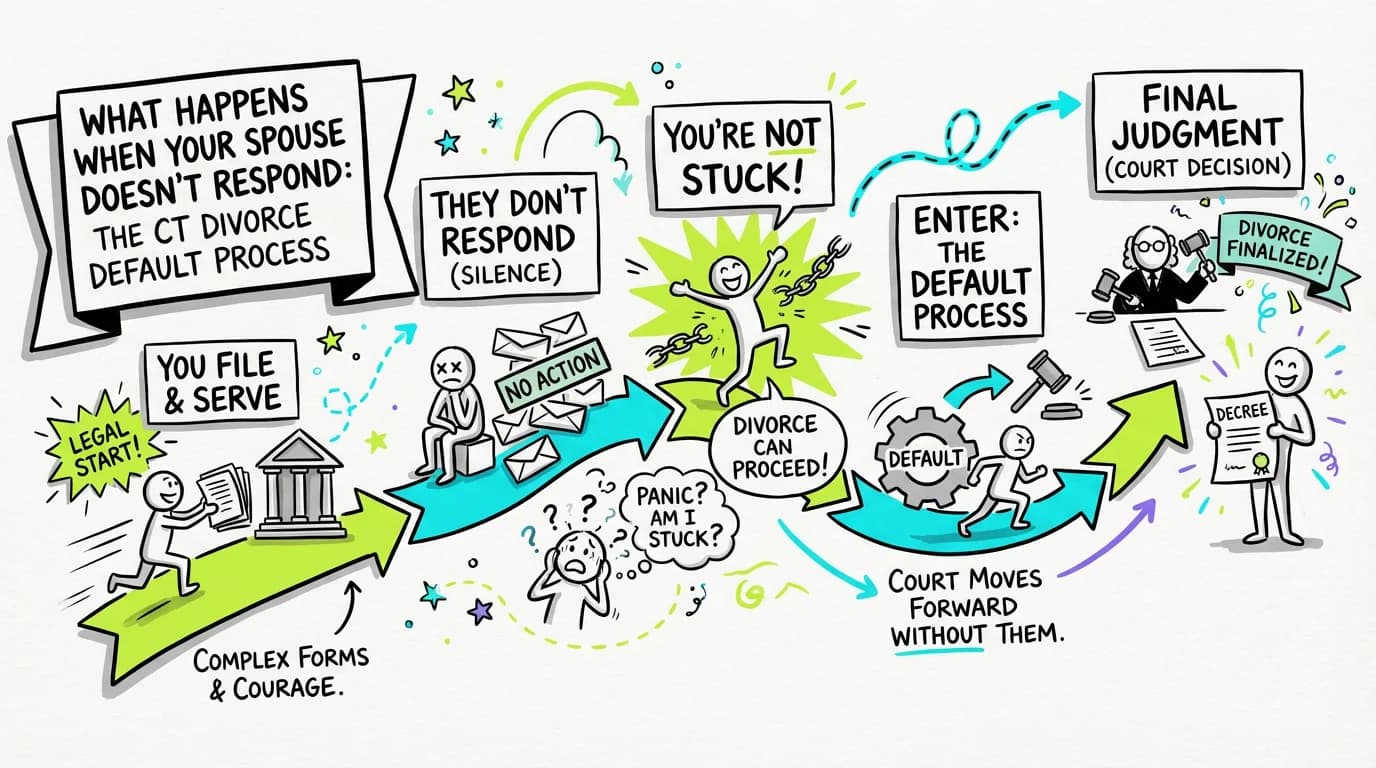
Filing for divorce is a significant and often stressful step. You've navigated the complex forms, summoned your courage, and officially started the legal process. But what happens when your efforts are met with silence? You serve the divorce papers, you wait, and… nothing. Your spouse doesn't respond, doesn't file any paperwork, and doesn't acknowledge the proceedings.
For many, this is a moment of panic. Am I stuck in this marriage forever? Can my spouse stop the divorce simply by ignoring it?
The answer in Connecticut is a clear and resounding no.
The Connecticut judicial system anticipates this exact scenario. A non-responsive spouse cannot indefinitely halt your divorce. Instead, the law provides a specific, structured pathway known as the Connecticut divorce default process. This legal mechanism ensures your case can move forward to a final judgment, even without your spouse's participation.
This article serves as your comprehensive guide to this critical procedure. We will demystify the concept of a "default" in family court, breaking down the unique rules that apply under the Connecticut Practice Book and current Judicial Branch guidance. You will learn:
- The precise definition of a default in a Connecticut divorce.
- The mandatory timing rules you must observe before taking action.
- A step-by-step guide to filing the current default-judgment motion.
- The critical importance of the Affidavit Concerning Military Service.
- What to expect if the court schedules a default judgment hearing.
- How to navigate the process correctly to achieve a final, legally sound divorce decree.
While your spouse's silence can be frustrating, it is not a roadblock. By understanding and correctly following the default process, you can regain control and move toward resolution.
Quick answer
When a Connecticut spouse ignores divorce papers, you can still finalize the case through the default process. Under Practice Book § 25-51 and General Statutes § 46b-67, you must wait 30 days after the return date if service was personal or abode service — 60 days if service was made another way — and then file the current default-judgment motion (Form JD-FM-272) with an Affidavit Concerning Military Service. A judge, not an automatic process, still reviews the record before entering final orders on property, alimony, support, and parenting.
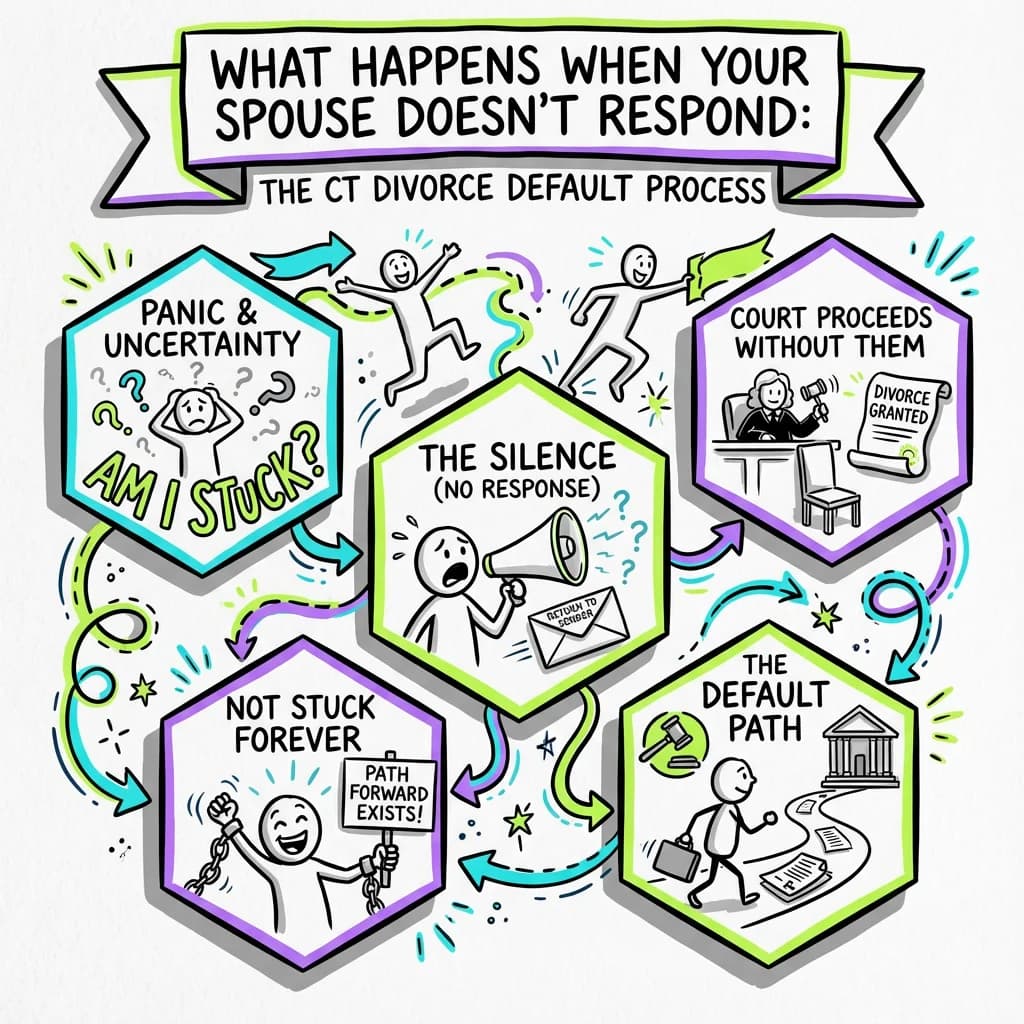
Understanding the "Default" in a Connecticut Divorce
Before diving into the procedural steps, it's essential to understand what the term "default" truly means in the context of a family law case. It's a legal term of art with a specific meaning that differs from its everyday use. In Connecticut family matters, default changes the procedure, not the court's duty to review the file. That distinction matters because Practice Book § 25-51 now points dissolution cases away from the ordinary civil-style default motion and toward the family-specific judgment path in General Statutes § 46b-67.
What Does It Mean for a Spouse to "Default"?
In a Connecticut divorce, a default is not a "win" or a "loss." It is a procedural status that the court assigns to a party who fails to perform a legally required action within the allotted time.
The most common action that triggers a default is the failure of the defendant (the spouse who was served with divorce papers) to file an Appearance form (JD-CL-12) with the court. The Appearance is a simple, one-page document that officially notifies the court and the plaintiff (the filing spouse) that the defendant is participating in the case.
When you file for divorce, the Summons form (JD-FM-3) clearly states a "Return Date." The defendant spouse has two business days after the Return Date to file their Appearance. If they fail to do so, they are at risk of being defaulted.
A Common Misconception: "My Spouse Won't Sign the Divorce Papers"
Many people believe a divorce requires both parties to "sign off" on the final papers. While this is true for a fully uncontested divorce where a settlement agreement is reached, it is not a requirement for the divorce to proceed. Your spouse's signature is not needed to initiate or finalize a divorce via the default process. Their failure to participate is what allows you to move forward without their consent. The key isn't their refusal to sign, but their failure to formally respond to the court by filing an Appearance.
Why the Family Court Default Process is Different
If you were suing someone over a broken contract (a general civil case) and they failed to respond, a judge might quickly enter a default judgment, awarding you exactly what you asked for. Family law in Connecticut operates under a different, more protective philosophy.
The state has a vested interest in the outcomes of family matters, particularly concerning children and the equitable distribution of finances. A divorce judgment establishes long-term obligations regarding property, debt, potential spousal support (alimony), and child custody. The court cannot simply rubber-stamp one party's demands without scrutiny, as this could lead to unfair or unworkable outcomes.
This structure is reflected in Connecticut Practice Book § 25-51 and General Statutes § 46b-67. The family court does not simply enter an automatic civil-style default judgment and close the file. Instead, the judge or clerk must confirm that service was proper, the timing rules were met, the military affidavit was handled correctly, and any requested family orders are supported by the record. This is why, unlike in many civil cases, a default in a divorce case doesn't automatically end the inquiry; it changes the procedure for reaching judgment.
The Step-by-Step Guide to the Connecticut Divorce Default Process
Navigating the default process requires precision and adherence to strict timelines. Missing a step or filing a motion prematurely can cause delays and require you to start over. Follow this guide carefully to ensure a smooth process. The court will expect proof of service, proof that the response deadline passed, proof that the required waiting period measured from the return date has passed, and proof that you complied with the military-service requirements before asking the clerk or judge to move the case forward.
Step 1: Proper Service and the Initial Waiting Period
The entire default process hinges on one foundational requirement: proper legal service. You must have official proof that your spouse received the initial divorce paperwork. In Connecticut, this is almost always accomplished by a State Marshal, who personally delivers the Summons, Complaint, and Automatic Court Orders to your spouse.
The marshal will complete a "Return of Service" document and file it with the court. This document is your proof. Without a valid Return of Service, you cannot proceed with a default.
Once service is complete, you must wait for the deadline for your spouse to file their Appearance to pass. As mentioned, this is two business days after the Return Date listed on your Summons.
Step 2: Wait Until the Return-Date Timing Rule Is Satisfied
Here is where a critical, often-missed rule comes into play. You cannot ask for a default judgment the day after your spouse misses the Appearance deadline. Under the Connecticut Judicial Branch's current default-divorce guidance and General Statutes § 46b-67, the plaintiff may file the default-judgment motion only after the required return-date waiting period has run: 30 days after the return date if service was personal or abode service, and 60 days after the return date if service was made in any other manner.
That means the timing is keyed to the return date itself, not to a separate "cure period" that starts after the two-business-day Appearance deadline. If your return date is July 1 and service was personal or abode service, do not file the default-judgment motion before July 31. If service was made in another approved way, do not file before August 30.
Filing too early can still result in rejection by the clerk or delay from the judge, so count from the return date and the service method before you submit anything.
Step 3: File the Current Default-Judgment Motion (JD-FM-272)
Once the applicable waiting period has passed, you are ready to formally ask the court to move the case forward. The current Judicial Branch guidance directs plaintiffs to file the Motion for Entry of Judgment Upon Default of Appearance - Divorce or Legal Separation (Form JD-FM-272).
This is different from the older general Motion for Default for Failure to Appear. The Judicial Branch states that the default-judgment motion should be filed only after compliance with Practice Book § 25-30 and Practice Book § 25-50A(d) when those provisions apply. Use the current form instructions on the official Judicial Branch site, complete the certification language accurately, and keep a copy for your records.
Step 4: The Crucial Affidavit Concerning Military Service
Simultaneously with your default-judgment motion, you must file another vital document: the Affidavit Concerning Military Service.
Federal law—the Servicemembers Civil Relief Act (SCRA)—provides active-duty military personnel with specific legal protections, including protection from default judgments being entered against them while they are deployed or otherwise unable to respond.
To comply with the SCRA, the Connecticut court requires you to inform them of your spouse's military status. You must state, under oath, one of three things:
- Your spouse is not in the military.
- Your spouse is in the military.
- You have been unable to determine your spouse's military status after a diligent effort.
To find this information, you can use the official SCRA website, which has a free, public search function that allows you to check an individual's military status using their name, date of birth, and/or Social Security number. If you conduct this search and find no record, you can confidently state that, to the best of your knowledge, they are not on active duty.
Do not skip this step. A judge cannot and will not grant the default-judgment request without a properly executed Affidavit Concerning Military Service on file.
Step 5: The Court's Action After the Motion Is Filed
After you have filed the default-judgment motion and the Military Affidavit, the court clerk or judge will review your case file. They will verify:
- That there is a valid Return of Service from the marshal.
- That no Appearance has been filed by the defendant.
- That the correct return-date waiting period has passed for the method of service used.
- That the Military Affidavit is on file.
If all requirements are met, the court may grant the motion and allow you to proceed toward judgment. Under the Judicial Branch's current guidance, once that motion is granted, the plaintiff may appear and proceed with judgment without further notice to the non-appearing spouse.
What happens next depends in part on how your spouse was served:
- If your spouse was served by personal or abode service, the court may enter judgment with or without a hearing.
- If service was made by order of notice, the court cannot enter judgment until it holds a hearing, and that hearing cannot be held sooner than 60 days after the return date.
That is why default cases are not all identical. Some move to a short uncontested hearing, while others may be decided on the papers if the court has everything it needs and the service method allows it.
If the Court Sets a Default Judgment Hearing: What to Expect
If the court sets a hearing, that is where the judge will review your case, listen to your testimony if needed, and decide whether to enter the final divorce decree. Because your spouse is not participating, you will usually be the only party presenting information to the judge. That makes preparation especially important: even in a default matter, the court still needs enough reliable financial and factual information to decide whether your requested orders are lawful and supported by the record.
Is a Hearing Always Required?
No. Under the current Connecticut default-divorce guidance and General Statutes § 46b-67, the court may enter judgment with or without a hearing when the defendant was served personally or at their abode and the motion for entry of judgment upon default of appearance has been granted.
The clearest mandatory-hearing scenario is service by order of notice. In that situation, the Judicial Branch says no judgment may enter until a hearing is held, and the hearing cannot occur sooner than 60 days after the return date.
As a practical matter, many default divorces still involve a short court appearance because judges often want updated financial paperwork, parenting documents, or brief testimony before signing final orders. But that is different from saying Connecticut law requires a hearing in every default divorce.
Preparing for Your Default Hearing
Preparation is key to a successful and efficient hearing. You should arrive at court with a complete package of documents for the judge to review:
- Your Proposed Orders: This is a document you draft that clearly outlines what you are asking the court to order. It should cover all relevant issues: property and debt division, alimony, and a full parenting plan if you have minor children.
- Your Updated Financial Affidavit (JD-FM-6): Your financial situation may have changed since you first filed. You must present an accurate, up-to-date financial affidavit at the hearing.
- Affidavit Concerning Children (JD-FM-164): If you have minor children, this form is required.
- Child Support Guidelines Worksheet (CCSG-001): This is also required if you have minor children. You will need to do your best to estimate your spouse's income based on any information you have (old pay stubs, tax returns, etc.) to complete the worksheet.
- Advisement of Rights (JD-FM-71): This form confirms you understand your rights regarding custody if you have children.
- Certificate of Completion for the Parenting Education Program: If you have minor children, you must have completed this mandatory class.
What Happens at the Hearing?
The default hearing is typically a brief and structured event. The courtroom will be relatively empty—it will likely just be you, the judge, a court clerk, and perhaps a court marshal.
-
The Canvass: The judge will call your case, and you will be asked to come forward and be sworn in. The judge will then ask you a series of standard questions, known as a "canvass," to establish the court's jurisdiction and the basic facts of your case. These questions include:
- "Are you [Your Name]?"
- "Have you lived continuously in Connecticut for at least 12 months prior to filing for this divorce?"
- "Is your marriage irretrievably broken with no reasonable hope of reconciliation?"
- "Were the Automatic Court Orders attached to the papers served on your spouse?"
- "Have you filed an Affidavit Concerning Military Service, and to your knowledge, is your spouse on active duty?"
-
Review of Orders: After the canvass, the judge will review your proposed orders and your financial affidavit. The judge's role here is to act as a check and balance. They will ask questions to ensure your requests are fair and equitable under Connecticut law. For example, if you have requested all the marital assets, the judge will likely ask you to justify why that is an equitable outcome. Be prepared to explain your requests calmly and rationally.
-
Judgment: If the judge finds that all procedural requirements have been met and that your proposed orders are fair and equitable, they will grant the divorce. The judge will state on the record that the marriage is dissolved and will issue the final orders. The divorce is effective as of that moment. You will receive a copy of the final Judgment File from the clerk.
Special Considerations and Common Pitfalls
While the process is straightforward, certain issues can arise. Being aware of them can help you avoid complications. As Linda Douglas, Chief Legal Officer at Untangle, notes, default cases often stall not because the spouse suddenly participates, but because the moving party skips a service, timing, or paperwork requirement that the judge still needs before entering judgment.
That is why the safest approach is to treat a default matter like a fully reviewed court file rather than a shortcut. Before each filing or hearing, confirm service, the military affidavit, the return-date timing, and the financial documents are all current. Linda Douglas's strategic guidance is to prepare as though the court may ask for a short hearing even in a case that could theoretically be decided on the papers, because that level of preparation protects the judgment if the non-appearing spouse later surfaces and claims the case moved too quickly or without the protections that family court still requires.
What if My Spouse Suddenly Appears? (Practice Book § 25-52)
A default judgment is not necessarily set in stone the moment it's issued. Practice Book § 25-52 allows a party against whom a default judgment was entered to file a motion to "set aside" or "reopen" the judgment.
The defendant has four months from the date of the judgment to file this motion. To be successful, they must demonstrate to the court that they had a "good cause" for their failure to appear and that they have a meritorious defense to the claims. "Good cause" is more than simply forgetting or choosing not to participate; it typically involves serious issues like hospitalization, a failure of service (i.e., they can prove they never received the papers), or significant duress. If the court grants the motion, the case is reopened, and the divorce proceeds as if the default never happened.
The Challenge of "Service by Publication"
What if you genuinely cannot find your spouse to have a marshal serve them? In these rare cases, you can ask the court for permission to perform "service by publication." This involves filing a motion and an affidavit explaining your diligent but unsuccessful efforts to locate your spouse. If the judge grants the motion, you will be ordered to pay to have a notice of the divorce published in a newspaper. This is a complex, expensive, and time-consuming alternative that should only be considered as a last resort.
Common Mistakes to Avoid
- Filing Too Early: Filing before the required waiting period has passed from the return date for your method of service.
- Using the Wrong Form: Relying on an older default motion instead of the current JD-FM-272 default-judgment motion listed by the Judicial Branch.
- Forgetting the Military Affidavit: This is an absolute requirement and a common reason for rejection.
- Assuming You Get Everything: Believing a default means you automatically get 100% of what you ask for. The judge must still find your requests equitable.
- Improper Initial Service: The entire process is invalid if the initial service by the marshal was not done correctly.
Frequently Asked Questions
The default process raises a different set of questions than an ordinary uncontested divorce because the court must balance efficiency with fairness even when only one spouse is participating. These answers focus on the practical issues that arise after service is complete, including late appearances, required financial paperwork, military-service protections, and the possibility that a final default judgment could later be challenged, reopened, delayed by a missing procedural step, sent back for corrections, or revisited entirely.
What if my spouse files an Appearance after I ask for a default?
That can change the path of the case quickly. If your spouse files an Appearance before the court grants the motion, the basis for a default for failure to appear may disappear. Even after a default enters, a judge can decide how to manage the case if the other party appears before judgment. Review the docket before every filing and be prepared for the case to move back toward a regular contested or uncontested schedule.
Do I still need a financial affidavit if my spouse never responds?
Yes. In a Connecticut family case, the judge still needs current financial information before entering final orders about property, debt, alimony, or child support. That is why default hearings usually require an updated financial affidavit and, when children are involved, the child-support worksheet and parenting forms. A silent spouse does not remove the court's obligation to test whether the requested outcome is fair, workable, supported by the record, and consistent with the children's best interests.
What if my spouse is on active duty military service?
You cannot ignore that issue. The federal Servicemembers Civil Relief Act protects active-duty service members from certain default judgments, so Connecticut courts require an Affidavit Concerning Military Service before default can move forward. If your spouse is on active duty, the court may delay the case or require additional procedural protections. If you are unsure about status, use the official SCRA search tools, keep the results, and document the effort before filing your affidavit with the court.
Can my spouse reopen a default divorce after the judgment enters?
Possibly. Under Practice Book § 25-52, a party may ask to open a default judgment within four months if they can show good cause and a potentially valid defense. That does not mean every late request will succeed, but it does mean you should keep your service records, mailing certifications, and hearing paperwork organized. A clean procedural record makes the final judgment much harder to challenge successfully.
How long after serving the divorce papers can I file for default?
Not until the return-date waiting period in General Statutes § 46b-67 has run. Under the Connecticut Judicial Branch's current default guidance, you may file the default-judgment motion only 30 days after the return date if service was personal or abode service, or 60 days after the return date for any other approved method. Filing earlier risks rejection or delay, so count from the return date, not the Appearance deadline.
What is Form JD-FM-272 and where do I find it?
JD-FM-272 is the Motion for Entry of Judgment Upon Default of Appearance — Divorce or Legal Separation, the current form the Connecticut Judicial Branch directs plaintiffs to use after the return-date waiting period has run. Always download the latest version from the Judicial Branch webforms library so the certification language is correct. Older general default motions do not replace JD-FM-272 in dissolution cases and can cause your filing to be bounced.
Does a default mean I automatically get everything I asked for?
No. Practice Book § 25-51 and General Statutes § 46b-67 still require a judge to review the file and decide whether proposed orders on property, alimony, child support, and custody are fair, equitable, and consistent with the children's best interests. If your requests look one-sided or unsupported by the financial affidavit, the court can reject them, ask for more information, or enter different orders even though your spouse never appeared.
Key takeaways
A default divorce in Connecticut still follows a protective, judge-reviewed path — not an automatic shortcut. The practical checklist looks like this:
- Confirm proper service with a completed Return of Service from a State Marshal before taking any default step.
- Respect the return-date waiting period in General Statutes § 46b-67: 30 days after the return date for personal or abode service, 60 days for other service methods.
- File the current Motion for Entry of Judgment Upon Default of Appearance (JD-FM-272) together with a fully completed Affidavit Concerning Military Service.
- Expect judicial review, not a rubber stamp — under Practice Book § 25-51 the judge must still test whether your proposed orders on property, alimony, support, and parenting are lawful and equitable.
- Keep your records organized — service, SCRA search results, financial affidavit, and hearing paperwork — so the final judgment is harder to challenge later.
- Understand the reopen window under Practice Book § 25-52: a defaulted spouse generally has four months from judgment to move to set aside the order for good cause.

Author
Linda Douglas, Esq.
Chief Legal Officer, Untangle
Linda Douglas is a Divorce and Family Attorney with 38 years of experience handling nearly 2,000 cases in Connecticut and New Hampshire. She is licensed to practice law in Connecticut and New Hampshire.
Legal citations
- Connecticut Judicial Branch default divorce guidance
- Connecticut General Statutes § 46b-67
- Connecticut Practice Book § 25-50A
- Connecticut Practice Book § 25-51
- Connecticut Practice Book § 25-52
Related guides
How do I file for divorce in Connecticut?
For the initial filing procedure that precedes any default
How to fill out JD-FM-3 (Summons for Family Actions)
For preparing the Summons that establishes the return date referenced throughout this article
How to fill out JD-FM-159 (Divorce Complaint)
For preparing the Complaint served alongside the Summons
How to fill out JD-FM-158 (Notice of Automatic Court Orders)
For the Automatic Orders that must be served with the divorce papers
What if my spouse refuses to sign divorce papers in Connecticut?
For a related FAQ on proceeding when a spouse will not cooperate
How to get a quick divorce in Connecticut
For the nonadversarial / joint-petition alternative when both spouses can agree
Keep exploring
Get Help
Get help with your divorce
Get guided answers, organize your paperwork, and move through Connecticut divorce with a clearer plan.