
What factors do Connecticut courts consider when deciding alimony?
A detailed guide to Connecticut's alimony laws under C.G.S. 46b-82. Explains the 17 factors courts consider when determining spousal support awards.
Quick answer: What to know first
Connecticut does not use a fixed alimony formula. Instead, C.G.S. § 46b82 requires the judge to decide whether to award spousal support, in what amount, and for how long by weighing 12 statutory factors such as marriage length, fault, health, income, employability, property division, and need.
- What is Alimony (Spousal Support) in Connecticut?
- A Deep Dive into the Alimony Factors of C.G.S. § 46b-82
- Differentiating Alimony Factors (46b-82) from Property Division Factors (46b-81)
Get Help
Get help with your divorce
Get guided answers, organize your paperwork, and move through Connecticut divorce with a clearer plan.
In this guide
- What is Alimony (Spousal Support) in Connecticut?
- A Deep Dive into the Alimony Factors of C.G.S. § 46b-82
- Differentiating Alimony Factors (46b-82) from Property Division Factors (46b-81)
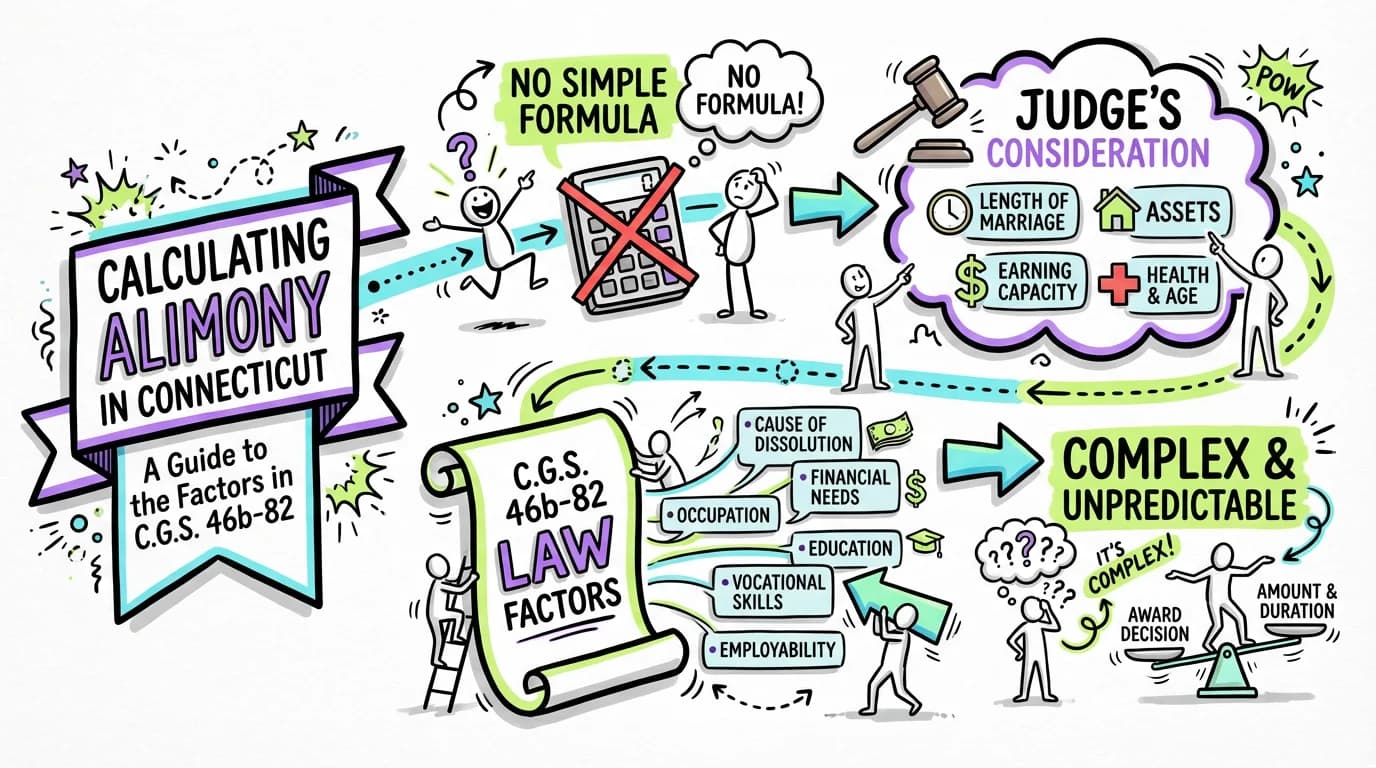
Connecticut does not use a fixed alimony formula. Instead, C.G.S. § 46b-82 requires the judge to decide whether to award spousal support, in what amount, and for how long by weighing 12 statutory factors such as marriage length, fault, health, income, employability, property division, and need.
This lack of a rigid formula can feel daunting. How can you possibly predict what a court will do?
This comprehensive guide is designed to demystify the process. We will break down the legal foundation for spousal support in Connecticut, Connecticut General Statutes § 46b-82, and explore each of the statutory factors a judge must consider. By understanding these factors, you can better prepare your case, advocate for your position, and move toward a fair and equitable resolution.
This article will cover:
- The purpose of alimony in a Connecticut divorce.
- A detailed analysis of each of the 12 statutory factors from C.G.S. § 46b-82.
- The critical differences between the factors for alimony and property division.
- The different types of alimony a court can award.
- The important role of life insurance in securing future alimony payments.
By the end of this guide, you will have a clear understanding of how alimony is calculated in CT and be empowered to discuss your circumstances with clarity and confidence.
What is Alimony (Spousal Support) in Connecticut?
Alimony is a court-ordered payment from one ex-spouse to the other following a divorce. Its primary purpose is not to punish one spouse or reward the other. Rather, it is a tool to address economic disparities that arise from the marriage and its dissolution. The goal is to help the lower-earning or non-earning spouse maintain a reasonable standard of living and, where possible, become financially self-sufficient.
It's important to note that alimony is gender-neutral. Either spouse can be ordered to pay or receive spousal support, depending on the financial circumstances of the marriage.
The court's decision-making process revolves around three fundamental questions:
- Should alimony be awarded at all? Is there a demonstrated financial need by one party and an ability to pay by the other?
- If so, for how long (duration)? Should it be for a short term to allow for retraining, or for a longer period?
- And for how much (amount)? What is a fair and equitable monthly payment?
The answers to all three questions are found by applying the same set of legal factors.

A Deep Dive into the Alimony Factors of C.G.S. § 46b-82
C.G.S. § 46b-82 requires the court to consider the same 12 factors when deciding whether alimony should exist at all, what the amount should be, and how long it should last. The judge does not apply those factors mechanically. Instead, the court uses them to compare both spouses' past contributions, current finances, and likely future earning capacity. The strongest alimony arguments explain how the factors interact rather than treating any one fact as automatically decisive.
1. The Length of the Marriage
This is often a starting point for the court's analysis. While there are no hard-and-fast rules, there is a general correlation: the longer the marriage, the more likely a court is to award alimony for a longer duration.
- Short-Term Marriage (e.g., under 5 years): Alimony is less likely, and if awarded, it is typically for a very short duration (rehabilitative).
- Mid-Length Marriage (e.g., 10-20 years): Alimony is common, often for a period that allows the recipient spouse to re-establish their career or earning capacity.
- Long-Term Marriage (e.g., 20+ years): Courts are more likely to award longer-term, or in rare cases, lifetime alimony, especially if there are significant age or health disparities.
2. The Causes for the Dissolution of the Marriage
This is one of the most significant aspects of CGS 46b-82 alimony law and a key differentiator from many other states. Connecticut is a "no-fault" state for the purpose of getting divorced, but it is a "fault" state for the purpose of awarding alimony and dividing property.
This means the court can consider a spouse's misconduct if it led to the breakdown of the marriage. Examples of fault include:
- Adultery
- Financial misconduct (e.g., dissipating marital assets through gambling, secret spending, or funding an affair)
- Substance abuse
- Domestic violence or cruelty
Practical Example: If a husband spent $100,000 of marital savings on an affair, a judge might order him to pay more alimony to his wife to compensate for that financial harm. The fault must have a financial consequence or be particularly egregious for the court to give it significant weight.
3. The Age of the Parties
Age is a critical factor because it directly relates to a person's ability to earn income and save for retirement.
- A 35-year-old spouse who left the workforce to raise children has a long career horizon to re-enter the job market and rebuild their financial life.
- A 62-year-old spouse in the same position has a much shorter time frame to become self-supporting and may never be able to achieve the earning potential they would have otherwise had. The court will consider this disparity.
4. The Health of the Parties
The physical, mental, and emotional health of each spouse is a mandatory consideration. A chronic illness, a disability, or a significant mental health condition that limits a spouse's ability to work is a powerful argument for an alimony award. The court will require medical evidence, such as testimony or records from doctors, to support any claims based on health. Health issues also affect insurance costs, attendance reliability, and whether a spouse can realistically return to a prior career or increase working hours.
5. The Station of the Parties
"Station" refers to the standard of living and lifestyle the couple enjoyed during the marriage. The court will look at the type of home you lived in, the vacations you took, the schools your children attended, and your general spending habits.
The goal of alimony is not necessarily to ensure both parties can perfectly replicate the marital lifestyle, as supporting two households is more expensive than one. However, the court strives to prevent a drastic and inequitable drop in the standard of living for the lower-earning spouse.
6. The Occupation of the Parties
The court will assess each spouse's current profession. This includes not just the job title but also the stability of the industry, the typical career trajectory, and potential for advancement. A tenured professor has a different occupational outlook than a freelance artist, and the court will take that into account. Some occupations also come with predictable raises, bonuses, or benefits, while others are seasonal or highly volatile. Judges look beyond the label on the business card.
7. The Amount and Sources of Income
This is a cornerstone of the analysis. The court examines all sources of income for both parties, including:
- Salary, wages, and commissions
- Bonuses and overtime pay
- Self-employment income
- Investment income (dividends, interest)
- Rental income
- Retirement or pension income
Judges will base their analysis on each party's Financial Affidavit, a sworn statement detailing all income, expenses, assets, and debts. Accuracy and honesty on this form are paramount. Courts also look for recurring but easy-to-hide income, such as cash business revenue, side work, or employer-paid perks that reduce personal expenses.
8. Vocational Skills
What are each spouse's marketable skills? Do they have a college degree, a professional license, or specialized training? Are those skills current and in demand, or have they become obsolete after a long absence from the workforce? A spouse with a recently earned nursing degree has different vocational skills than a spouse whose teaching certificate expired 15 years ago. The court is trying to measure not just what a spouse once could do, but what they can realistically do now without unreasonable delay or retraining.
9. The Employability of the Parties
This factor combines occupation, skills, age, and health to answer the question: "How easily can each spouse find and maintain a job that allows them to be self-supporting?"
A spouse who was a stay-at-home parent for two decades may have low immediate employability. The court might award "rehabilitative alimony" specifically to fund the education or retraining needed to make that spouse more employable. Judges may compare current job prospects, the time needed to reenter the market, and whether child-care responsibilities limit realistic work hours in the near term.
10. The Estate and Needs of the Parties
"Estate" refers to the assets each party will have after the property division. "Needs" refers to their reasonable monthly expenses as detailed on their Financial Affidavit.
The court performs a balancing act. It looks at the assets each person is leaving the marriage with (e.g., cash, investments, real estate) and their reasonable budget. If one spouse receives significant income-producing assets in the property settlement, their "need" for alimony may be reduced. Large assets can reduce need, but illiquid assets do not always solve a monthly cash-flow problem.
11. The Division of Property
This factor is explicitly linked to the one above. Under Connecticut law, the court must first decide on the equitable distribution of marital property under C.G.S. § 46b-81. Only after determining who gets what assets and debts does the court turn to alimony.
Practical Example: A wife is awarded the marital home free and clear, along with a $200,000 cash settlement from the husband's 401(k). This substantial property award will likely reduce the amount or duration of alimony the court orders the husband to pay, as the wife's "estate" is now larger and her "needs" (e.g., no mortgage payment) are lower.
12. The Desirability and Feasibility of the Custodial Parent Securing Employment
When minor children are involved, the court must consider what is in their best interests. This factor weighs the financial benefit of the custodial parent working against the potential non-financial benefit of that parent being more available to the children, especially if they are very young or have special needs. This is a highly subjective determination that depends entirely on the family's specific circumstances. School schedules, childcare costs, transportation limits, and a child's medical or educational needs can all shape that analysis.
Differentiating Alimony Factors (46b-82) from Property Division Factors (46b-81)
While many of the factors for dividing property and awarding alimony overlap (e.g., length of marriage, age, health, income), there are two critical distinctions every person going through a Connecticut divorce should understand.
-
The Role of "Fault": The "causes for the dissolution" is a statutory factor for alimony. A judge can explicitly award more or less alimony based on a spouse's misconduct. However, fault is not a statutory factor for the division of property under C.G.S. § 46b-81. While a judge might indirectly consider egregious financial misconduct when dividing assets (under the factor "contribution of each of the parties in the acquisition, preservation or appreciation in value of their respective estates"), it is a primary and direct consideration for alimony.
-
The Consideration of Future Earning Capacity: Property division is primarily backward-looking. It focuses on dividing the assets and debts accumulated during the marriage. Alimony, on the other hand, is fundamentally forward-looking. It is based on a projection of each spouse's future needs and their future ability (or inability) to earn income. A spouse's high earning potential is a key factor for alimony but less so for dividing the existing marital pot.
Types of Alimony in Connecticut
Based on its analysis of the 12 factors, a court can award several different types of alimony in CT:
-
Pendente Lite Alimony (Temporary Alimony): This is spousal support ordered during the divorce proceedings. It is designed to maintain the financial status quo and ensure the lower-earning spouse can pay their bills and legal fees while the case is pending. It automatically terminates when the divorce is finalized and is replaced by any post-judgment alimony award.
-
Rehabilitative Alimony (Time-Limited Alimony): This is the most common type of alimony awarded in Connecticut. It is granted for a specific, finite period. The purpose is to provide the recipient with the financial support needed to "rehabilitate" their earning capacity through education, training, or work experience. For example, a court might award three years of alimony to allow a spouse to finish a college degree and re-enter the workforce.
-
Lifetime Alimony (Permanent Alimony): This form of alimony is increasingly rare and is typically reserved for the dissolution of very long-term marriages (often 25+ years). It is usually awarded when one spouse, due to advanced age, chronic health issues, or a long-term absence from the workforce, has no realistic prospect of ever becoming self-supporting.
-
Lump-Sum Alimony: Instead of periodic monthly payments, a court can order alimony to be paid in a single lump sum or a few large installments. This can be an effective tool for creating a clean break between the parties, eliminating the need for future contact or concerns about non-payment.
Securing Alimony with Life Insurance: A Critical Protection
What happens if the spouse paying alimony (the payor) passes away before the alimony term is complete? Under Connecticut law, the obligation to pay alimony automatically terminates upon the death of either party. This can leave the recipient in a devastating financial position.
To prevent this, C.G.S. § 46b-82 specifically authorizes the court to order the payor to secure the alimony award by maintaining a life insurance policy.
How it works:
- The court orders the paying spouse to maintain a life insurance policy for a specific amount.
- The recipient spouse is named as the irrevocable beneficiary of the policy.
- The death benefit is typically set to cover the total remaining alimony obligation.
Practical Example: A husband is ordered to pay his wife $2,000 per month in alimony for 10 years (120 months). The total alimony obligation is $240,000. The court can order the husband to maintain a life insurance policy with a $240,000 death benefit. The order may also state that the required coverage amount can decrease over time as the alimony is paid down. This ensures that if the husband dies in year five, the wife receives the remaining five years of support from the insurance proceeds.
Common Mistakes to Avoid When Dealing with Alimony
Navigating spousal support in Connecticut is complex, and the biggest errors usually happen when people argue from instinct instead of the statute and financial records. As Linda Douglas, Chief Legal Officer at Untangle, advises, alimony disputes become much easier to negotiate when each claimed need, expense, and earning limit is tied to documents instead of assumptions or anger about the marriage. The mistakes below are the ones that most often distort negotiations or produce orders people later regret.
Assuming There's a Secret Formula
The single biggest mistake is believing that alimony is calculated by a simple percentage of income. It is not. Your case has to be built around the 12 statutory factors and how they interact in your specific marriage. A party who walks into negotiations expecting a formula can misread settlement value, overestimate certainty, and overlook the evidence a judge will actually care about when deciding amount or duration.
That mistake weakens planning from the start.
Being Dishonest on Your Financial Affidavit
Hiding income or assets is a fatal error. If discovered, it can destroy your credibility with the judge and lead to severe sanctions, including paying the other side's attorney's fees. Even less dramatic inaccuracies can cause serious damage because alimony depends so heavily on reported income, expenses, and debts. If the affidavit is unreliable, the court may doubt the rest of your story as well.
Credibility is hard to rebuild later with the judge overall.
Failing to Document Your "Needs"
Your "needs" are not just what you want after divorce. They are the expenses you can justify as reasonable in light of the marital standard of living and your current circumstances. A detailed, well-documented budget on your Financial Affidavit is essential. Unsupported numbers invite attack, while organized records for housing, insurance, childcare, transportation, and debt service give the court a concrete basis for measuring actual need.
Specific backup records matter in court at hearings later.
Ignoring the Tax Implications
For divorce agreements executed after December 31, 2018, alimony payments are no longer tax-deductible for the payor or considered taxable income for the recipient at the federal level, as the IRS explains in Topic no. 452, Alimony and separate maintenance. That change significantly affects the net cost and value of an alimony award. A payment that sounds workable before taxes can feel very different once both sides calculate what the dollars actually mean after the divorce.
Waiving Alimony Without Understanding the Consequences
If you waive your right to alimony in your divorce decree, you usually cannot come back later and ask for it, no matter how your circumstances change. In some cases, parties agree to a nominal $1 per year alimony award. That amount is nonmodifiable, but it can keep the door open to a later substantive request if there is a substantial change in circumstances. Waiver decisions therefore need the same level of analysis as any major property trade.
Frequently Asked Questions About Connecticut Alimony Factors
These are the questions people usually ask once they realize Connecticut alimony is discretionary rather than formula-driven. The common thread is that judges want documents, credible testimony, and a full picture of both households after property division. That means the useful question is rarely "What is the number?" and more often "Which facts in this marriage make a particular amount or duration fair to both spouses now?" That is why each short answer below still comes back to evidence, not intuition.
Is there a formula for alimony in Connecticut?
No. Connecticut does not use a child-support-style formula for alimony. The judge weighs the 12 factors in C.G.S. § 46b-82 and then decides whether support is warranted, how much should be paid, and for how long based on the specific marriage, finances, and future earning capacity involved.
That means income numbers can produce different outcomes in marriages if health, fault, childcare duties, or property division look different.
Does adultery or other fault matter when the court decides alimony?
Yes, potentially. C.G.S. § 46b-82 lets the court consider the causes of the marriage breakdown, so adultery, abuse, or serious financial misconduct can influence alimony. Fault usually matters most when it is well proved and tied to concrete harm, not just mutual resentment or suspicion. Judges are generally more persuaded by documented financial or personal consequences than by vague moral arguments about who was the worse spouse.
How important is the financial affidavit in an alimony case?
Extremely important. Judges rely heavily on the financial affidavit to compare income, expenses, assets, and debts. If the affidavit is incomplete or inaccurate, it can undermine credibility and distort the court's view of need or ability to pay. Good alimony arguments usually rise or fall with the supporting financial records. In practice, the affidavit is often the document that anchors settlement talks because it turns general complaints into numbers the court can test.
It frames the case.
Can a large property award reduce or replace alimony?
Yes. After property division under C.G.S. § 46b-81, the court looks at each spouse's post-divorce estate and monthly needs. A large cash or real-estate award may reduce the amount or duration of alimony, especially if it generates income or eliminates major expenses such as housing costs. The opposite is also true: a property award that is hard to liquidate may not solve an immediate support problem.
Can alimony be changed later if circumstances change?
Often yes. Under C.G.S. § 46b-86, many periodic alimony orders can be modified after a substantial change in circumstances, but the exact language of the decree matters. Some orders are nonmodifiable, and events like remarriage, cohabitation, retirement, or major income shifts can affect whether a later change is available.
That is why the wording of the original judgment matters as much as the facts that develop later.
Summary and Your Next Steps
Understanding how alimony is calculated in CT is about understanding the court's discretionary process, not a mathematical formula. The outcome of your alimony case will depend on a judge's holistic evaluation of the 12 factors in C.G.S. § 46b-82 as they apply to the unique story of your marriage.
Key Takeaways:
- Alimony is decided based on 12 statutory factors, not a formula.
- The court has broad discretion in weighing these factors.
- Fault, or the "causes for the dissolution," can directly impact the alimony award.
- The court decides property division first, which then influences the need for alimony.
- Alimony can be secured with a life insurance policy to protect the recipient.
Your Next Steps:
- Gather Financial Documents: Collect tax returns, pay stubs, bank statements, investment reports, and credit card statements.
- Complete a Draft Financial Affidavit: This is the single most important document in your divorce. Be thorough and honest.
- Analyze the 12 Factors: Go through each of the 12 factors listed above and write down how they apply to your specific situation. This will form the basis of your argument for or against alimony.
- Consider Negotiation: Armed with this knowledge, you and your spouse may be able to negotiate a fair alimony agreement without the need for a costly and stressful court battle.
Take Control of Your Divorce with Untangle
Feeling overwhelmed by the complexities of Connecticut alimony and the mountain of financial paperwork? You're not alone. The process is designed to be thorough, but it can be daunting to navigate.
At Untangle, we provide powerful tools and resources to help you organize your finances, understand the legal factors, and prepare for a fair outcome. Our platform simplifies the creation of your Financial Affidavit, helps you model different settlement scenarios, and empowers you to approach your divorce with the clarity and confidence you deserve.
Learn how Untangle can simplify your Connecticut divorce journey and help you build a secure financial future.

Author
Linda Douglas, Esq.
Chief Legal Officer, Untangle
Linda Douglas is a Divorce and Family Attorney with 38 years of experience handling nearly 2,000 cases in Connecticut and New Hampshire. She is licensed to practice law in Connecticut and New Hampshire.
Legal citations
- C.G.S. § 46b-56 (Orders re Custody and Support of Children)
- C.G.S. § 46b-81 (Assignment of Property)
- C.G.S. § 46b-82 (Alimony)
- C.G.S. § 46b-86 (Modification of Alimony or Support Orders)
Related guides
How Is Property Divided in a Connecticut Divorce? Understanding C.G.S. 46b-81
Learn more about how is property divided in a connecticut divorce? understanding c.g.s. 46b-81
Modifying a Connecticut Divorce Decree: Alimony and Child Support (C.G.S. 46b-86)
Learn more about modifying a connecticut divorce decree: alimony and child support (c.g.s. 46b-86)
The 17 'Best Interests of the Child' Factors in Connecticut Custody Cases (C.G.S. 46b-56)
Learn more about the 17 'best interests of the child' factors in connecticut custody cases (c.g.s. 46b-56)
Keep exploring
Get Help
Get help with your divorce
Get guided answers, organize your paperwork, and move through Connecticut divorce with a clearer plan.